
Share this @internewscast.com
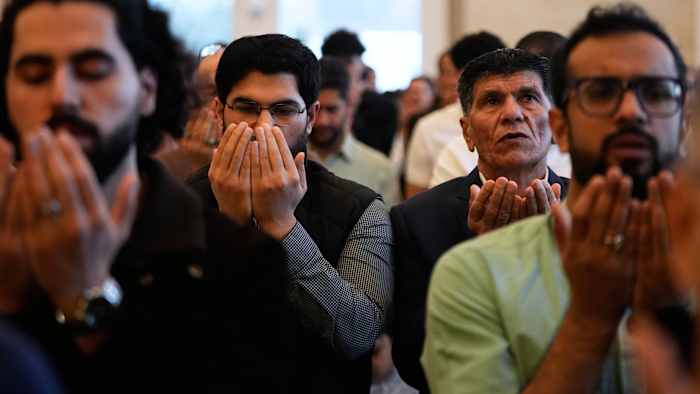
On Tuesday, law enforcement officials revealed their proactive measures to address and mitigate threats targeting Jewish and Muslim communities across the United States. These actions come in response to the escalating conflict in the Middle East, which has led to a surge in hate crimes and an attempted terrorist incident, prompting enhanced security protocols at religious sites and intensified scrutiny of extremist activities.
The FBI is currently investigating a March 12 event in West Bloomfield, Michigan, where an individual drove a vehicle into the entrance of Temple Israel, the nation’s second-largest Reform Judaism congregation. Authorities have evaluated the threat landscape facing faith communities and are formulating strategies to safeguard religious venues.
Michael Masters, the national director of the Secure Community Network, highlighted during a national security briefing that adversaries aim to instill fear to deter community participation. However, with robust security measures, communities can continue their activities without succumbing to intimidation.
“With strong safety and security measures in place, that doesn’t need to happen,” Masters emphasized.
Prior to Passover and amidst global tensions, the Secure Community Network, responsible for Jewish community security in North America, conducted the briefing. Recent anti-Semitic incidents have been reported in Southern California and Toronto, while authorities in Europe are probing car arson cases in Antwerp and London as possible anti-Semitic acts.
These incidents have heightened fears among Jewish Americans about the growing threat of antisemitism, underscoring the necessity to combat extremism while maintaining their religious practices without fear. Simultaneously, there’s been a rise in anti-Muslim rhetoric from some GOP politicians and Christian nationalists, reminiscent of the sentiments post-9/11 during the Afghanistan and Iraq conflicts, which fueled Islamophobia both in the U.S. and internationally.
Jewish leaders meet with federal officials on threats to communities
Jewish leaders have called on lawmakers and civic leaders to combat the heightened threats.
“As shocking as the incident in Temple Israel was, it has become, for us in the Jewish community, no longer a surprise,” said Gary Torgow, chair of the Jewish Federations of North America, during the briefing on security measures Jewish organizations were taking nationwide. Torgow, a Michigan business executive, said that “hate today spreads at lightning speed through misinformation on social media” and warned that its unchecked spread “inevitably creates a climate where violence becomes more likely.”
Torgow and other Jewish leaders met last week with senior FBI officials to discuss federal efforts to combat antisemitic incidents since the Trump administration launched joint strikes with Israel on Iran, sparking retaliatory strikes and a regional conflict that has reverberated globally. Among the meeting’s participants was Andrew Bailey, the FBI’s deputy director, who Torgow said was receptive and responsive to their concerns.
“What we saw in that meeting is a sincere concern and a really active engagement,” said Torgow. “An attack on a synagogue, we shared with them, has to be really understood for what it is: an attack on the principle that every American should be able to worship in peace.”
Federal authorities are also monitoring for increased activities from radicalized individuals who may seek to attack places of worship or strike during high profile upcoming events or holidays. Officials during the security briefing did not share any known threats to upcoming events and Secure Community Network officials said they did not know of any active threats to Jewish communities at present.
“As we not only seek to defend against would-be malicious actors, particularly ones encouraged by or empathetic to Iran, we also need to be equally on guard for all aspects and assailants as America looks forward to hosting both the 2026 FIFA World Cup and the America 250 celebrations later this year,” said Matthew Kozma, the under secretary for intelligence and analysis at the Department of Homeland Security, during the security briefing.
Director of National Intelligence Tulsi Gabbard said during a March Senate hearing that intelligence agencies had focused efforts “on individuals either who have been radicalized by Islamist propaganda and may not have ever had contact with ISIS or al-Qaida” but were nonetheless radicalized online while in the U.S.
The FBI is investigating two recent incidents as acts of terrorism, including an attempted bombing of anti-Muslim protests in front of the New York mayor’s residence and a deadly shooting at Old Dominion University in Norfolk, Virginia.
Jewish Federations president Eric Fingerhut said the terror attack on Temple Israel showed that “even our most advanced security efforts can be overtaken by world events and by the very determined planning of terrorists,” meaning that Jewish communities “must, yet again, increase our level of security for our community” and work closely with law enforcement to monitor risks, and civic leaders to address the root causes of bigotry and extremism.
The Jewish Federations of North America will also host rallies calling for greater efforts to combat antisemitism from lawmakers in Washington in May.
Since the attack on Temple Israel, for instance, Oakland County, Michigan, Sheriff Michael Bouchard said that he’d received antisemitic death threats himself for responding to the attacks.
“I think it’s incumbent on all of us to step up, stand out and do everything we can to protect our communities,” Bouchard said.
A spike in hateful activities
The causes of the spikes in antisemitic attacks and other hateful conduct are complex and longstanding, experts say. Heightened international tensions, polarized domestic politics and new digital technologies have all contributed to the increase in bigoted views.
“We’re seeing a lot of ideas and conspiracy theories that were once on the fringes of public conversation being ingested into political debate,” said Seth Levi, chief strategy officer at the Southern Poverty Law Center. Levi cited social media and the increased ease of hateful rhetoric to spread unfiltered to a mass audience as the primary driver of radicalization for many extremists.
Muslim Americans, meanwhile, have expressed fear and alarm as anti-Muslim rhetoric and actions by state governments designating Muslim communities as security threats have risen in recent months.
The Southern Poverty Law Center has monitored a large rise in antisemitic and Islamophobic rhetoric over the last year that only intensified since the war in the Middle East began, Levi said.
“We continue to see incidents like hateful and racist flyering, especially neighborhoods that have a particular faith community,” Levi said. “In person, physical harassment where you live creates a different, more visceral reaction than online activity.”
Levi said that most Americans still strongly disapprove of hateful violence and rhetoric in polling reviewed by the Southern Poverty Law Center, but that comments from federal lawmakers, including President Donald Trump, were often echoed in the hateful rhetoric used by some figures online or in physical threats reviewed by the center.
For many Jewish leaders, the moment underscores a need for greater resolve and closer community.
“The vibrancy of Jewish life in North America, Jewish life everywhere, only happens with our own efforts,” said Wendy Berger, chair of the Secure Community Network. “It is in our hands. And we have these extraordinary, amazing federal, local, state partners. But security is up to us, and the vibrancy of Jewish lives depends on it.”
Copyright 2026 The Associated Press. All rights reserved. This material may not be published, broadcast, rewritten or redistributed without permission.