
Share this @internewscast.com
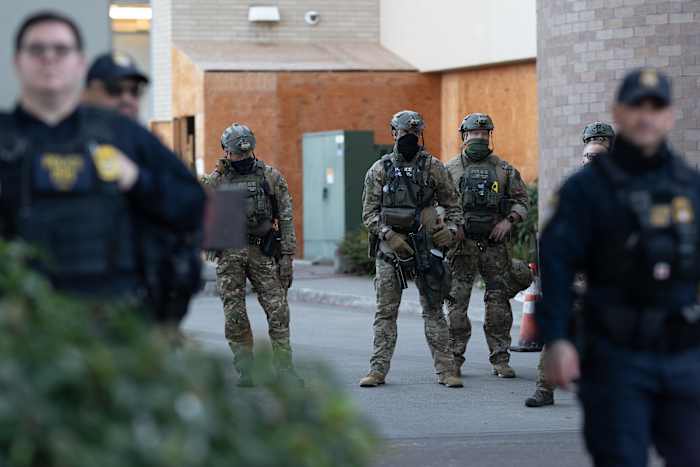
In a significant legal development, a federal judge in Oregon has mandated that U.S. immigration officers halt the practice of arresting individuals without warrants unless there is a credible risk of the person fleeing. This ruling was issued on Wednesday by U.S. District Judge Mustafa Kasubhai.
The decision comes as part of a preliminary injunction in a proposed class-action lawsuit challenging the Department of Homeland Security’s approach to enforcement, which critics have derisively termed as “arrest first, justify later.” The lawsuit specifically targets the department’s routine of apprehending immigrants during intensified enforcement actions.
The Department of Homeland Security, named as a defendant in the lawsuit, has not immediately offered a response to inquiries from The Associated Press regarding this ruling.
This ruling echoes concerns raised nationwide by civil rights organizations, particularly in the context of President Donald Trump’s aggressive deportation strategies. Similar judicial decisions have emerged from courts in Colorado and Washington, D.C., all of which the government is appealing.
Adding to the discourse, Todd Lyons, the acting director of U.S. Immigration and Customs Enforcement, recently issued a memo underscoring that agents should refrain from making arrests without a supervisor-issued administrative warrant. Exceptions are made only when agents establish probable cause to believe the individual is unlawfully present in the U.S. and likely to abscond before a warrant can be obtained.
In a memo last week, Todd Lyons, the acting head of U.S. Immigration and Customs Enforcement, emphasized that agents should not make an arrest without an administrative arrest warrant issued by a supervisor unless they develop probable cause to believe that the person is in the U.S. illegally and likely to escape from the scene before a warrant can be obtained.
But the judge heard evidence that agents in Oregon have arrested people in immigration sweeps without such warrants or determining escape was likely.
The daylong hearing included testimony from one plaintiff, Victor Cruz Gamez, a 56-year-old grandfather who has been in the U.S. since 1999. He told the court he was arrested and held in an immigration detention facility for three weeks even though he has a valid work permit and a pending visa application.
Cruz Gamez testified that he was driving home from work in October when he was pulled over by immigration agents. Despite showing his driver’s license and work permit, he was detained and taken to the ICE building in Portland before being sent to an immigration detention center in Tacoma, Washington. After three weeks there, he was set to be deported until a lawyer secured his release, he said.
He teared up as he recounted how the arrest impacted his family, especially his wife. Once he was home they did not open the door for three weeks out of fear and one of his grandchildren did not want to go to school, he said through a Spanish interpreter.
Afterward a lawyer for the federal government told Cruz Gamez he was sorry about what he went through and the effect it had on them.
Kasubhai said the actions of agents in Oregon — including drawing guns on people while detaining them for civil immigration violations — have been “violent and brutal,” and he was concerned about the administration denying due process to those swept up in immigration raids.
“Due process calls for those who have great power to exercise great restraint,” he said. “That is the bedrock of a democratic republic founded on this great constitution. I think we’re losing that.”
The lawsuit was brought by the nonprofit law firm Innovation Law Lab, whose executive director, Stephen Manning, said he was confident the case will be a “catalyst for change here in Oregon.”
“That is fundamentally what this case is about: asking the government to follow the law,” he said during the hearing.
The preliminary injunction will remain in effect while the lawsuit proceeds.
___
Associated Press writer Gene Johnson in Seattle contributed.
Copyright 2026 The Associated Press. All rights reserved. This material may not be published, broadcast, rewritten or redistributed without permission.