
Share this @internewscast.com

Milan’s legendary Teatro alla Scala is set to launch its gala season this Sunday with a Russian opera, marking the second such occasion since Russia’s invasion of Ukraine in 2022. This year’s event, however, will be distinguished by a peace demonstration, rather than protests against Russian culture.
The evening’s performance of Dmitry Shostakovich’s “Lady Macbeth of Mtsensk” will be conducted by La Scala’s esteemed music director, Riccardo Chailly. This gala premiere, renowned for attracting prominent figures from the realms of culture, business, and politics, remains one of the most eagerly awaited highlights of Europe’s cultural calendar.
Written in 1934, Shostakovich’s opera delves into the plight of women under Stalin’s Soviet rule. The opera was infamously banned just days after Stalin himself attended a performance in 1936, a year that marked the onset of his brutal campaign of political repression known as the Great Purge.
In conjunction with the opening, the Italian left-wing party +Europa has organized a demonstration outside the theater. This gathering aims to spotlight the defense of freedom and European democracy, which they assert is currently under threat from Putin’s Russia, while expressing solidarity with the Ukrainian people.
Emphasizing the opera’s themes, the party noted that Shostakovich’s work critiques the misuse of power and underscores the significance of personal resistance.
Concerns over security have prompted officials to relocate the demonstration from the square in front of La Scala to another location behind City Hall, ensuring a peaceful and secure environment for both the event and the protest.
Shostakovich’s journey to La Scala gala premiere
Chailly began working with stage director Vasily Barkhatov on the title about two years ago, following the 2022 gala season premiere of the Russian opera “Boris Godunov,” which was attended by Italian Premier Giorgia Meloni and European Commission President Ursula von der Leyen, both of whom separated Russia’s politicians from its culture.
But outside the Godunov premiere, Ukrainians protested against highlighting Russian culture during a war rooted in the denial of a unique Ukrainian culture. The Ukrainian community did not announce any separate protests this year.
Chailly called the staging of Shostakovich’s “Lady Macbeth,’ for only the fourth time in La Scala’s history “a must.’’
“It is an opera that has long suffered, and needs to make up for lost time,’’ Chailly told a news conference last month.
La Scala’s new general manager, Fortunato Ortombina, defended the choices made by his predecessor to stage both Shostakovich’s “Lady Macbeth” and Modest Mussorgsky’s “Boris Godunov.”
‘‘Music is fundamentally superior to any ideological conflict,’’ Ortombina said on the sidelines of the press conference. “Shostakovich, and Russian music more broadly, have an authority over the Russian people that exceeds Putin’s own.’’
An American soprano makes her La Scala Debut
American soprano Sara Jakubiak is making her La Scala debut in the title role of Katerina, whose struggle against existential repression leads her to commit murder, landing her in a Siberian prison where she dies. It’s the second time Jakubiak has sung it, after performances in Barcelona, and she said the role is full of challenges.
“That I’m a murderess, that I’m singing 47 high B flats in one night, you know, all these things,’’ Jakubiak said while sitting in the makeup chair ahead of the Dec. 4 preview performance to an audience of young people. “You go, ‘Oh my gosh, how will I do this?’ But you manage, with the right kind of work, the right team of people. Yes, we’re just going to go for the ride.”
Speaking to journalists recently, Chailly joked that he was “squeezing” Jakubiak like an orange. Jakubiak said she found common ground with the conductor known for his studious approach to the original score and composer’s intent.
“Whenever I prepare a role, it’s always the text and the music and the text and the rhythms,” she said. “First, I do this process with, you know, a cup of coffee at my piano and then we add the other layers and then the notes. So I guess we’re actually somewhat similar in that regard.”
Stage direction highlights Stalin’s end
Barkhatov, who has a flourishing international career, called the choice of “Lady Macbeth,” “very brave and exciting.”
Barkhatov’s stage direction sets the opera in a cosmopolitan Russian city in the 1950s, the end of Stalin’s regime, rather than a 19th-century rural village as written for the 1930s premier.
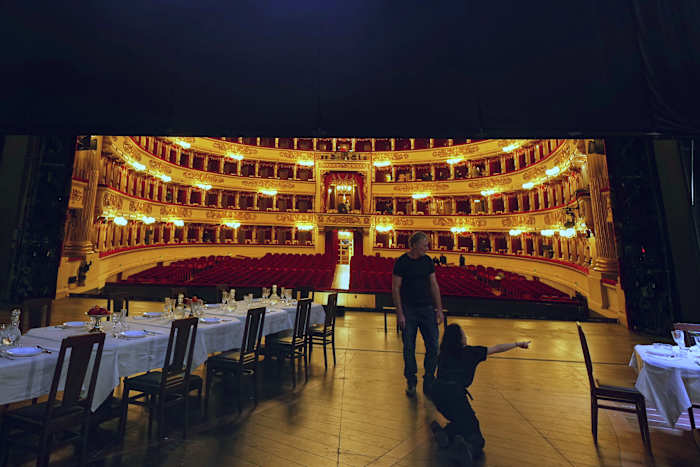
For Barkhatov, Stalin’s regime defines the background of the story and the mentality of the characters for a story he sees as a personal tragedy and not a political tale. Most of the action unfolds inside a restaurant appointed in period Art Deco detail, with a rotating balustrade creating a kitchen, a basement and an office where interrogations take place.
Despite the tragic arc, Barkhatov described the story as “a weird … breakthrough to happiness and freedom.’’
“Sadly, the statistics show that a lot of people die on their way to happiness and freedom,’’ he added.
Copyright 2025 The Associated Press. All rights reserved. This material may not be published, broadcast, rewritten or redistributed without permission.