
Share this @internewscast.com
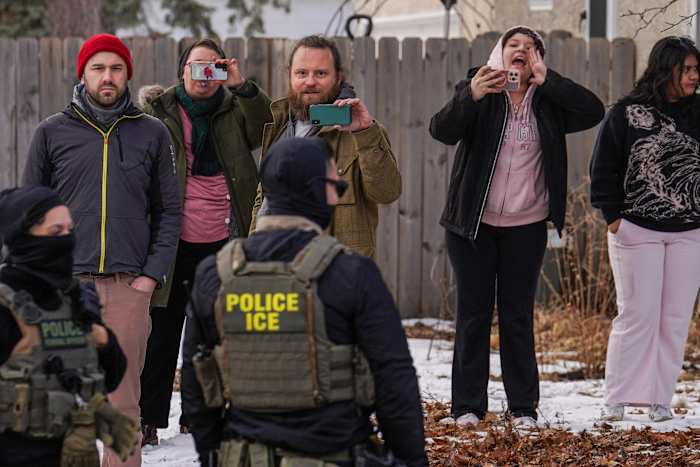
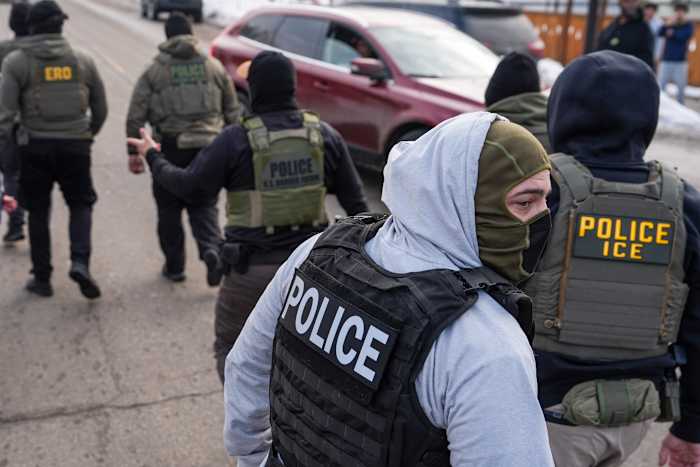
WASHINGTON – The sight of federal officers, their faces obscured by masks, has become a focal point in the Trump administration’s immigration enforcement efforts. This imagery, capturing incidents such as smashed car windows, individuals being tackled on city streets, and even a young child wearing a bunny-eared snowcap being detained, has sparked widespread debate.
In recent memory, no other American policing operation has consistently disguised its officers to such a degree. The Department of Homeland Security argues that masking is necessary to protect its employees from online harassment. However, experts caution that this practice serves a dual purpose: it not only instills fear within communities but also threatens to undermine established norms, accountability, and the essential trust between law enforcement and the public.
The question of whether to prohibit the use of masks or to allow their continued use has become a significant point of contention in Congress. This debate is unfolding against the backdrop of discussions on funding Homeland Security, with a partial agency shutdown looming if an agreement isn’t reached by midnight Friday.
“Humans are wired to interpret each other’s facial expressions,” observed Justin Smith, a former Colorado sheriff and now the executive director and CEO of the National Sheriffs’ Association. “When federal agents in these operations can’t be identified because their faces are hidden, it understandably makes people uneasy. This situation is raising important questions.”
The call from Democrats is clear: they demand that the masks come off, seeking to restore transparency and accountability in these enforcement operations.
Democrats demand ‘masks off’
Masks on federal agents have been one constant throughout the first year of President Donald Trump’s mass deportation operation.
What began as a jarring image last spring, when plain-clothed officers drawing up their masks surrounded and detained a Tufts University doctoral student near her Massachusetts home, has morphed into familiar scenes in Los Angeles, Chicago and other cities. The shooting deaths of two American citizens at the hands of federal immigration officers during demonstrations against ICE raids in Minneapolis sparked widespread public protest and spurred lawmakers to respond.
“Cameras on, masks off” has become a rallying cry among Democrats, who are also insisting the officers wear body cameras as a way to provide greater accountability and oversight of the operations.
House Democratic Leader Hakeem Jeffries told reporters at the Capitol that unmasking the federal agents is a “hard red line” in the negotiations ahead.
Immigration and Customs Enforcement says on its website that its officers “wear masks to prevent doxing, which can (and has) placed them and their families at risk. All ICE law enforcement officers carry badges and credentials and will identify themselves when required for public safety or legal necessity.”
Fueled with funds from the Trump’s big tax cuts bill, which poured some $170 billion into Homeland Security, ICE has grown to become among the largest law enforcement operations in the nation. Last year, it announced it had more than doubled its ranks, to 22,000, with rapid hiring — and $50,000 signing bonuses. Homeland Security did not respond to an emailed request for further comment.
Most Republicans say the current political climate leaves the immigration officers, many of them new to the job, exposed if their faces and identities are made public.
Sen. Thom Tillis, R-N.C., said he just can’t agree with Democrats’ demand that officers unmask themselves.
“You know, there’s a lot of vicious people out there, and they’ll take a picture of your face, and the next thing you know, your children or your wife or your husband are being threatened at home,” he said. “That’s just the reality of the world that we’re in.”
ICE stands apart with masks
It appears no other policing agency in the country regularly uses masking on a widespread basis. Instead, masks are used during special operations, particularly undercover work or at times during large crowd control or protest situations, and when there is inclement weather or individual health concerns.
Experts said only perhaps during the Ku Klux Klan raids or in the Old West has masking been a more widely used tool.
“It is without precedent in modern American history,” said the American Civil Liberties Union’s Naureen Shah in Washington.
She said the idea of masked patrols on city streets seeking immigrants can leave people scared and confused about who they are encountering — which she suggested is part of the point.
“I think it’s calculated to terrify people,” she said. “I don’t think anybody viscerally feels like, OK, this is something we want to become a permanent fixture in our streets.”
Toward the end of the first Trump administration, Congress sought to clamp down after masked federal agents showed up in 2020 to quell protests in Portland and other cities. A provision requiring agents to clearly identify themselves was tucked into a massive defense authorization bill that Trump assigned into law.
Last year, California became the first state in the nation to ban most law enforcement officers, including federal immigration agents, from covering their faces. The Trump administration’s Justice Department sued, saying the state’s policies “create risk” for the agents.
Police seek middle ground, advocates say unmasking is not enough
Smith, of the sheriffs’ association, said there’s no easy answer to the current masking debate.
He suggested perhaps a middle ground could be reached — one that would allow officers to wear masks, but also require their badge or other identifying numbers to be prominently displayed.
Advocates said while unmasking the federal agents would be an important step, other restraints on immigration enforcement operations may be even more so.
They are pushing Congress to curb the ability of ICE officers to rely on administrative warrants in immigration operations, particularly to enter people’s homes, insisting such actions should be required to use judicial warrants, with sign off from the courts.
There is also an effort to end roving patrols — the ability of immigration officers to use a person’s race, language or job location to question their legal status, sometimes called “Kavanaugh stops” after Supreme Court Justice Brett Kavanaugh’s concurring opinion to a Supreme Court decision last summer.
Greg Chen, senior director of government affairs at the American Immigration Lawyers Association, said because Congress gave Homeland Security such robust funding in the tax cuts bill, “That’s why the policy reforms are so important right now to bring the agency in check.”
Rep. Ayanna Pressley, D-Mass., who recently returned from Minnesota, said the weight of the masked enforcement operation can be felt in ways that impact everyone — regardless of a person’s own immigration status.
“It’s a very a heavy presence of surveillance and intimidation,” she said. “No one is exempt.”
Copyright 2026 The Associated Press. All rights reserved. This material may not be published, broadcast, rewritten or redistributed without permission.