
Share this @internewscast.com

EL PASO, Texas (Border Report) – On Monday, the Drug Enforcement Administration announced the initiation of Gatekeeper, a bilateral effort to pinpoint leaders of Mexican cartels operating in smuggling routes along the Southwest border.
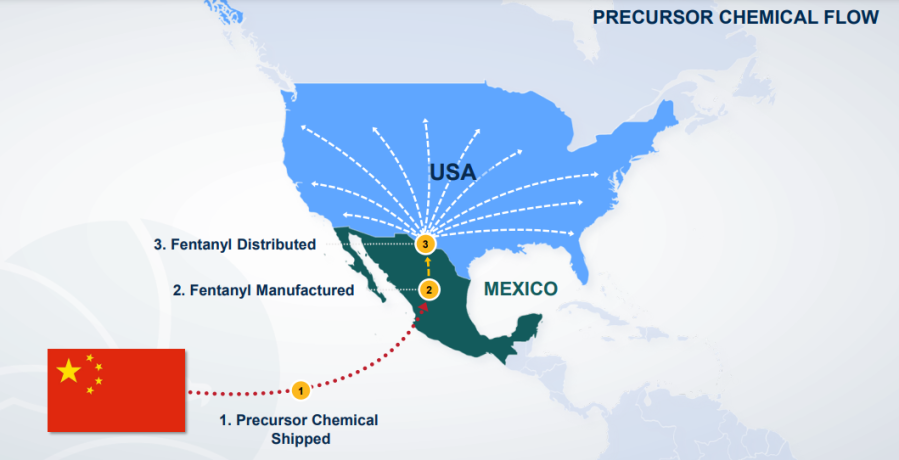
These gatekeepers, or “plaza” bosses, manage the transport of fentanyl, cocaine, meth, and other drugs into the United States, while ensuring drug money and American weapons are sent back into Mexico.
“To further this mission, the DEA has initiated a multi-week training and collaboration initiative at one of its intelligence centers on the Southwest Border. This initiative unites Mexican investigators with U.S. law enforcement, prosecutors, defense officials, and intelligence community members,” stated DEA in a press release. “Over several weeks, attendees will pinpoint joint targets, devise coordinated enforcement strategies, and enhance intelligence sharing.”
But on Tuesday, Mexican President Claudia Sheinbaum said her country had agreed to no such thing.
“There is no agreement with DEA. DEA releases a communiqué based on what, I am unaware. We have not reached any agreement with DEA, none of our security bodies have,” Sheinbaum remarked during her YouTube-broadcasted daily news briefing.
Sheinbaum said a small number of Mexican law enforcement officers recently attended a seminar in Texas, but no one else.
“I am uncertain why they issued this communiqué. The sole agreement in terms of security, which has been in development for months, is with the Department of State – coordinated by the Foreign Relations Ministry,” Sheinbaum explained. “This agreement is fundamentally grounded on sovereignty and mutual trust … respect for territory – each operates within its territory – and coordination without subordination.”
She clarified there is ongoing communication between the security agencies of both nations, but “no recent agreement exists for a specific operation with the DEA.”
She added her Foreign Minister would be asking the U.S. Ambassador why the DEA published the news release without her government being aware of it.
Border Report reached out to DEA headquarters for a comment. Late on Tuesday, it received a response reaffirming the need to strengthen binational security cooperation.
“On Monday, DEA announced its training initiative in support of Project Portero (Goalkeeper, in Spanish), which is being conducted in coordination with Mexican law enforcement counterparts. This is a significant step forward in advancing and strengthening law enforcement and intelligence sharing with partners regarding an issue that has positive implications on both sides of the border,” the DEA said in a statement to Border Report.
Mexico walks tight-rope on binational drug cooperation
U.S. law enforcement presence in Mexico traditionally has been heavily scrutinized and often turned controversial.
Sheinbaum’s predecessor, Andres Manuel Lopez Obrador, in 2020 sent an initiative that the Mexican Senate approved limiting the DEA’s scope of operations in Mexico. Later, he accused the DEA of fabricating charges against former Mexican Defense Minister Salvador Cienfuegos, whose drug charges in the U.S. were dropped afterwards.
Scott Stewart, vice president of intelligence for TorchStone Global international security firm, said Mexico has always walked a fine line between cooperating with the United States on law enforcement and not appearing subservient.
“There is a long history of Mexico coordinating with the U.S. and attempting to keep it on the down-low due to domestic political sensitivities over sovereignty. The Trump Administration has a domestic political motive for commenting on the operation,” Stewart told Border Report.
Taking down mid-level cartel bosses, especially on the border, could make a temporary dent on cross-border drug trafficking, but it’s not a long-term solution.
“It’s all economics. If one plaza boss is taken out, he is quickly replaced, either internally from someone withing his cartel group, or by a rival cartel,” Stewart said. “There is a long history of this in plazas like Nuevo Laredo, Reynosa, Matamoros, Juarez, etc. with no reduction in the flow of drugs.”