
Share this @internewscast.com

WASHINGTON – Each year, the U.S. Coast Guard locates and captures multiple vessels transporting drugs across the Caribbean as part of its duty as the global enforcer against maritime drug trafficking.
However, this anti-drug mission could transform significantly following a U.S. military action against a ship near Venezuela. Last week, Trump administration officials reported that the vessel involved gang members trafficking drugs intended for the United States.
The Trump administration has hinted at the possibility of further military actions targeting drug-related activities, expressing its intention to intensify efforts against Latin American cartels accused of pushing substances like cocaine and fentanyl into the U.S. Nevertheless, there is growing concern regarding the legality of such strikes and any potential escalation, which challenges the long-standing methods of intercepting suspected drug-carrying vessels.
“This significantly disrupts the decades-long U.S. commitment to developing a comprehensive legal system for capturing and prosecuting alleged drug traffickers,” stated Kendra McSweeney, a geographer from Ohio State University who has extensively studied U.S. legal measures for drug interceptions at sea.
Citing self-defense and an ‘immediate threat’
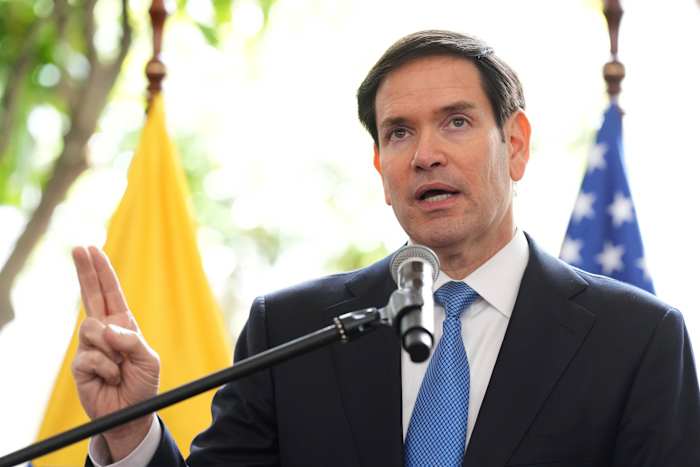
During a visit to Latin America last week, Secretary of State Marco Rubio claimed that drug cartels “constitute an immediate danger to the United States,” and justified that President Donald Trump “is entitled to respond to imminent threats to the U.S. under urgent circumstances.”
A U.S. official, who was not authorized to speak publicly, also mentioned self-defense as the legal groundwork for the strike, which allegedly resulted in the deaths of 11 members of Venezuela’s Tren de Aragua gang, labeled as a foreign terrorist group. To ensure safety from repercussions, the official remained anonymous.
The administration used a similar argument months prior to justify an intense bombing camping against Houthi rebels in Yemen. However, behind the scenes, the justification for strikes against the cartels appears to be far more complex.
The New York Times reported last month that Trump signed a directive to the Pentagon to start using military force against certain Latin American drug cartels. That reporting was related to the Venezuela strike, according to a U.S. official, who spoke on condition of anonymity to discuss operational details.
Touting the strike, but no details on how it happened
Vice President JD Vance celebrated the strike over the weekend, suggesting that the use of force is necessary to protect American families from deadly drugs.
“Killing cartel members who poison our fellow citizens is the highest and best use of our military,” Vance said on X.
Several Democrats and even some fellow Republicans criticized Vance’s comments. Congressional leaders also have pressed for more information on why the administration took the military action.
The Pentagon has been silent about any details on the strike. Military officials have not divulged what service carried it out, what weapons were used or how it was determined that the vessel was operated by Tren de Aragua or carrying drugs.
Defense Secretary Pete Hegseth said last week that “foreign terrorist organizations have been designated, we have those authorities, and it’s about keeping the American people safe. There’s no reason for me to give the public or adversaries any more information than that.”
Pentagon officials did not respond to direct questions about the legal justification for the strike and whether the military considered itself at war with Venezuelan President Nicolás Maduro’s government.
Hegseth traveled Monday to Puerto Rico, where troops deployed for a training exercise and where the U.S. is sending 10 F-35 fighter jets for operations against drug cartels.
‘There’s no authority for this whatsoever’
Claire Finkelstein, a professor of national security law at the University of Pennsylvania, said “extrajudicial killing” would be a better term to describe the strike. She sees it as an outgrowth of the two-decade blurring of the lines between law enforcement and armed conflict.
Following the Sept. 11, 2001, attacks, the U.S. started designating members of foreign terrorist organizations, such as al-Qaida and the Taliban, as unlawful combatants, making them vulnerable to U.S. attacks even when not directly engaged in warfare.
Trump has designated several Latin American cartels, including Venezuela’s Tren de Aragua, as foreign terrorist organizations. But that in itself does not make a U.S. strike against suspected members of the group legal, Finkelstein said. Congress has not authorized the use of force against Venezuela nor are there any U.N. resolutions that would justify the U.S. actions.
“There’s no authority for this whatsoever under international law,” she said. “It was not an act of self-defense. It was not in the middle of a war. There was no imminent threat to the United States.”
A pair of armed Venezuelan planes flew by a U.S. warship in the Caribbean days after the strike, and Trump warned Friday that any future flights would be met with gunfire.
The strike “quite arguably is an act of war against Venezuela and they would potentially be justified in responding with the use of force,” Finkelstein said. “Could you imagine what would happen if their navy was 12 miles off the coast of the U.S.?“
Turning to the seas during the drug war
The search and seizures by sea are a routine feature of America’s first “forever war” — the drug war, which President Richard Nixon declared in 1971.
In 1986, at the height of Pablo Escobar’s Medellin drug cartel, Congress passed the Maritime Drug Law Enforcement Act, which defines drug smuggling in international waters as a crime against the United States and gives the U.S. unique arrest powers.
Usually, authorities stop and board boats, arrest the crew and seize any contraband. The efforts are led by the U.S. Coast Guard with support from the Pentagon, State Department, Drug Enforcement Administration and FBI as well as allies from the U.K., France, Netherlands and across Latin America.
Now, warning operations like the strike “will happen again,” Rubio said Trump “wants to wage war on these groups because they’ve been waging war on us for 30 years and no one has responded.”
Under the maritime drug enforcement law, 127 new prosecutions were brought in the first nine months of the current fiscal year, according to Syracuse University’s Transactional Records Access Clearinghouse, which collects Justice Department data. That compares to 131 for all of 2024.
Since each case involves multiple defendants, the actual number of foreigners detained at sea is likely much higher.
The Coast Guard announced last month what it called its largest drug haul on record from multiple interdictions over two months. Some of those seizures were carried out by a Coast Guard law enforcement detachment aboard a Dutch naval vessel in the Caribbean.
“While no one is sympathetic to the plight of drug dealers, the reason we do this through a judicial process, in partnership with other nations, is so we can collect evidence that allows us to build bigger cases and go after the cartel bosses,” said James Story, who served as ambassador to Venezuela during the first Trump administration.
Story, who ran the State Department’s anti-narcotics bureau in Colombia and Latin America earlier in his career, said 20 nations have liaisons at a multiagency task force based in the Naval Air Station in Key West, Florida, where high seas boardings are coordinated.
“Anything that could potentially jeopardize those relationships would make us less effective in the long run,” he said.
___
Goodman reported from Miami.
Copyright 2025 The Associated Press. All rights reserved. This material may not be published, broadcast, rewritten or redistributed without permission.