Share this @internewscast.com

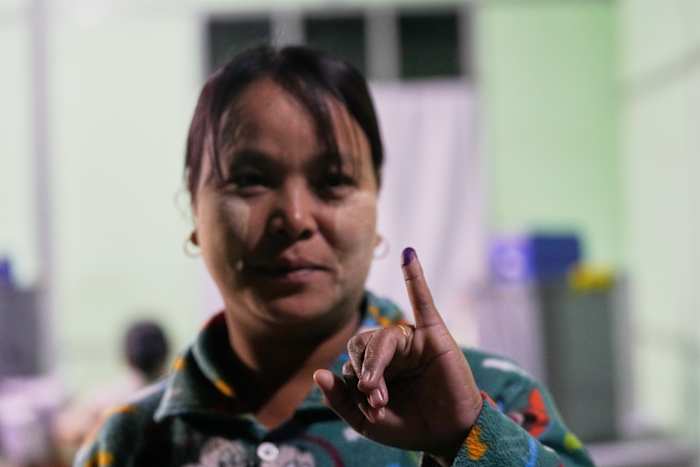
YANGON – On Sunday, Myanmar entered the final phase of its three-part general election, culminating a process that has spanned nearly a month. This voting cycle is set to secure a parliamentary majority for the nation’s military rulers and their allies, paving the way for the formation of a new government.
Opponents argue that the election is neither free nor fair, asserting that it’s a strategic move to legitimize military dominance following the overthrow of Aung San Suu Kyi’s elected civilian government in February 2021.
The Union Solidarity and Development Party (USDP), backed by the military, has claimed the majority of the seats from the first two rounds of voting. Additionally, the military is guaranteed a quarter of the seats in both the upper and lower houses of Myanmar’s Parliament, ensuring it and its allies maintain legislative control.
With the new Parliament set to convene, many anticipate that Senior Gen. Min Aung Hlaing, the current leader of the military government, will ascend to the presidency, a sentiment echoed by both his supporters and detractors.
Critics have denounced this election as a façade.
They argue that the elections, conducted under tight restrictions on public discourse, are merely an attempt to cement military authority, a power play initiated by Min Aung Hlaing’s 2021 coup against Suu Kyi’s administration.
The takeover triggered widespread opposition that dragged Myanmar into a civil war. Security concerns engendered by the fighting meant voting was not held in more than one-fifth of the country’s 330 townships, another reason the process has been described as neither free nor fair.
Malaysian Foreign Minister Mohamad Hasan told Parliament on Tuesday that the Association of Southeast Asian Nations, of which Myanmar is a member, did not send observers and would not certify the election, citing concerns over the lack of inclusive and free participation.
His comments were the first clear statement that the 11-member regional bloc will not recognize the election results.
Observers have been sent from Russia, China, Belarus, Kazakhstan, Nicaragua, Vietnam and Cambodia, all seen as authoritarian states, as well as India and Japan, regarded as democratic.
Suu Kyi, Myanmar’s 80-year-old former leader, and her party are not participating in the polls. She is serving a 27-year prison term on charges widely viewed as spurious and politically motivated. Her party, the National League for Democracy, was forced to dissolve in 2023 after refusing to register under new military rules.
Other parties also refused to register or declined to run under conditions they deem unfair, while opposition groups called for a voter boycott.
A new Election Protection Law imposed harsh penalties for most public criticism of the polls, with the authorities charging more than 400 people recently for activities such as leafleting or online activity.
The previous two rounds of voting were disrupted by armed groups opposed to military rule carrying out attacks on polling stations and government buildings in several townships, killing at least two administrative officials, according to the reports by the military government.
Voting on Sunday began at 6 a.m. in 61 townships across six regions and three states, including many areas that have seen clashes in recent months.
No voting in many areas beset by fighting
The election is being held in three phases due to the armed conflict. The first two rounds took place on Dec. 28 and Jan. 11 in 202 of the country’s 330 townships. A total of 67 townships – mostly areas controlled by armed opposing groups – did not participate, reducing the original seats in the 664-member national parliament to 586.
Final results for all parliament seats are expected to be announced later this week. The military government has announced that Parliament will be convened in March, and the new government will take up its duties in April.
The party with a majority in the combined upper and lower houses of Parliament can select the new president, who in turn names a Cabinet and forms a new government.
Figures released by the Union Election Commission after the first two rounds showed the USDP won 233 seats in Parliament’s two chambers. That means that along with the military, which is allocated 166 seats, the two already hold just under 400 seats, comfortably surpassing the 294 needed to come to power.
Seventeen other parties have won a small number of seats in the legislature, ranging from one to 10.
More than 4,800 candidates from 57 political parties are competing for seats in national and regional legislatures, though only six are contesting nationwide. The military government said there are more than 24 million eligible voters, about 35% fewer than in 2020. The turnout in the first two rounds of voting was between 50% and 60%, it announced.
___
Peck reported from Bangkok.
Copyright 2026 The Associated Press. All rights reserved. This material may not be published, broadcast, rewritten or redistributed without permission.