
Share this @internewscast.com

SPRINGFIELD, Ohio – Raised in the contrasting environments of rural Haiti and Michigan’s farm country, two individuals found a shared mission in the heart of Springfield, Ohio. One was shaped by the challenges of a picturesque yet tumultuous Caribbean homeland, while the other hails from the industrious heartland of Middle America.
Each followed a path to pastoral leadership, converging in Springfield with a united purpose driven by their faith: to stand by Haitian migrants facing the threat of deportation under the stringent immigration policies of President Donald Trump.
Reginald Silencieux, the guiding force behind the First Haitian Evangelical Church, and Carl Ruby, the leader at Central Christian Church, discovered not only a shared mission but also deep mutual respect. When Trump erroneously accused Springfield’s Haitian community of consuming domestic animals in 2024, they both rose to defend their congregants.
They opened the doors of their churches as sanctuaries and rallied the community to join in prayer and peaceful protest against the damaging rumors that fueled anti-immigrant sentiments.
In the aftermath of Trump’s allegations, a wave of bomb threats targeted schools, government facilities, and homes of local officials. Ruby and Silencieux also found themselves in the crosshairs. Yet, they remained resolute.
They organized workshops to prepare for potential immigration raids, offered legal support, distributed food, and continued to provide worship services in both Creole and English, alongside language education classes.
And while they’ve prayed for Trump, they’ve demanded an extension of the Temporary Protection Status program that has allowed thousands of Haitians to legally arrive in Springfield in recent years, escaping unrest and gang violence in their homeland.
“Both of them have been great leaders for the community,” said Viles Dorsainvil, who has worked closely with both pastors as executive director of the Haitian Community Help and Support Center in Springfield.
He calls Ruby a champion of migrants, even putting his life at risk to support and welcome them.
He’s grateful to Silencieux for hosting the Haitian community center in his church since 2021 and inviting immigration attorneys to meet with congregants after services.
“He prays for them; he’s fasting with them; he’s giving them spiritual advice,” Dorsainvil said.
Guiding the hub of Haitian spiritual life in Springfield
Silencieux grew up in a Christian family, loving Jesus and wanting to serve God — just not as a pastor. Instead, he became an attorney.
But by his mid-twenties, he was preaching part-time and eventually moved to Port-au-Prince where he pastored several churches in the gang-controlled capital city.
“Life in Haiti was not easy. But it shaped my character,” Silencieux said. “It taught me perseverance, responsibility and the importance of community.”
It also prepared him for his next challenge.
In 2021, he felt called to move to Springfield, where Haitian immigrants were helping meet rising labor demands for the city’s growing manufacturing industry. He didn’t know English and he left behind his wife and children, who still live in Haiti.
Since then, he has been helping some of the thousands of Haitians who legally moved to Springfield in recent years under the TPS program. The U.S. initially gave TPS to Haitians following a devastating earthquake in 2010 and extended it several times since. But the Trump administration has pushed to end that status, saying conditions in Haiti have improved.
A federal judge recently ruled to keep the protection temporarily in place. But uncertainty and fear continue in Springfield.
After her ruling, the judge received death threats. Bomb threats closed schools, offices and businesses in Springfield.
Silencieux feels powerless at times, but he reminds the community — and himself — to keep faith.
“As a pastor, I don’t have any possibility to protect them,” he said. “Faith helps me to help the community.”
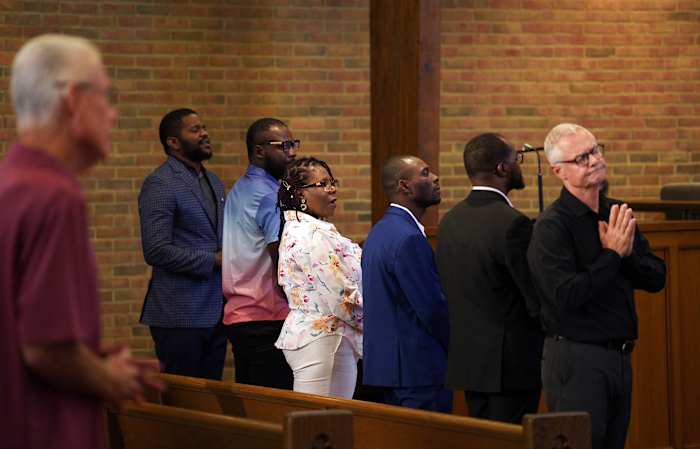
At a recent Sunday service, he recommended that his congregants stay home as much as possible in case of immigration raids. He offered a prayer for Trump and the Haitian community.
“The president is our president. He can take decisions. But he is limited,” he said. “God is unlimited.”
Leading a faith-based movement for migrants
Ruby grew up in a Baptist family in rural Michigan and spent most of his life identifying as an evangelical and a Republican. When he moved to Springfield — and for years after — he knew no Haitians.
But tensions flared in 2023 after a boy was killed and dozens injured when a Haitian immigrant driver hit a school bus.
From home, Ruby tuned into a live city council meeting discussing the crash.
“I was hearing one ugly racist statement after another,” he said, recalling how he drove immediately to the meeting to speak out.
“All I said was, ’We need to remember that there are advantages of having immigrants come into our community; they’re good people.’ And I immediately became the friend of Haitians in town and the enemy of anti-immigrant people in town.”
After Trump’s derogatory comments in 2024, Ruby invited Springfield’s Haitians to worship at his church. He encouraged his congregation to hand out cards around Springfield with a supportive message for Haitians. In Creole and English, it read: “I’m glad you are here. Christ loves you and so do I.”
Ruby said God began preparing him for this moment 15 years ago. At the time, he was vice president of student life at Cedarville University, a Baptist college near Dayton, Ohio, and he organized a trip with students to trace the life of the Rev. Martin Luther King Jr.
The group visited the 16th Street Baptist Church in Birmingham, Alabama, where in 1963 four Black girls were killed when a bomb planted by Ku Klux Klan members exploded during a Sunday service.
They also visited the Birmingham Civil Rights Institute, where Ruby read King’s “Letter from Birmingham Jail.” The letter was directed at Alabama clergy who had asked King to delay civil rights demonstrations in Birmingham.
“I didn’t know that was a letter addressed to pastors who had failed to stand because they wanted to be safe,” Ruby said.
“I made a commitment to myself that I wouldn’t do that; that if there were an opportunity for me to use my voice to help someone who was being oppressed, that I wouldn’t be silent.”
He organized a national conference of Christian colleges, hoping students could return to their campuses inspired to launch organizations focused on serving immigrants.
His work for migrants continued when he became pastor in 2015.
Working with faith leaders, he founded G92, an immigrant advocacy group named after the Hebrew word “ger,” meaning stranger or foreigner, which appears 92 times in the Old Testament.
Today, he takes pride that Springfield’s resistance to Trump’s immigration crackdown is faith-based.
“This is definitely a faith-led movement,” he said. “God loves immigrants and part of demonstrating that you’re one of God’s people is taking care of immigrants.”
He has been targeted with threats and slanderous comments. But he remains undaunted.
“I’ve never lost a moment of sleep over worrying about someone harming me,” he said. “I believe God will protect me.”
On Feb. 2, he helped put on an event where hundreds packed a church to sing and pray in support of Haitians. So many people turned up that a fire marshal asked scores to leave because the church had exceeded its capacity.
“Outside beautiful events with my family, it was the most beautiful day of my life,” Ruby said.
With the TPS program’s uncertain future, Ruby remains worried about the fate of Haitian migrants in Springfield. But he’s also hopeful.
“I think God’s going to bless our city for doing the right thing.”
___
Associated Press religion coverage receives support through the AP’s collaboration with The Conversation US, with funding from Lilly Endowment Inc. The AP is solely responsible for this content.
Copyright 2026 The Associated Press. All rights reserved. This material may not be published, broadcast, rewritten or redistributed without permission.