
Share this @internewscast.com
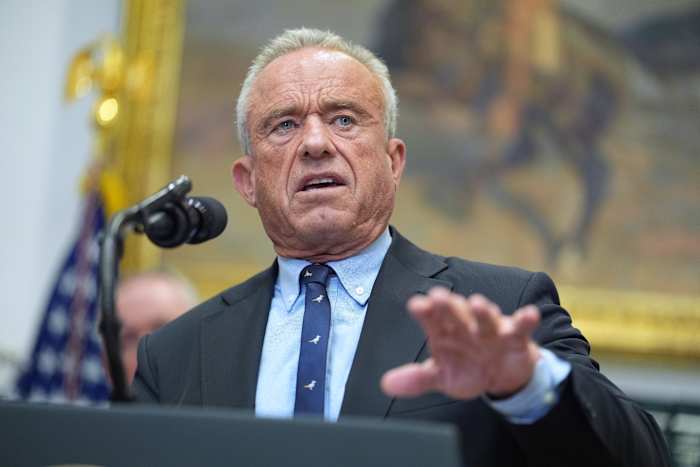
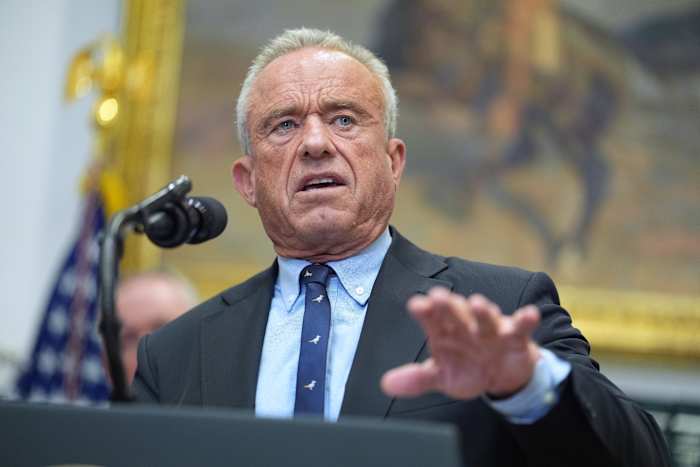
NEW YORK – On Tuesday, a group comprising 19 states and the District of Columbia launched a lawsuit against the U.S. Department of Health and Human Services (HHS), its Secretary Robert F. Kennedy Jr., and the department’s inspector general. The legal action challenges a recent declaration that could hinder young people’s access to gender-affirming healthcare.
The declaration, released last Thursday, labels treatments such as puberty blockers, hormone therapy, and surgeries as unsafe and ineffective for children and adolescents experiencing gender dysphoria. This condition arises when an individual’s gender identity does not align with their sex assigned at birth. Furthermore, the declaration cautions medical professionals that they could face exclusion from federal health programs like Medicare and Medicaid if they offer these types of care.
The announcement coincided with HHS’s proposal of new rules intended to further restrict gender-affirming care for minors. However, the lawsuit does not address these proposed rules since they have not been finalized.
Filed in the U.S. District Court in Eugene, Oregon, the lawsuit contends that the declaration is both inaccurate and unlawful, urging the court to prevent its enforcement. This development marks another chapter in the ongoing conflict between the current administration, which argues that transgender healthcare for children may be harmful, and advocates who assert that such care is essential and should remain accessible.
“Secretary Kennedy cannot unilaterally change medical standards by posting a document online, and no one should lose access to medically necessary health care because their federal government tried to interfere in decisions that belong in doctors’ offices,” said New York Attorney General Letitia James, who spearheaded the lawsuit, in a statement on Tuesday.
The lawsuit claims that the HHS declaration is an attempt to pressure healthcare providers into discontinuing gender-affirming care, bypassing the legal procedures required for implementing policy changes. It argues that federal law mandates public notification and an opportunity for comment before any substantial alterations to health policy are made — steps that the suit asserts were neglected prior to issuing the declaration.
A spokesperson for HHS declined to comment.
HHS’s declaration based its conclusions on a peer-reviewed report that the department conducted earlier this year that urged greater reliance on behavioral therapy rather than broad gender-affirming care for youths with gender dysphoria.
The report questioned standards for the treatment of transgender youth issued by the World Professional Association for Transgender Health and raised concerns that adolescents may be too young to give consent to life-changing treatments that could result in future infertility.
Major medical groups and those who treat transgender young people have sharply criticized the report as inaccurate, and most major U.S. medical organizations, including the American Medical Association, continue to oppose restrictions on transgender care and services for young people.
The declaration was announced as part of a multifaceted effort to limit gender-affirming health care for children and teenagers — and built on other Trump administration efforts to target the rights of transgender people nationwide.
HHS on Thursday also unveiled two proposed federal rules — one to cut off federal Medicaid and Medicare funding from hospitals that provide gender-affirming care to children, and another to prohibit federal Medicaid dollars from being used for such procedures.
The proposals are not yet final or legally binding and must go through a lengthy rulemaking process and public comment before becoming permanent. But they will nonetheless likely further discourage health care providers from offering gender-affirming care to children.
Several major medical providers already have pulled back on gender-affirming care for young patients since Trump returned to office — even in states where the care is legal and protected by state law.
Medicaid programs in slightly less than half of states currently cover gender-affirming care. At least 27 states have adopted laws restricting or banning the care. The Supreme Court’s recent decision upholding Tennessee’s ban means most other state laws are likely to remain in place.
Joining James in Tuesday’s lawsuit were Democratic attorneys general from California, Colorado, Connecticut, Delaware, Illinois, Maine, Maryland, Massachusetts, Michigan, Minnesota, New Jersey, New Mexico, Oregon, Rhode Island, Vermont, Wisconsin, Washington and the District of Columbia. Pennsylvania’s Democratic governor also joined.
Copyright 2025 The Associated Press. All rights reserved. This material may not be published, broadcast, rewritten or redistributed without permission.