
Share this @internewscast.com

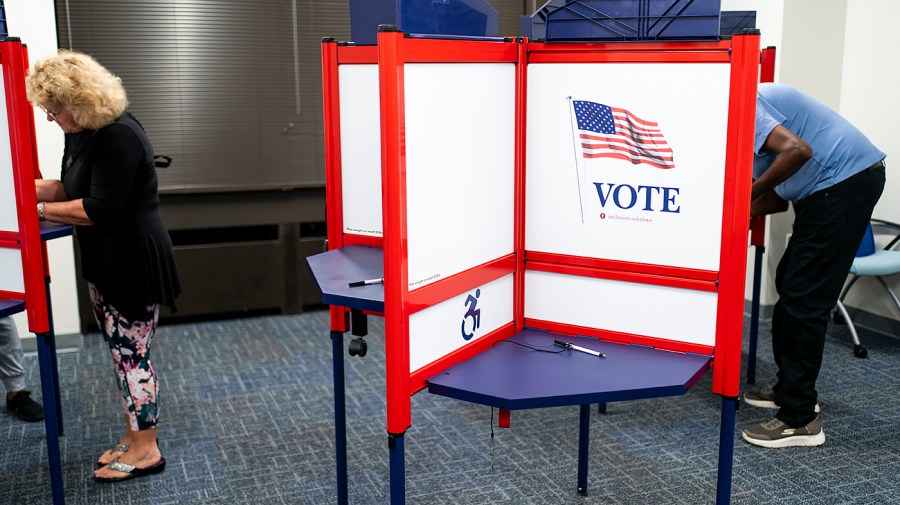
The number of registered independent voters in the U.S. is increasing, prompting campaigns to face challenging decisions on how to appeal to these voters in anticipation of next year’s midterms and the 2028 presidential election.
A recent report by The Hill’s partners at Decision Desk HQ indicates that in most U.S. states, the largest voter registration increases are among those who prefer not to align with any political party. Furthermore, exit polls from the 2024 presidential election showed that self-identified independents exceeded the number of registered Democrats.
Experts say one of the main drivers in independent voters is a growing discontent with the two-party system.
Geoffrey Skelley, chief elections analyst at Decision Desk HQ, said, “The dissatisfaction with the current political climate’s partisan conflicts and the frustration over gridlock are leading people to proclaim, ‘I don’t wish to identify openly with either of the two main parties.’”
Some attribute the rise in independent voters to the expansion of automatic voter registration across various states. With front-end administration, individuals are automatically registered to vote at the Department of Motor Vehicles with an option to opt out. In contrast, back-end administration enrolls voters automatically without permitting an opt-out during the process.
Skelley remarked that a constant trend persists: most independents tend to favor either the left or right. Exit polling from the previous year’s presidential election indicates many independents leaned towards Republicans, playing a pivotal role in securing significant battleground states for President Trump.
Edison Research’s exit polling data reveals that in 2024, independent voters matched Republicans with a share of 34 percent. Democrats accounted for 32 percent of the electorate. Additionally, the turnout percentage for independent voters increased by 8 points in November, yet remained lower than those of Republicans and Democrats.
Some Democrats say this should be cause for concern for the party, given Trump’s widespread wins.
“This isn’t a surprise,” said Jon Reinish, a Democratic strategist. “It’s also a very direct rebuke and an indication of the fact that national Democrats, so many of them have lost their way and have just failed at communicating to voters, so voters are either being pulled to the right or they’re being disaffected and registering that dissatisfaction by going to the independent option.”
However, exit polling showed former Vice President Kamala Harris outperformed Trump with independents. According to Edison Research, 50 percent of independents said they voted for Harris, while 45 percent said they voted for Trump.
Still, the data showed Trump improving his standing among independents by 4 points.
Reinish blames the Democrats’ slippage with independent voters on the failure to meet voters where they are and speak to them in an authentic manner.
“Stop talking like you’re trying to run a small liberal arts college and talk to people about what exactly matters,” he said.
One Republican operative noted the GOP has been able to target these voters by focusing on kitchen-table issues that are catered toward particular states.
“It’s going to the economy, cost of living, education, public safety. Those are consistently at the top,” the operative said. “But it’s also going to be things like energy costs.”
The operative used New Jersey’s gubernatorial race as an example of a state where energy costs are one of the top issues, noting GOP nominee Jack Ciatarelli’s talking point that the state has driven up those costs.
“That same persuadable message isn’t going to work in a Virginia for a Winsome Sears,” the operative said, referring to state Lt. Gov. Winsome Earle-Sears (R), who is running for governor.
“Their behavior varies state by state, election by election, issue by issue,” the operative said. “It’s not a monolith. A good chunk of independent voters aren’t truly independent. They tend to vote with a party 90 percent of the time but can be persuaded in big critical races.”
Skelley echoed this point, noting independent voters often reflect a state’s political lean. Last week, the Colorado secretary of state office announced unaffiliated voters make up the majority of registered voters. According to the data, 50.3 percent of registered voters said they were unaffiliated, while 24.8 percent said they identified with the Democratic Party and 22.4 percent said the same about the Republican Party.
But that does not necessarily mean a statewide win for Republicans in Colorado would be easy. According to Axios Denver, 60 percent of those unaffiliated voters lean to the left, while the rest lean toward Republicans.
“We know at the end of the day given Colorado’s lean that generally speaking those voters are more likely to be Democratic-leaning than Republican-leaning,” Skelley said. “In a state that is more conservative, there is a decent chance that those voters are going to lean Republican.”
Massachusetts and Alaska lead the states in independent voters, with independents making up 62 percent of the voting population in Massachusetts and 60 percent in Alaska.
Other states with large independent voter shares include New Hampshire, Connecticut, North Carolina, Iowa and Oregon, showing how independent voters are spread throughout red, blue and purple states.
Skelley predicted the increased share of independent voters ironically could stand to feed partisanship, allowing the most staunch supporters of each party to take the reins of party apparatuses and campaigns.
“To some extent that also means they are in a way absenting themselves from the political process given how we nominate candidates, who people within parties listen to, who’s volunteering for campaigns, who’s involved in politics,” Skelley said. “It is quite possible that is contributing to polarization because people who might be less stringent in their partisan views are not involving themselves closely.”
The Republican operative noted that ultimately, both parties will have to grapple with the rise in independent voters going forward.
“That independent voter does get treated differently in each state and even their propensity to vote is different in each state,” the operative said.
“You have to be able to figure out how to message to both,” the operative added. “This is the art of campaigning.”