Share this @internewscast.com
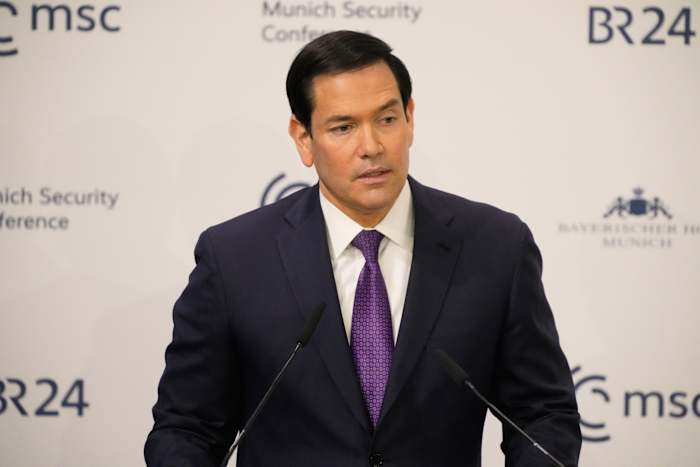
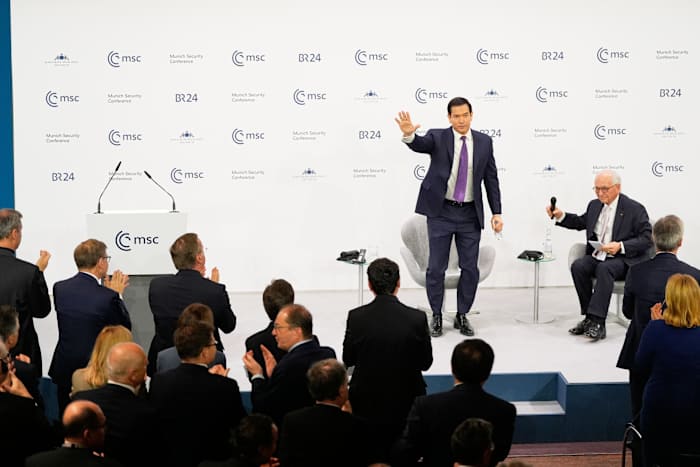
MUNICH – On Saturday, U.S. Secretary of State Marco Rubio offered a composed and reassuring address to America’s allies, presenting a more measured stance about the Trump administration’s plans to redefine the trans-Atlantic alliance. This came after a year of President Donald Trump’s often confrontational remarks regarding long-standing allies.
Speaking at the annual Munich Security Conference, Rubio emphasized America’s deep-rooted connections with Europe, stating that the United States would remain closely linked to the continent. This commitment stands firm even as the U.S. advocates for adjustments in its relationships and the international frameworks that have underpinned the post-World War II global order.
Rubio’s appearance marked a contrast to Vice President JD Vance’s speech a year prior, which shocked attendees with criticism of European values. The Trump administration has since taken actions that strained alliances, including a recent, albeit brief, threat to impose tariffs on European nations to assert U.S. influence over Greenland, a territory affiliated with NATO ally Denmark.
German Chancellor Friedrich Merz, addressing the conference on Friday, called for a renewed and cooperative trans-Atlantic relationship. He highlighted that neither Europe nor the U.S. can prosper in isolation in a world where the old order has shifted. Merz reiterated Europe’s commitment to free speech and climate change, rejecting protectionism and “culture wars.”
Rubio reflected on the post-Cold War era, suggesting that the West’s triumph led to the erroneous belief in a global shift towards liberal democracy and a world without borders. This “euphoria,” he argued, fostered a dangerous notion that trade and commerce alone could replace national identity.
“We made these errors collectively, and now together, we must confront these realities and move forward,” Rubio asserted. Under Trump, he pledged that the U.S. would embark on a path of renewal and restoration.
“This is why we Americans may sometimes come off as a little direct and urgent in our counsel,” he said. “This is why President Trump demands seriousness and reciprocity from our friends here in Europe.”
“In a time of headlines heralding the end of the trans-Atlantic era, let it be known and clear to all that this is neither our goal nor our wish,” Rubio said. “Because for us Americans, our home may be in the Western hemisphere, but we will always be a child of Europe.”
“We have fought against each other, then reconciled, then fought and reconciled again. And we have bled and died side-by-side on battlefields from Kapyong to Kandahar,” Rubio said. “And I’m here today to make it clear that America is charting the path for a new century of prosperity. and that once again, we want to do it together with you, our cherished allies and our oldest friends.”
Rubio said that the United Nations “still has tremendous potential” but that, on today’s most pressing matters, “it has no answers and has played virtually no role.”
Speaking directly after Rubio, Chinese Foreign Minister Wang Yi offered a contrasting view.
“The main reason for the inadequacy of the current international system is not the United Nations itself, but the fact that some countries magnify differences, pursue national priorities … and even revive the Cold War mentality,” he argued. “All these have undermined the basis of trust, worsened the atmosphere of cooperation, and made the operation of international mechanisms difficult.”
___
Geir Moulson in Berlin contributed to this report.
Copyright 2026 The Associated Press. All rights reserved. This material may not be published, broadcast, rewritten or redistributed without permission.