
Share this @internewscast.com

The Senate late Thursday approved its massive annual defense policy bill as the U.S. government remains shut down.
The Republican-led chamber approved the National Defense Authorization Act (NDAA) with a vote of 70-20, setting funding for the U.S. military at $924.7 billion for fiscal year 2026. The decision followed a day of negotiations that resolved a deadlock over the bill.
With the bill’s approval, the House and Senate armed services committees can initiate the often challenging conference process. This involves reconciling differences between each chamber’s version of the legislation. Last month, the House passed its version of the NDAA, which proposes a significantly lower budget of nearly $893 billion.
The NDAA had initially reached the Senate floor in early September but saw little progress until Thursday morning. Progress was hindered because unanimous consent from all 100 senators was needed to vote on amendments. Several unresolved issues led a few lawmakers to delay the proceedings.
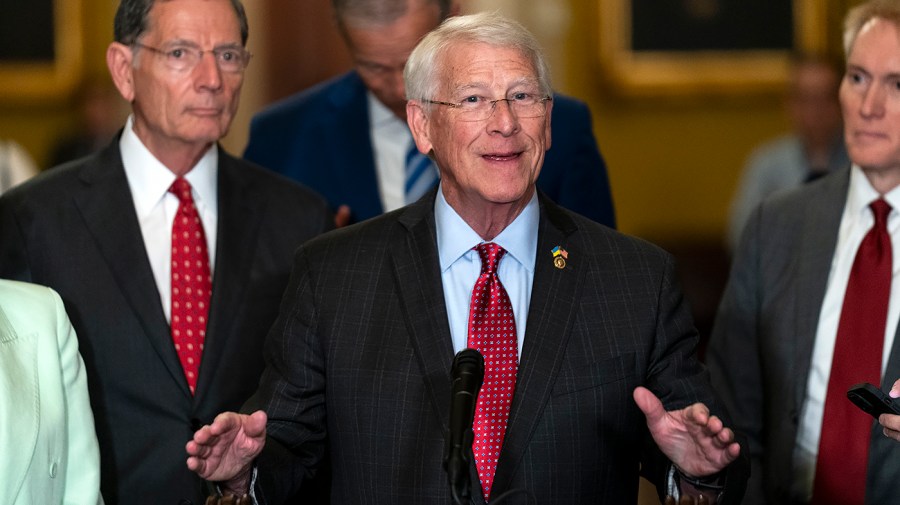
However, Senate Armed Services Committee Chair Roger Wicker (R-Miss.) successfully negotiated an agreement to vote on 17 individual amendments and a collection of nearly 50 less contentious amendments.
“We simply cannot delay this process any longer,” Wicker stated on the Senate floor. “If we don’t bring this to the floor today, there won’t be enough time for proper deliberation on the Senate floor. We would end up pretending to conduct a conference between House and Senate members, with a very small group of senators drafting the final bill for floor passage. That’s not how this should be done.”
The Senate held votes throughout Thursday night, quickly addressing over a dozen partisan amendments and the 50 additional measures before advancing the bill.
Among those passed was from Sen. Tim Kaine (D-Va.), who offered the proposal to repeal the 2002 Authorization for Use of Military Force for Iraq. It also would repeal a similar resolution passed in 1991 during the Gulf War.
And in a show of bipartisanship, an amendment offered by Sens. Tom Cotton (R-Ark.), and Kirsten Gillibrand (D-N.Y.) made it into the bill and would give additional authorities to the Pentagon to counter drone threats over military installations.
“Hundreds of drones have been spotted in the vicinity of military installations over the past few years, including military-sensitive sites like Langley Air Force Base,” Gillibrand said. “But current laws give the Department of Defense quite limited authority to mitigate these threats, and the patchwork of interagency coordination required to address them leaves gaps that endanger our military bases and the men and women who serve there.”
But amendments that failed to pass included one from Senate Minority Leader Chuck Schumer (D.N.Y.) who had hoped to block money for President Trump to retrofit a luxury Qatari jet he accepted as an intended replacement for Air Force One.
“Retrofitting this foreign-owned luxury jet to make it fully operational will cost hundreds of millions of taxpayer dollars. That’s money that shouldn’t be wasted,” Schumer said.
And Sen. Chris Van Hollen (D-Md.) put forward a proposal that was voted down and would have stopped Trump and state governors from allowing National Guard troops from one state to be sent to another if a governor or mayor rejected the move.
Among the issues that were resolved prior to the bill’s Senate passage was a roadblock posed by Sen. Maria Cantwell (D-Wash.), who stalled the NDAA over a bipartisan proposal to scrutinize U.S. investments in China. She reportedly agreed to allow the bill to advance after receiving assurances that senators would address concerns raised by Microsoft, one of her state’s biggest employers, over the amendment.
Another dropped effort was Sen. Ruben Gallego’s (D-Ariz.) insistence that senators vote on his amendment to label Air Force veteran Ashli Babbitt — who was shot and killed by police while attempting to enter a restricted area of the Capitol during the Jan. 6, 2021, insurrection ineligible for military funeral honors, Politico reported.
Updated at 10:55 p.m. EDT.