
Share this @internewscast.com
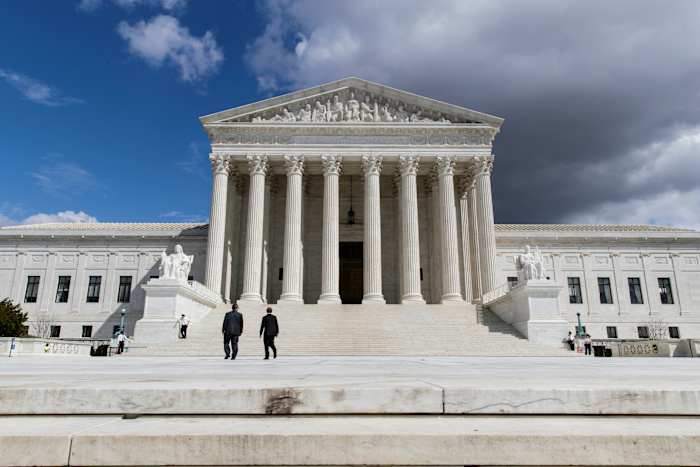
WASHINGTON – In a notable development, the Supreme Court on Friday delivered a verdict favoring immigration judges, temporarily halting the Trump administration’s efforts in a case that could impact the authority of federal employees as the justices consider extending presidential powers of dismissal.
This decision represents a technical juncture in an enduring legal battle, yet it is intertwined with the consequences of several high-profile dismissals executed during President Donald Trump’s tenure. Although the court upheld a prior ruling that cast doubt on the administration’s management of the federal workforce, it also advised lower courts to proceed with caution in their evaluations.
At the heart of the case is a critical issue: can immigration judges—who are federal employees—initiate lawsuits to contest a policy that limits their public speaking, or must they adhere to a separate grievance procedure set aside for federal workers?
The Trump administration, responding to an appeals court’s concerns over the legitimacy of the complaint system following the dismissal of its top officials, sought the Supreme Court’s intervention. The administration argued that these dismissals fell within the president’s purview, and claimed the lower court lacked the authority to question them.
The Justice Department, through the solicitor general, urged the Supreme Court to suspend the appeals court’s ruling while pushing to dismiss the immigration judges’ case from federal court jurisdiction.
Despite the administration’s request, the justices refused to issue a freeze, suggesting, however, that the administration could seek further intervention if lower courts acted hastily. For now, the Supreme Court has permitted most of Trump’s dismissals and is deliberating whether to officially broaden his legal capacity to remove officials from independent agencies by revisiting job protections established nearly 90 years ago.
A union formerly representing immigration judges, who work for the Justice Department, first sued in 2020 to challenge a policy restricting what the judges can speak about in public. They say the case is a free-speech issue that belongs in federal court.
In recent months, Trump’s administration has fired dozens of immigration judges seen by his allies as too lenient.
While the order is not a final decision, the case could eventually have implications for other federal workers who want to challenge firings in court rather than the employee complaint system now largely overseen by Trump appointees.
The decision comes after a series of wins for the Justice Department on the high court’s emergency docket. The court has sided with the Trump administration about two dozen times on issues ranging from immigration to federal funding.
___
Follow the AP’s coverage of the U.S. Supreme Court at https://apnews.com/hub/us-supreme-court.
Copyright 2025 The Associated Press. All rights reserved. This material may not be published, broadcast, rewritten or redistributed without permission.