
Share this @internewscast.com

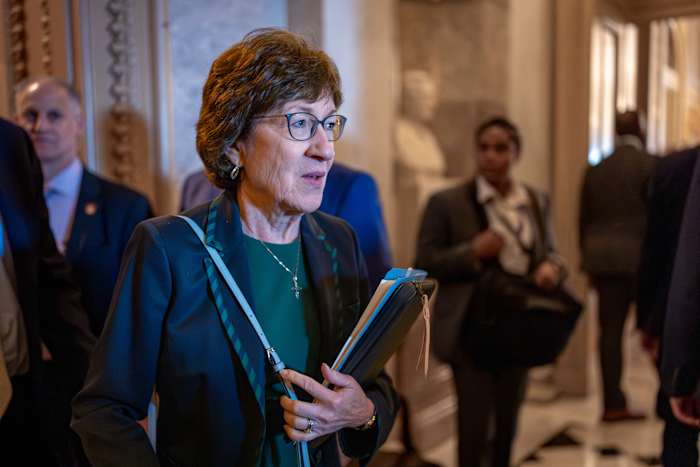
PORTLAND, Maine – Senator Susan Collins of the Republican party has officially thrown her hat in the ring for another term, declaring her intention to run for reelection on Tuesday. This move sets the stage for a fiercely contested battle for her seat, a crucial position that could swing the balance of power in the U.S. Senate as Democrats intensify efforts to unseat her.
This will be a significant test of Collins’ political acumen. At 73, she has successfully secured five terms by embodying Maine’s independent ethos, sometimes diverging from President Donald Trump while still largely endorsing his policies. However, as she campaigns for a sixth term, she faces new challenges that could shake her standing.
One such challenge is the backlash over recent immigration enforcement actions, which are turning into a stumbling block for Republican candidates nationwide. In Maine, a sweep operation resulted in numerous arrests, sparking criticism for targeting individuals without criminal records, adding a complex layer to Collins’ campaign.
In response, Collins has claimed credit for halting an influx of federal agents into the state, attributing this to her direct discussions with Kristi Noem, the Secretary of Homeland Security. Yet, this has not silenced her critics.
Democrats have voiced dissatisfaction, arguing Collins hasn’t taken a strong enough stance. They highlight her decision not to demand Noem’s resignation and her support for a bipartisan funding bill for Homeland Security as points of contention. With the Democratic party needing to capture four additional seats to regain Senate control, Maine is a critical battleground alongside North Carolina, Alaska, and Ohio.
Among Collins’ main Democratic opponents are Governor Janet Mills and oyster farmer Graham Platner. Mills enjoys the backing of the Democratic establishment and influential progressive groups, whereas Platner has gained attention for his anti-establishment rhetoric and focus on economic equality. However, Platner’s campaign has been marred by controversies, including scrutiny over offensive social media posts and a problematic tattoo resembling a Nazi symbol, which he has since covered.
Mills has accused Collins of governing “without any courage” shortly after the Republican voted in favor of funding the DHS and several other agencies in January. Platner has demanded that the agency be dismantled and said he did not believe Collins or the Trump administration’s promise to leave Maine.
Platner recently outraised both Mills and Collins in campaign fundraising, according to the latest federal filings. The first-time candidate collected nearly $4.6 million, while Mills raised $2.7 million. Collins, who had not yet officially launched her campaign during the filing period, had more than $8 million in cash on hand at the end of 2025.
Collins, who has said she didn’t vote for Trump in 2016, voted to convict Trump after his 2021 impeachment over his role in the Jan. 6 Capitol riot. After Collins joined a handful of Republican colleagues in backing a failed effort to limit the president’s ability to unilaterally use force in Venezuela, Trump said on social media that they “should never be elected to office again.”
But Collins has also broadly backed Trump’s agenda, including his tax and spending bill, and his nominees.
Notably, Collins voted to confirm Robert F. Kennedy Jr. as Trump’s choice to be secretary of Health and Human Services. Kennedy has since espoused anti-vaccine policy and ousted public health officials at the Centers for Disease Control and Prevention.
She has faced down tough challenges before. Democrat Sara Gideon raised $69 million in 2020, outspending Collins in a bid to help take back the Senate during a presidential election year when the Democrats won the top of the ticket. Collins defeated Gideon by more than 8 points.
Collins has remained in office despite Maine becoming increasingly blue. The proportion of registered Democrats has increased since her last reelection campaign, when “unenrolled” independent voters outnumbered Democrats in 2019 but now trail them in 2026. Republicans have trailed both groups for years.
___
Kruesi reported from Providence, Rhode Island.
Copyright 2026 The Associated Press. All rights reserved. This material may not be published, broadcast, rewritten or redistributed without permission.