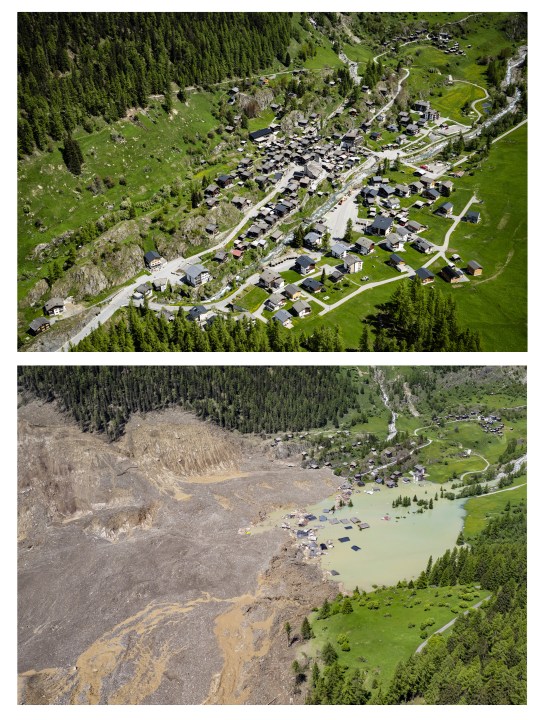


The recent landslide that engulfed a large part of a Swiss village has brought the global warming-induced risks of glacier collapses into sharper focus worldwide.
Scientists note that while the mechanisms of glacier collapses vary from the Alps and Andes to the Himalayas and Antarctica, climate change is consistently a contributing factor.
In Switzerland, a slope near the village of Blatten collapsed on Wednesday in the Lötschental valley. This occurred because the permafrost on the mountainside above the Birch Glacier thawed, destabilizing the rock and causing debris to cascade and bury the glacier over the past few years, explains Martin Truffer, a physics professor at the University of Alaska Fairbanks specializing in glacier dynamics.
While the debris insulated the glacier and slowed melting, its weight caused the ice to begin moving — which accelerated dramatically a few weeks ago. Authorities ordered the evacuation of about 300 people, as well as all livestock, from the village in recent days, “when it became clear that there’s a whole mountainside that’s about to collapse,” said Truffer, who is from Switzerland.
Glacial lakes pose threat
Lakes that form at the base of glaciers as they melt and retreat also sometimes burst, often with catastrophic results. Water can even lift an entire glacier, allowing it to drain, said Truffer, adding that Alaska’s capital of Juneau has flooded in recent years because a lake forms every year on a rapidly retreating glacier and eventually bursts.
In 2022, an apartment building-sized chunk of the Marmolada glacier in Italy’s Dolomite mountains detached during a summer heat wave, sending an avalanche of debris down the popular summer hiking destination, killing 11.
A glacier in Tibet’s Aru mountain range suddenly collapsed in 2016, killing nine people and their livestock, followed a few months later by the collapse of another glacier.
There also have been collapses in Peru, including one in 2006 that caused a mini tsunami; most recently, a glacial lagoon overflowed in April, triggering a landslide that killed two.
“It’s amazing sometimes how rapidly they can collapse,” said Lonnie Thompson, a glacier expert at the Ohio State University. “The instability of these glaciers is a real and growing problem, and there are thousands and thousands of people that are at risk.”
Scientists say melting glaciers will raise sea levels for decades, but the loss of inland glaciers also acutely affects those living nearby who rely on them for water for drinking water and agriculture.
No way to stop the melting
Scientists say greenhouse gases from the burning of fossil fuels such as coal have already locked in enough global warming to doom many of the world’s glaciers — which already have retreated significantly.
For example, glaciers in the Alps have lost 50% of their area since 1950, and the rate at which ice is being lost has been accelerating, with “projections … that all the glaciers in the Alps could be gone in this century,” Thompson said.
Switzerland, which has the most glaciers of any country in Europe, saw 4% of its total glacier volume disappear in 2023, the second-biggest decline in a single year after a 6% drop in 2022.
A 2023 study found that Peru has lost more than half of its glacier surface in the last six decades, and 175 glaciers disappeared due to climate change between 2016 and 2020, mostly due to the increase in the average global temperature.
A study published Thursday in Science said that even if global temperatures stabilized at their current level, 40% of the world’s glaciers still would be lost. But if warming were limited to 1.5 degrees Celsius (2.7 degrees Fahrenheit ) — the long-term warming limit since the late 1800s called for by the 2015 Paris climate agreement — twice as much glacier ice could be preserved than would be otherwise.
Even so, many areas will become ice-free no matter what, Truffer, the University of Alaska expert.
“There’s places in Alaska where we’ve shown that it doesn’t take any more global warming,” for them to disappear, Truffer said. “The reason some … (still) exist is simply because it takes a certain amount of time for them to melt. But the climate is already such that they’re screwed.”
___
The Associated Press’ climate and environmental coverage receives financial support from multiple private foundations. AP is solely responsible for all content. Find AP’s standards for working with philanthropies, a list of supporters and funded coverage areas at AP.org.