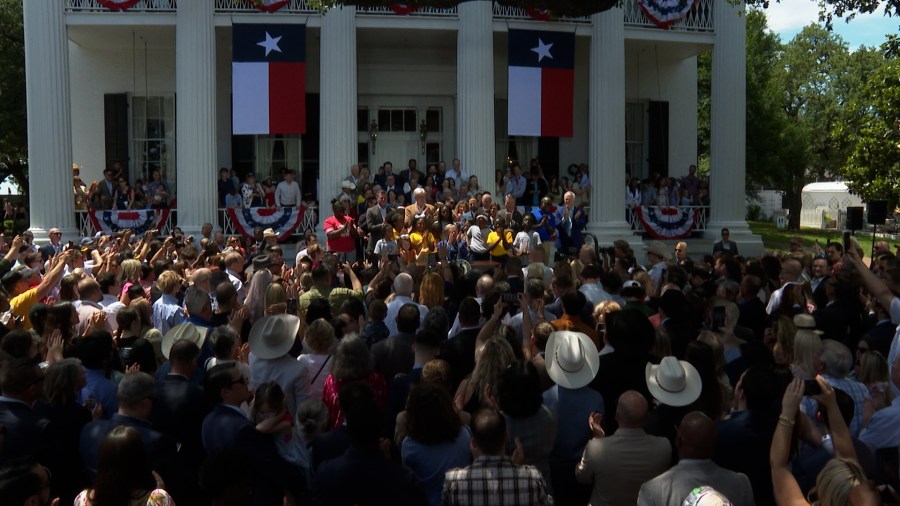
AUSTIN (Nexstar) — Texas Gov. Greg Abbott signed Senate Bill 2, the education savings account (ESA) program, into law on Saturday afternoon, creating the nation’s largest day-one school choice program.
After previous failed attempts, alleged threats against Republican House members, and a call from President Donald Trump, Abbott will finally get one of his top priorities across the finish line.
The front lawn of the Governor’s Mansion was filled with Texans from around the state who drove in to witness the historic piece of legislation. A spokesperson for the Governor’s Office said it received 1,400 RSVPs for the signing.

The governor was joined alongside the authors of the bill, State Sen. Brandon Creighton, R-Conroe, and State Rep. Brad Buckley, R-Salado, as well as Lt. Gov. Dan Patrick and Speaker of the House Dustin Burrows, R-Lubbock. A school choice advocate and private school director are also listed to make comments at the signing.
Editor’s Note: The above video is KXAN’s previous coverage of Senate Bill 2 when it passed in the Texas Senate.
Abbott took the time to thank members of his staff, parents around the state, and lawmakers who were able to finally get this piece of legislation across the finish line.
“School choice is now the law in the great state of Texas,” Abbott said to applause and cheers from the crowd. “Gone are the days that families are limited to only the school assigned by government. The day has arrived that empowers parents to choose the school that’s best for their child.”
What will ESAs look like?
The ESA program will allow approved applicants to use public dollars to help cover the costs of sending their children to a private school. Parents would be able to use money to pay for things like tuition, school supplies, uniforms, travel, etc.
The program is allocated for $1 billion in its first year, but the bill language states that cap will be removed after the first year of implementation. Lawmakers could set the same cap in the next legislative session when they write the budget, or can even increase or decrease the program amount.
How much does each student get?
Each child accepted into the program will receive 85% of the statewide average of local and state dollars that each student receives in public schools. Right now, that is a little over $10,000 per year. Special education students are able to receive the same amount of money they would receive if they attend public school, with a cap at $30,000. Home-schooled students are eligible to receive up to $2,000 per year.
Who is prioritized?
Since there is a cap, only so many students will be able to take advantage of the program. The bill does prioritize applicants based on educational needs and family income. Here’s how it is broken down:
| Priority Level | Eligibility |
| 1 | Children with a disability in a household with income at or below 500% of the federal poverty line |
| 2 | Children in a household with income at or below 200% of the federal poverty line |
| 3 | Children in a household with income that is above 200% and below 500% of the federal poverty line |
| 4 | Everyone else |
If the comptroller, the agency tasked with operating the program, receives more applicants than available spots, it will use a lottery system to fill out the program. A child whose sibling is in the program would automatically be placed in the program as well.
What’s next for public school finance?
Just across the street from the celebrations at the Governor’s Mansion, a group of Democratic state lawmakers and public school teachers and advocates gathered in a parking lot to protest the education savings account program.
The group unveiled a banner hanging down from the AFL-CIO building that reads from top to bottom, “Kids and Teachers Over Billionaires.” Underneath that is a picture of Gov. Abbott with money around him. In parenthesis below the governor’s picture it says, “And those that cave to them.”

The Texas House passed both school choice and public school finance legislation at the same time. Speaker Burrows called the initiative the “Texas Two-Step.” House Democrats fought against the ESA program arguing it would cause public schools to lose out on state dollars, since that money is determined by attendance.
“With the stroke of his pen, Greg Abbott is betraying nearly 6 million Texas public school students,” State Rep. James Talarico, D – Austin, said at the protest.
Republicans and supporters of the bill disagree with that argument, and instead they argue it will create more competition among schools in the state, therefore increasing the quality of education.
“We are going to make, through school choice, public schools even more competitive and better. It’s not about us against them or them against us, all together,” Lt. Gov. Dan Patrick said during the bill signing event.
Democrats argued they wanted to use the $1 billion set aside for school choice to be used toward increasing public school financing. House Bill 2, the public school finance bill, increased public school funding by roughly $7.7 billion.
Democrats said the school finance bill does not go far enough in increasing the basic allotment, which is a portion of the total school funding a school district receives per student. The last time it was increased was in 2019 when the legislature bumped it up to $6,160. The latest school finance bill would increase the basic allotment by $340, but Democrats argue the basic allotment needs to increase by about $1,400 in order for schools to catch up with inflation.
But unlike school choice legislation, the school finance bill has not been fully approved by both chambers. The bill was referred to the Senate Committee on Education K-16, but does not have a hearing date set. The bill was passed on the same night as school choice, April 17.
This past week, State Rep. Gene Wu, D-Houston, voiced his concerns with the Senate not scheduling a hearing for school finance. In a line of parliamentary questioning to the Speaker, Wu asked, “Is the Senate aware that if HB 2 does not pass that our school system may completely collapse?”
“Mr. Wu, the Chair is not advised,” Burrows responded.
“I think it’s very concerning that the governor forced his private school voucher bill through the House and is now stalling on funding for our public schools,” Talarico said. “This was supposed to be the Texas two-step, but right now I’m just seeing one step, and that’s defunding our neighborhood public schools across the state.”
State Sen. Creighton is the chair of the Senate education committee. He said the two proposals for public school finance are similar in the amount of money, but differ in how that money would be spent. He says his office is working on a hybrid of the two proposals and will schedule a hearing soon.
“It’ll be probably the largest funding increase for public schools by percentage in Texas history,” Creighton said.
The last day for the Texas Senate to consider all bills on second and third reading is May 28, according to the Legislature’s Deadline Action calendar.


