
Share this @internewscast.com
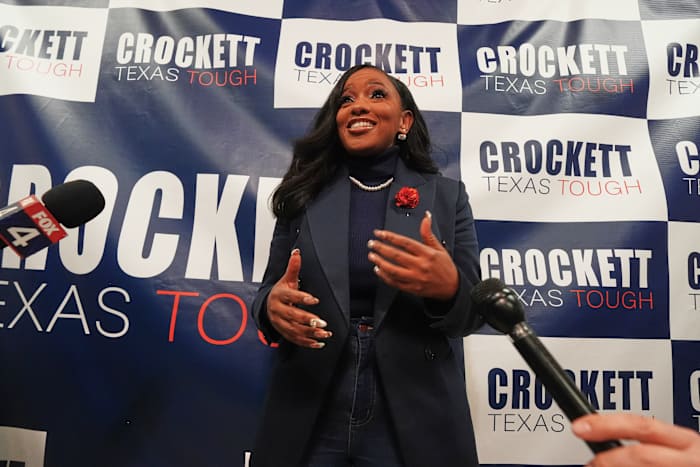
WASHINGTON – In the early stages of her Senate bid, a congresswoman from Dallas emphasized her confrontations with Donald Trump to connect with voters. Meanwhile, her rival in the Democratic primary argued that the nation has grown weary of “politics as a blood sport.”
This contrast in strategy showcases how U.S. Rep. Jasmine Crockett and state Rep. James Talarico are positioning themselves in a race where Democrats are eager to end a 30-year losing streak in Texas. It also highlights a deeper division within the party, as some candidates continue to spotlight Trump while others steer clear of mentioning him.
Identifying the most effective strategy is crucial for Democrats aiming to regain power in the upcoming midterm elections, which will decide the balance of Congress, and as they prepare for the next presidential contest.
On the other hand, Republicans have articulated a clear stance. Susie Wiles, the White House chief of staff, mentioned in a recent podcast that Trump will be a prominent figure in midterm campaigns and that the party is eager to “put him on the ballot.”
“He is the greatest vote energizer in the history of politics,” remarked Neil Newhouse, a seasoned Republican pollster. “But the challenge remains that he mobilizes Democrats just as effectively as he does Republicans.”
Crockett’s campaign highlights her battles with Trump.
In her campaign launch video, Crockett was silent as audio of Trump’s insults played, including multiple times that he’s called her a “very low-IQ person.” At the end of the video, she breaks out into a smile.
During her first stump speech on Monday, she addressed the president more directly.
“Trump, I know you’re watching, so let me tell you directly,” Crockett said. “You’re not entitled to a damn thing in Texas. You better get to work because I’m coming for you.”
Trump responded on Tuesday, telling reporters aboard Air Force One that her candidacy is “a gift to Republicans” and “I can’t even believe she’s a politician actually.”
For nearly a decade, Democrats have used attacks on Trump to draw attention and fuel fundraising. Governors who are considered potential 2028 presidential contenders, including California’s Gavin Newsom and Illinois’ JB Pritzker, saw their profiles rise as they positioned themselves as staunch opponents of the president.
Arizona Sen. Mark Kelly recently participated in a video telling service members that they shouldn’t follow illegal orders. Trump responded by accusing him of “seditious behavior” that’s “punishable by death.”
Kelly started a national press tour and sent out a flurry of fundraising emails, both for himself and other Democrats. He said Trump has bullied everyone in his career, “but not now, because I won’t let it happen.”
When it comes to running for office, “Trump is the red meat that drives donors,” said John Anzalone, a longtime Democratic pollster.
“There are clearly some candidates that are playing towards the donor world that don’t actually make a great argument for winning races. But it’s great for clicks and making money. And money is the first primary that you need to win.”
Talarico charts a different course
Talarico has built a following with a less combative style. The former teacher-turned-pastor and state legislator gained attention by posting viral social media content challenging Republicans’ claims to Christian values. He has focused little on Trump or other politicians.
“The biggest divide in our country is not left versus right. It’s top versus bottom,” Talarico said in his campaign launch video.
There are echoes of other Democratic successes this year, such as when gubernatorial candidates won in New Jersey and Virginia by focusing on affordability concerns.
Mikie Sherrill, the incoming New Jersey governor, said recently that Trump motivates his critics to vote, but it isn’t enough for Democrats to rely solely on anti-Trump fervor.
“Trump makes a difference. He’s a forcing mechanism to coalesce the party,” Sherrill said. “But to really turn out the vote in a really strong manner, you have got to run a really sharp campaign.”
When Democrats talk about Trump, they have to connect his actions to voters’ everyday lives, she said.
“You can’t just say, oh, I’m so upset that Trump demolished the East Wing of the White House,” she said. “You have to say, look, there’s a tariff regime that is being run that is enriching the president to the tune of $3 billion, and you’re paying more for everything from your cup of coffee in the morning to the groceries that you’re buying to cook your family dinner at night.”
It’s an approach that could have more staying power in the coming years.
“In the not-too-distant future, Trump will not be on the ballot and that will be a challenge for both parties,” said Austin Cook, a senior aide for Democratic Sen. Elissa Slotkin’s successful campaign in Michigan last year. “He is a starting gun for Democratic enthusiasm. But soon we won’t have him as a foil.”
Republicans need Trump to turn out voters
Republicans have little choice but to enlist Trump’s help, considering his enduring support among voters who are less likely to turn out during midterm elections.
“They need to energize Republican voters and the only real way to energize Republican voters and get them out to vote is by enlisting Trump in the campaign,” said Newhouse, who is advising some of the party’s Senate candidates running in 2026.
He warned that Trump’s popularity does not necessarily transfer to candidates he supports, “but there isn’t an alternative.”
“What they are trying to do here is basically wrap themselves up in him, hope that his approval and the economic numbers improve and get their voters out to the polls to match the Democrats’ intensity,” Newhouse said.
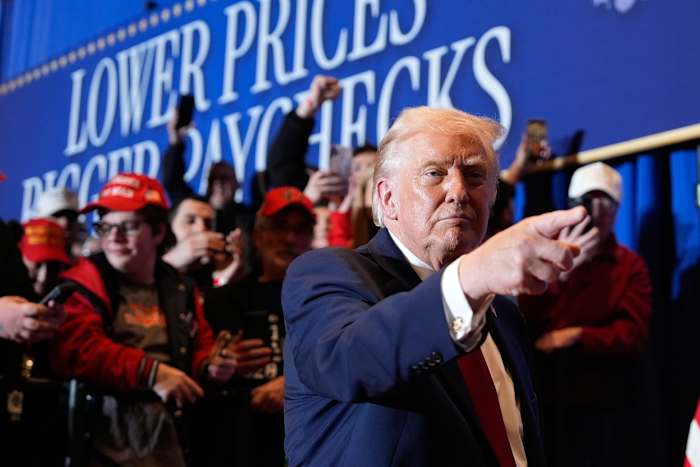
The White House has said that Trump will be on the road more in the coming months. He hosted his first rally in a while in Pennsylvania on Tuesday evening, where he blamed Democrats for inflation.
“They gave you high prices,” he said, adding that “we’re bringing those prices down rapidly.”
___
Beaumont reported from Des Moines, Iowa. Associated Press writer Jonathan J. Cooper in Phoenix, Arizona, contributed to this report.
Copyright 2025 The Associated Press. All rights reserved. This material may not be published, broadcast, rewritten or redistributed without permission.