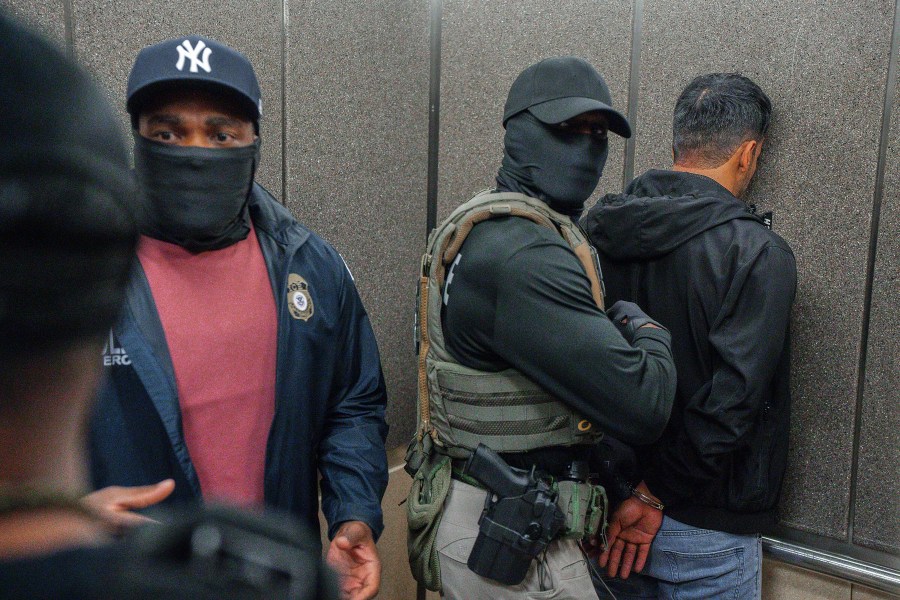

NEW YORK (AP) — Across the nation, immigration enforcement agents have become a common sight as they detain individuals, prompting public anger and protests. However, these agents have adopted a significant change in appearance: they now often wear caps, sunglasses, neck gaiters, or balaclavas, effectively concealing their identities.
With the year only half over, this image of covered faces—used by law enforcement during a wave of immigration crackdowns initiated by President Donald Trump’s administration—has emerged as one of the most powerful and divisive symbols of 2025.
The heightened immigration enforcement was already a contentious issue, polarizing those opposed to Trump’s policies against their supporters. The presence of masked agents executing these operations has intensified conflicts, marking a unique and unparalleled development in the history of U.S. policing.

Trump administration officials have consistently defended the practice, saying that immigration agents have faced strident and increasing harassment in public and online as they have gone about their enforcement in service of Trump’s drive toward mass deportation, and hiding their identities is for their and their families’ safety to avoid things like death threats and doxing, where someone’s personal information is released without their permission on the internet.
“I’m sorry if people are offended by them wearing masks, but I’m not going to let my officers and agents go out there and put their lives on the line, their family on the line because people don’t like what immigration enforcement is,” Immigration and Customs Enforcement acting director Todd Lyons said last month.
There’s pushback, as expected
Democrats and others, including the several state attorneys general, have pushed back, saying the use of face masks generates public fear and should be halted.
In a letter to Lyons last week, a group of Democratic senators said the stepped-up immigration enforcement in workplaces, restaurants and other sites was already causing dismay and the increasingly common sight of masked agents “represents a clear attempt to compound that fear and chaos – and to avoid accountability for agents’ actions.”
In American culture, covering one’s face has often gone hand in hand with assumptions of negative behavior. Think bandits donning bandanas in cowboy movies, or robbers putting on ski masks before pulling a heist on a bank. Even comic-book superheroes who cover their faces have been swept up in storylines in recent years that derisively refer to them as “masks” and say their decision to hide their identities while enforcing justice is transgressive.
And the presence of masked police or paramilitary forces in other countries has been seen by Americans as antithetical to promised democracy and justice for all — and to the common-law principle of being able to face your accusers.
Mask-wearing overall in American life took another hit during the COVID-19 pandemic, when many Trump supporters scoffed at notions that protective masks would insulate people from the deadly virus and scorned people who wore them. More recently, Trump has come out against masks, at least when they’re being worn by protestors. He posted on social media last month that demonstrators wearing masks should be arrested.
Given all that cultural context, it’s even more problematic that those enforcing laws be the ones with their faces covered, said Tobias Winright, professor of moral theology at St. Patrick’s Pontifical University in Maynooth, Ireland. He has worked in law enforcement in the U.S. and writes frequently about policing ethics.
If “what you’re doing is above board and right,” he said, “then why conceal your identity?”
Power gives different symbols different meanings
For those who question why it’s different for law enforcement to wear masks if protestors and non-law enforcement personnel are doing it, it’s because symbols have different meanings based on the power and position of the people using them, said Alison Kinney, author of “Hood,” a book about that clothing item and the various ways people have used it.
“ICE agents are agents of the state. and they’re invested with not only power but also with protections in carrying out their job,” she said. “But that job is also supposed to be public service. It’s also supposed to be accountable and responsible to the public.”
“And so they have a greater responsibility for transparency and accountability and making themselves known so that we can hold them accountable for the justice or injustice of their actions,” she said.
Concerns over how law enforcement is held accountable to the public have come up before. Advocates pushed for officers to wear body cameras and demanded that police officers have visible names and badge numbers. But there hasn’t previously been much discussion around police masking because there isn’t a history of it being done in any kind of official widespread way in the United States, outside of SWAT- or undercover-type operations, Winright said.
The most high-profile example of mask-wearing in American history for the purpose of hiding identity is also its most negative one — racist attacks carried out by the members of the Ku Klux Klan.
The masks served a purpose, of course, of keeping the wearers’ identities secret, said Elaine Frantz, a history professor at Kent State University and author of “Ku-Klux: The Birth of the Klan during Reconstruction.” But they also made it easier for those wearing them to commit violent acts against others, she said.
“One thing about a mask is it kind of works like being behind a riot shield,” Frantz said. “When you have more of separation from the person you’re attacking, it’s easier to dehumanize that person.”
Winright said he hoped law enforcement mask-wearing wouldn’t be normalized. There has been at least one expansion into local policing. In Nassau County, on Long Island just outside New York City, County Executive Bruce Blakeman last week signed an executive order allowing police officers to wear masks during certain types of work, including working with immigration agents.
Winright is concerned, though, that the move could strain police-community relations even more, thus putting officers at even more risk.
“Wearing a mask seems to increase fear and decrease trust, and policing from federal to local in America needs trust and transparency and community relations that are positive,” he said.
He added: “The harms, the risks, are greater by wearing masks, not only to the individual officers, but to the profession itself, as well as to the United States society. It’s just going to further exacerbate the us-versus-them polarization, the lack of trust, and that’s the probably the last thing we need right now.”