
WASHINGTON – On Thursday evening, the House is anticipated to approve President Donald Trump’s proposal to retract roughly $9 billion from public broadcasting and foreign aid. This move by Republicans aims to cut back on institutions and programs perceived as excessive or misaligned with their policy goals.
The White House has characterized this initiative as a preliminary case, suggesting that if Congress concurs, additional proposals may follow. If approved by the House, it would represent the first successful submission of such a rescission request by a president in decades, with mixed responses in the past. Unlike his predecessors, Trump is poised to secure almost all the reductions he has put forward.
Critics expressed unease not only about the specific programs being cut but also about the potential shift in spending power from Congress to the executive branch. They noted concern over investment allocations approved through bipartisan consensus being later revoked via votes divided along party lines. The measure did not receive any Democratic support when it passed the Senate with a slim margin of 51-48, and two Republicans also opposed it.
“We need to get back to fiscal sanity and this is an important step,” House Speaker Mike Johnson, R-La., told reporters.
The package cancels about $1.1 billion for the Corporation for Public Broadcasting and nearly $8 billion for a variety of foreign aid programs, many designed to help countries where drought, disease and political unrest endure.
The effort to claw back a sliver of federal spending comes just weeks after Republicans also muscled through Trump’s tax and spending cut bill without any Democratic support. The Congressional Budget Office has projected that measure will increase the U.S. debt by about $3.3 trillion over the coming decade.
A heavy blow to the Corporation for Public Broadcasting
The cancellation of $1.1 billion for the CPR represents the full amount it is due to receive during the next two budget years.
The White House says the public media system is politically biased and an unnecessary expense.
The corporation distributes more than two-thirds of the money to more than 1,500 locally operated public television and radio stations, with much of the remainder assigned to National Public Radio and the Public Broadcasting Service to support national programming.
Democrats were unsuccessful in restoring in the Senate.
Lawmakers with large rural constituencies have voiced particular concern about what the cuts to public broadcasting could mean for some local public stations in their state.
Sen. Lisa Murkowski, R-Ala., said Tuesday that the stations are “not just your news — it is your tsunami alert, it is your landslide alert, it is your volcano alert.”
Less than a day later, as the Senate debated the bill, a 7.3 magnitude earthquake struck off the remote Alaska Peninsula, triggering tsunami warnings on local public broadcasting stations that advised people to get to higher ground.
Sen. Mike Rounds, R-S.D., said he secured a deal from the White House that some money administered by the Interior Department would be repurposed to subsidize Native American public radio stations in about a dozen states.
But Kate Riley, president and CEO of America’s Public Television Stations, a network of locally owned and operated stations, said that deal was “at best a short-term, half-measure that will still result in cuts and reduced service at the stations it purports to save.”
Inside the cuts to foreign aid
Among the foreign aid cuts are $800 million for a program that provides emergency shelter, water and family reunification for refugees and $496 million to provide food, water and health care for countries hit by natural disasters and conflicts. There also is a $4.15 billion cut for programs that aim to boost economies and democratic institutions in developing nations.
Democrats argued that the Republican administration’s animus toward foreign aid programs would hurt America’s standing in the world and create a vacuum for China to fill.
Sen. Brian Schatz, D-Hawaii, said the amount it takes to save a starving child or prevent the transmission of disease is minuscule, even as the investments secure cooperation with the U.S. on other issues. The cuts made to foreign aid programs through Trump’s Department of Government Efficiency were having life-and-death consequences around the world, he said.
“People are dying right now, not in spite of us but because of us,” Schatz said. “We are causing death.”
After objections from several Republicans, GOP leaders took out a $400 million cut to PEPFAR, a politically popular program to combat HIV/AIDS that is credited with saving millions of lives since its creation under Republican President George W. Bush.
Looking ahead to future spending fights
Democrats say the bill upends a legislative process that typically requires lawmakers from both parties to work together to fund the nation’s priorities.
Triggered by the official rescissions request from the White House, the legislation only needs a simple majority vote to advance instead of the 60 votes usually required to break a filibuster. That meant Republicans could use their 53-47 majority to pass it along party lines.
In the end, two Republican senators, Murkowski and Sen. Susan Collins of Maine, joined with Democrats in voting against the bill, though a few other Republicans also raised concerns about the process.
“Let’s not make a habit of this,” said Senate Armed Services Committee Chairman Roger Wicker of Mississippi, who voted for the bill but said he was wary that the White House wasn’t providing enough information on what exactly will be cut.
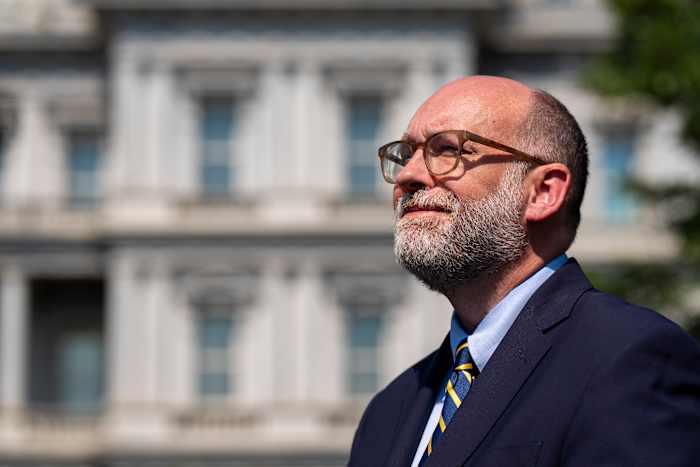
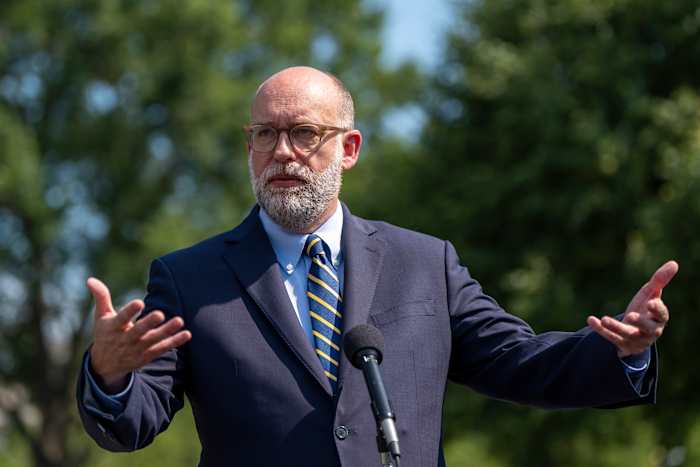
Russ Vought, the director of the Office of Management and Budget, said the imminent successful passage of the rescissions shows “enthusiasm” for getting the nation’s fiscal situation under control.
“We’re happy to go to great lengths to get this thing done,” he said during a breakfast with reporters hosted by the Christian Science Monitor.
In response to questions about the relatively small size of the cuts — $9 billion — Vought said that was because “I knew it would be hard” to pass in Congress.
Vought said another rescissions package is ’likely to come soon.”
“But we’re not there yet,” he said.
___
Associated Press writers Becky Bohrer in Juneau, Alaska, and Seung Min Kim contributed to this report.
Copyright 2025 The Associated Press. All rights reserved. This material may not be published, broadcast, rewritten or redistributed without permission.