
Share this @internewscast.com
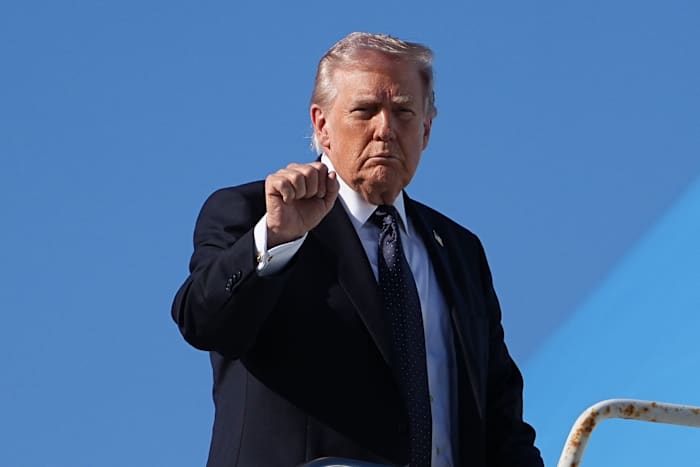
In a surprising turn of events, President Donald Trump has led the United States into a military conflict with Iran. This move starkly contrasts with his long-standing public stance against foreign military entanglements, especially in the Middle East. Trump’s campaign was heavily rooted in an “America first” philosophy, emphasizing a focus on Western Hemisphere interests.
The justification for this sudden military involvement alongside Israel in targeting Iran’s leadership and infrastructure was based on claims that Iran posed significant and immediate threats to U.S. and allied interests. This reasoning mirrors the rhetoric used when Trump authorized a military intervention in Venezuela last month to oust former President Nicolas Maduro.
However, even those within Trump’s inner circle have struggled to provide concrete evidence of an imminent threat from Iran that necessitated such drastic measures. Previously, Trump had claimed that a strike had effectively “obliterated” Iran’s nuclear capabilities, and a Defense Intelligence Agency report suggested Iran was still a decade away from developing missiles capable of reaching the United States.
The initial strikes resulted in the deaths of key figures in the Iranian government, creating a power vacuum in Tehran. This situation, compounded by the fragmented nature of Iranian opposition groups abroad, risks dragging the United States into a prolonged conflict—the exact scenario Trump has expressed intent on avoiding.
As Operation Epic Fury unfolds, reactions are divided. Within just two days of the operation’s commencement, U.S. lawmakers, Middle East diplomats, and experts are offering varied and conflicting forecasts on the potential outcomes and path forward in this volatile region.
Less than two days after the Operation Epic Fury began, U.S. lawmakers and Middle East diplomats and experts offered conflicting assessments of the road ahead.
One Middle Eastern diplomat said Arab nations were particularly disappointed that the U.S. and Israel chose to move ahead with the military option while diplomacy remained possible and are “very concerned” about potential escalation. “This is precisely what we did not want,” the diplomat said, speaking on condition of anonymity due to the sensitivity of the situation.
The diplomat said de-escalation is of “paramount” importance because the longer the strikes go on “the worse it will be not only for the region but it will be felt around the world.”
Trump supporters, though, disagreed.
“America First is not isolationism,” said Republican Sen. Lindsey Graham of South Carolina, a Trump ally who has long supported military action against Iran. “America First is not head in the sand. America First is not to get entangled. We’re not going to have any boots on the ground in Iran. But America First is to kill people who wish us ill with a record of trying to destroy us in the region, to take them off the table.”
Graham and other Trump defenders have argued that the president acts swiftly when necessary and not before exhausting non-military options. They point to his order to eliminate the head of Iran’s Revolutionary Guards Corps during his first term, his strikes last June on several of Iran’s most important nuclear facilities and the Maduro operation.
Sen. Tom Cotton, R-Ark., chairman of the Senate Intelligence Committee, predicted that Republican lawmakers and more importantly voters will back Trump even though they support the president’s America First policy.
“I suspect you’ll see overwhelming support from elected Republicans in the Congress, who are answerable to our voters in places like Arkansas and states all across the country when we’re back in the Capitol later this week,” Cotton said.
Although Trump has held out the prospect of a return to negotiations with Iran, Democrats who allege the war is illegal because it was not approved by Congress, remain skeptical and point out the difference between Iran and Venezuela, where there was a relatively seamless transition of power.
Sen. Mark Warner, D-Va., the ranking Democrat on the Intelligence Committee said, “I think and fear that we are seeing just the opening salvos of what could be not an in-and-out conflict, but what could be a sustained war in the region. And our record of sustained wars in the Middle East leaves something to be desired.”
Sen. Mark Kelly, D. Az. and a combat veteran, said he wanted to see a strategy from the president. “My concern here, you know, going forward is what happens now… I don’t want to see a wider conflict in the Middle East.”
A leading voice pushing for a congressional vote on Trump’s action, Sen. Tim Kaine, D-Va., added, “Haven’t we learned something from 25 years of war in the Middle East? Have we learned nothing?”
Graham and Kelly spoke on NBC’s “Meet the Press,” Cotton and Warner spoke on CNN’s “State of the Union,” and Kaine spoke on “Fox News Sunday.”
Copyright 2026 The Associated Press. All rights reserved. This material may not be published, broadcast, rewritten or redistributed without permission.