Share this @internewscast.com
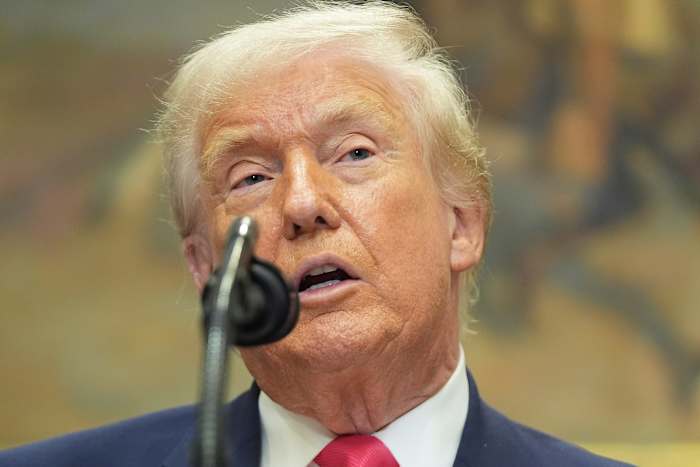
WASHINGTON – President Donald Trump is poised to unveil a new initiative on Wednesday aimed at relaxing vehicle mileage standards for the automotive industry. This move is expected to ease the current regulatory burden on automakers concerning emissions from gasoline-powered vehicles, as shared by sources familiar with the administration’s plans.
The forthcoming proposal intends to substantially lower fuel efficiency targets, which dictate the distance new cars must cover per gallon of gasoline, extending through the 2031 model year. This information comes from a White House official and others in the know, who requested anonymity due to the lack of an official announcement. Specific details of the proposal remain under wraps for now.
This decision marks another step by the Trump administration to overturn policies from the previous administration that promoted cleaner vehicle technologies, including electric cars. Gasoline consumption is a significant source of greenhouse gases contributing to climate change. The Republican-led administration asserts that the revised rules will expand Americans’ access to a broader spectrum of affordable gasoline vehicles.
Trump is expected to reveal the plan at a White House event featuring senior leaders from the nation’s three largest automakers, who have expressed support for the proposed regulatory adjustments. Since assuming office in January, Trump has rolled back auto emission standards, eliminated penalties for manufacturers failing to meet federal mileage criteria, and scrapped consumer incentives worth up to $7,500 for purchasing electric vehicles.
Ford CEO Jim Farley expressed approval of the proposed policy shift, stating Wednesday that it represented “a victory for consumers and common sense.”
“As the leading auto manufacturer in America, we commend President Trump’s efforts to align fuel economy standards with market conditions. We can achieve meaningful advancements in reducing carbon emissions and enhancing energy efficiency while maintaining customer choice and affordability,” Farley stated.
Stellantis CEO Antonio Filosa said the automaker appreciates the administration’s actions to “realign” the standards.
Environmentalists decried the decision.
“In one stroke Trump is worsening three of our nation’s most vexing problems: the thirst for oil, high gas pump costs and global warming,” said Dan Becker, director of the Safe Climate Transport Campaign for the Center for Biological Diversity.
“Trump’s action will feed America’s destructive use of oil, while hamstringing us in the green tech race against Chinese and other foreign carmakers,” Becker said.
Trump has repeatedly pledged to end what he falsely calls an EV “mandate,” referring incorrectly to Democratic President Joe Biden’s target that half of all new vehicle sales be electric by 2030. EVs accounted for about 8% of new vehicle sales in the United States in 2024, according to Cox Automotive.
No federal policy has required auto companies to sell EVs, although California and other states have imposed rules requiring that all new passenger vehicles sold in the state be zero-emission by 2035. Trump and congressional Republicans blocked the California law earlier this year.
Transportation Secretary Sean Duffy urged his agency to reverse existing fuel economy requirements, known as Corporate Average Fuel Economy, soon after taking office. In June, he said that standards set under Biden were illegal because they included use of electric vehicles in their calculation. EVs do not run on gasoline. After the June rule revision, the traffic safety agency was empowered to update the requirements.
Under Biden, automakers were required to average about 50 miles (81 kilometers) per gallon of gas for passenger cars by 2031, compared with about 39 miles (63 kilometers) per gallon today.
The Biden administration also increased fuel-economy requirements by 2% each year for light-duty vehicles in every model year from 2027 to 2031, and 2% per year for SUVs and other light trucks from 2029 to 2031. At the same time, it called for stringent tailpipe rules meant to encourage EV adoption.
The auto industry has complained that both Biden-era rules were difficult to meet.
Mileage rules have been implemented since the 1970s energy crisis, and over time, automakers have gradually increased their vehicles’ average efficiency.
___
St. John reported from Detroit. Associated Press writer Darlene Superville contributed to this report.
Copyright 2025 The Associated Press. All rights reserved. This material may not be published, broadcast, rewritten or redistributed without permission.