
Share this @internewscast.com

WASHINGTON – President Donald Trump is getting his way with the world economy.
Trade partners from regions like the European Union, Japan, and Vietnam seem to be yielding to the president’s insistence on accepting increased costs — in the form of elevated tariffs — for the opportunity to sell their products in the United States. For Trump, these deals, which are a combination of coercion and persuasion, embody his long-standing belief in protectionism and involve a significant risk that this approach will yield political and economic benefits for American consumers.
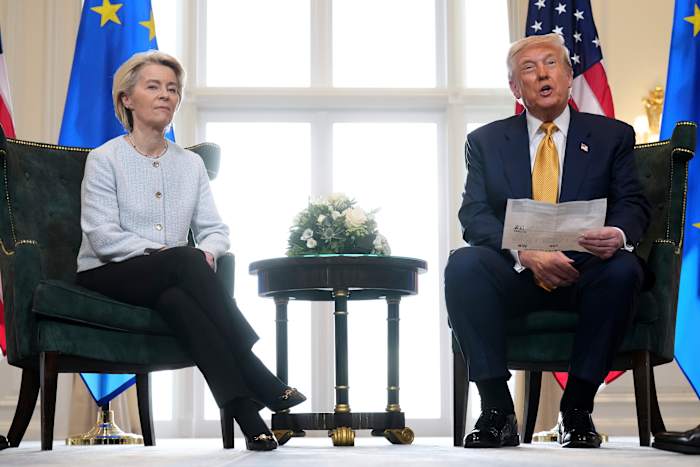
On Sunday, the U.S. and the 27-member European Union revealed they had established a trade framework agreement: the EU consented to 15% U.S. tariffs on the majority of their goods, tempering worries about a devastating trans-Atlantic trade conflict. Additionally, the EU committed to buying $750 billion in U.S. energy products and pledged $600 billion in new investments until 2028, as reported by the White House.
“We just signed a very big trade deal, the biggest of them all,” Trump said Monday.
However, there’s no certainty that Trump’s extensive revamp of U.S. trade policy will result in the beneficial outcomes he’s suggested. The framework agreement was notably lacking in specifics. Most trade agreements involve protracted negotiations that hinge on complex details and can take months or even years to finalize.
High-stakes negotiations break Trump’s way
Financial markets, at first panicked by the president’s protectionist agenda, seem to have acquiesced to a world in which U.S. import taxes — tariffs — are at the highest rates they’ve been in roughly 90 years. Several billion in new revenues from his levies on foreign goods are pouring into the U.S. Treasury and could somewhat offset the massive tax cuts he signed into law on July 4.
Outside economists say that high tariffs are still likely to raise prices for American consumers, dampen the Federal Reserve’s ability to lower interest rates and make the U.S. economy less efficient over time. Democrats say the middle class and poor will ultimately pay for the tariffs.
“It’s pretty striking that it’s seen as a sigh of relief moment,” said Daniel Hornung, a former Biden White House economic official who now holds fellowships at Housing Finance Policy Center and the Massachusetts Institute of Technology. “But if the new baseline across all trading partners is 15%, that is a meaningful drag on growth that increases recession risks, while simultaneously making it harder for the Fed to cut.”
The EU agreement came just four days after Japan also agreed to 15% U.S. tariffs and to invest in the United States. Earlier, the United States reached deals that raised tariffs on imports from Vietnam, Indonesia, the Philippines and the United Kingdom considerably from where they’d been before Trump returned to the White House.
More one-sided trade deals are likely as countries try to beat a Friday deadline after which Trump will impose even higher tariffs on countries that refuse to make concessions.
Trump’s long-held theory now faces reality
The U.S. president has long claimed that America erred by not taking advantage of its clout as the world’s biggest economy and erecting a wall of tariffs, in effect making other countries ante up for access to America’s massive consumer market.
To his closest aides, Trump’s use of tariffs has validated their trust in his skills as a negotiator and their belief that the economists who warned of downturns and inflation were wrong. Stocks dipped slightly in Monday afternoon trading, but they’ve more than recovered from the tariff-induced selloff in April.
“Where are the ‘experts’ now?” Commerce Secretary Howard Lutnick posted on X.
But the story is not over. For one thing, many of the details of Trump’s trade deals remain somewhat hazy and have not been captured in writing. The U.S. and Japan, for instance, have offered differing descriptions of Japan’s agreement to invest $550 billion in the United States.
“The trade deals do seem to count as a qualified win for Trump, with other countries giving the U.S. favorable trade terms while accepting U.S. tariffs,” said Eswar Prasad, a Cornell University economist. “However, certain terms of the deals, such as other countries’ investments in the U.S., seem more promising in the abstract than they might prove in reality over time.”
Trump is also facing a court challenge from states and businesses arguing that the president overstepped his authority by declaring national emergencies to justify the tariffs on most of the world’s economies. In May, a federal court struck down those tariffs. And an appeals court, which agreed to let the government continue collecting the tariffs for now, will hear oral arguments in the case Thursday.
And he’s yet to reach an accord with China — which has deftly used the threat of retaliatory tariffs and withholding exports of rare earth minerals that are desperately needed for electric vehicles, computer chips and wind turbines to avoid caving in to Trump’s demands. The U.S. and China are talking this week in Stockholm, Sweden.
Economists remain skeptical of the impacts for US consumers
There is also skepticism that tariffs will produce the economic boom claimed by Trump.
Analysts at Morgan Stanley said “the most likely outcome is slow growth and firm inflation,” but not a recession. After all, the 15% tariffs on the EU and Japan are a slight increase from the 10% rate that Trump began charging in April during a negotiation period.
While autos made in the EU and Japan will no longer face the 25% tariffs Trump had imposed, they will still face a 15% tax that has yet to appear in prices at U.S. dealerships. The administration has said the lack of auto price increases suggests that foreign producers are absorbing the costs, but it might ultimately just reflect the buildup of auto inventories to front-run the import taxes.
“Dealers built stocks ahead of tariff implementation, damping the immediate impact on retail prices. That cushion is starting to wear thin,” Morgan Stanley said in a separate note. “Our Japan auto analyst notes that as pre-tariff inventory clears, replacement vehicles will likely carry higher price tags.”
Economist Mary Lovely of the Peterson Institute for International Economics warned of a “slow-burn efficiency loss’’ as U.S. companies scramble to adjust to Trump’s new world. For decades, American companies have mostly paid the same tariffs – and often none at all – on imported machinery and raw materials from all over the world.
Now, as a result of Trump’s trade deals, tariffs vary by country. “U.S. firms have to change their designs and get inputs from different places based on these variable tariff rates,’’ she said. “It’s an incredible administrative burden. There’s all these things that are acting as longer-term drags on economy, but their effect will show up only slowly.’’
Mark Zandi, chief economist at Moody’s Analytics, said that the United States’ effective tariff rate has risen to 17.5% from around 2.5% at the start of the year.
“I wouldn’t take a victory lap,” Zandi said. ”The economic damage caused by the higher tariffs will mount in the coming months.”
Copyright 2025 The Associated Press. All rights reserved. This material may not be published, broadcast, rewritten or redistributed without permission.