Share this @internewscast.com
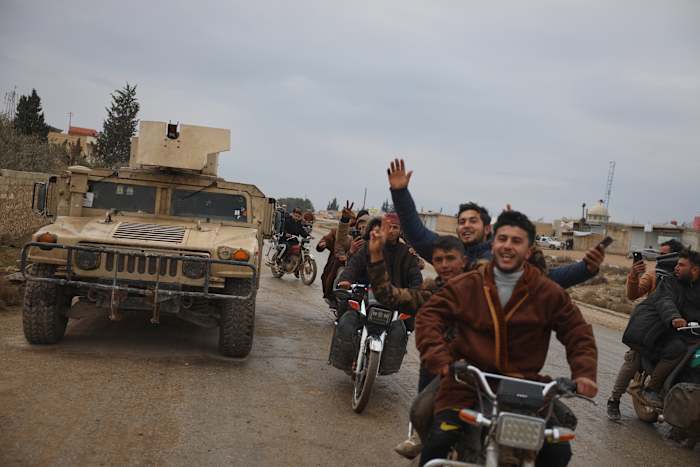
ANKARA – In recent developments, Turkey is marking significant progress in Syria, where the newly established government has successfully overpowered a prominent Kurdish-led faction through a swift military campaign.
Ankara has consistently regarded Kurdish-led armed groups as a security threat. This is due to Turkey’s ongoing struggle against the Kurdistan Workers’ Party (PKK), a group whose insurgency has spanned several decades, resulting in substantial casualties. The Kurdish population is notably concentrated in eastern Turkey, Iraq, and northern Syria.
The recent disintegration of the Kurdish-led Syrian Democratic Forces (SDF) represents a pivotal moment for Ankara, aligning with its broader regional objectives. This development follows shortly after a Kurdish militant faction in Turkey agreed to disarm, furthering Turkey’s strategic aims.
The once-formidable Kurdish group in Syria was decisively overcome by the new Syrian government.
Within a mere two-week span, the Kurdish-led SDF, formerly the primary ally of the United States in the battle against the Islamic State in Syria, saw its northern Syrian stronghold diminish significantly. This shift was driven by an offensive orchestrated by interim President Ahmad al-Sharaa.
Subsequently, the SDF was compelled to agree to a settlement that required its dissolution. The agreement stipulated that its fighters would integrate into the Syrian government’s military forces individually, following the breakdown of protracted negotiations regarding the incorporation of its troops into the evolving Syrian army.
The SDF was established a decade ago with U.S. support as a coalition of militias to fight IS. Its backbone was made up of a Syrian Kurdish armed group affiliated with the PKK.
Al-Sharaa took power after the ouster of the Assad government in December 2024, and has been consolidating authority while dealing with challenges from the remnants of pro-Assad groups as well as some former opposition groups that want to maintain autonomy from the state. In particular, minority religious and ethnic groups have viewed the Sunni Arab-led government with suspicion. Turkey has been a key backer of al‑Sharaa, providing political and military support to strengthen his government.
Washington declined to intervene on behalf of the Kurdish group, shifting its support to the nascent government and focusing on brokering a ceasefire.
Turkey played behind-the-scenes role in offensive
“The fact that the PKK-linked SDF has essentially lost its influence and territorial hold is certainly a very favorable outcome for Turkey,” said Sinan Ulgen, director of the Istanbul-based EDAM research center. “The extension of the capabilities of the new Syrian government is also another favorable outcome.”
Ulgen cautioned, however, that the Syrian government’s recent gains could prove temporary if al-Sharaa fails to stabilize the northeast of the country.
Turkish President Recep Tayyip Erdogan extended congratulations to the Syrian government in remarks to his ruling party’s legislators on Wednesday.
“From the very beginning, Turkey has strongly defended the existence of a single Syrian state,” he said. “We have repeatedly declared that we will not consent to any separatist structure along our southern borders that poses a threat to our country’s security.”
Turkey not only benefited from the developments but played a supportive role, advising the Syrian government during operations that led to the withdrawal of SDF forces from Aleppo, Turkish security officials said.
Turkey’s intelligence agency remained in contact with the Syrian administration to prevent harm to civilians and the safe evacuation of SDF members and their families, according to the officials, who spoke on condition of anonymity in line with regulations. Turkey also kept in touch with the United States, the international coalition against the Islamic State group, and other regional countries during the offensive, they said.
Decline of Kurdish group removes of a source of tension between Turkey and US
Also key to the Syrian government’s success was the willingness of the U.S. to see a former ally dismantled. Experts say the SDF counted on Washington’s support when it rejected an earlier deal proposed by al-Sharaa.
Erdogan’s warm personal ties with U.S. President Donald Trump likely helped win the U.S. President over, Ulgen said. But he added that the shift in U.S. policy was based on the White House’s assessment that its “interlocutor in Syria should be the new government and not a non-state entity.”
Israel refrains from intervening
The development also came despite tensions between Turkey and Israel over Syria.
Some SDF representatives openly called for Israeli intervention during the recent clashes, citing Israel’s past support for the Druze community during violence in Sweida province in southern Syria, but Israel also chose to stand aside.
Ulgen said a key turning point was a recent meeting between Syrian and Israeli officials in Paris, during which Syria effectively recognized Israel’s zone of influence along its southern border.
Ozgur Unluhisarcikli, an expert on Turkey at the German Marshall Fund, also said Syria and Israel reached a “tacit agreement” on the SDF during the meeting in Paris but added that the United States’ support to the Syrian government played a key role.
Boost to Turkey’s peace effort with the PKK
Turkish officials now hope that the integration of the SDF into Syrian government structures will help advance Ankara’s latest peace initiative aimed at ending the conflict with the PKK.
In May, the PKK announced that it would disarm and disband as part of reconciliation effort, following a call by its imprisoned leader, Abdullah Ocalan. The PKK staged a symbolic disarmament ceremony in northern Iraq in the summer, and later announced that it was withdrawing its remaining fighters from Turkey to Iraq.
The SDF, however, rejected pressure to follow suit, insisting that Ocalan’s call applied only to the PKK.
“Now that handicap has been eliminated” Ulgen said. The analyst however, cautioned that Ankara must still address potential frustrations among its own Kurdish population should tensions arise in Syria.
On Tuesday, Turkey’s pro-Kurdish party, warned that any violence against Kurds in Syria would undermine peace efforts in Turkey.
“At a time when we are talking about internal peace and calm, can there really be peace if Kurds are being massacred in Syria and the feelings of Kurds in Turkey are ignored?” said the party’s co-chair, Tulay Hatimogullari.
Copyright 2026 The Associated Press. All rights reserved. This material may not be published, broadcast, rewritten or redistributed without permission.