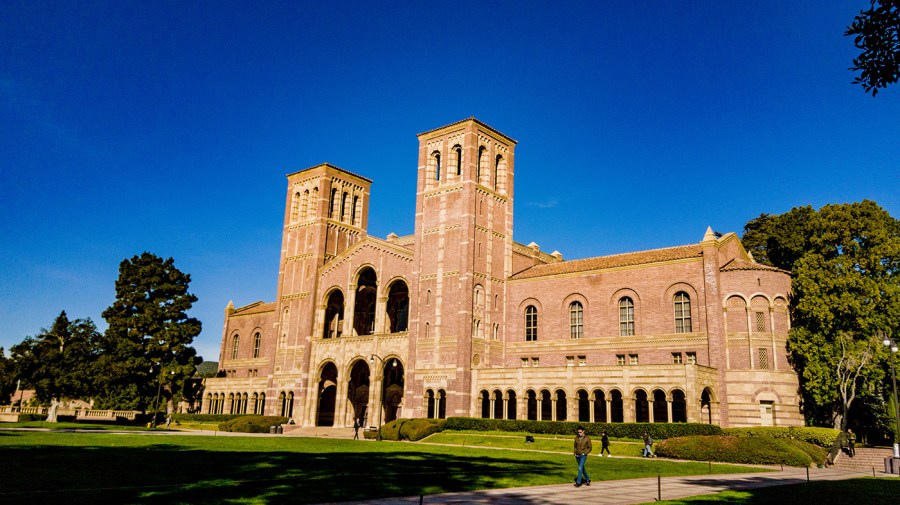


(The Hill) The faculty of the University of California scored a victory for the Los Angeles branch campus against the White House, the first win for a university individually targeted by the federal government.
A judge ordered the Trump administration to restore a portion of the more than $550 million the president paused after the federal government found the University of California, Los Angeles (UCLA) was in violation of federal civil rights law over alleged antisemitism on campus.
But the situation is unique, as other universities do not have faculty challenging the federal government’s crackdown on funding.
Jon Fansmith, senior vice president for government relations and national engagement at the American Council of Education, said in UCLA’s case, researchers sued “to protect their own research projects.”
“I wonder a little bit if you won’t see more research faculty and staff across the country looking at this and saying … ‘My grants were suspended. What relief is available to me?’ and pursue the same action,” he said.
The lawsuit between faculty in the University of California system and the Trump administration began earlier this year, when the National Science Foundation (NSF) terminated grants to the institution.
U.S. District Judge Rita Lin issued a preliminary injunction to have that funding be restored.
But when the Trump administration pulled more than $550 million from the university due to antisemitism on campus, more NSF funding was suspended from the researchers. While the federal government tried to argue these grants didn’t count in the preliminary injunction because they were suspended, not completely terminated, the judge did not go for it.
“For avoidance of doubt, the court also clarifies that grant ‘termination,’ as the term is used in the preliminary injunction, encompasses circumstances where grant funding is cut off on a long-term or indefinite basis, like the suspensions carried out by NSF on July 30,” Lin said at a court hearing, the Los Angeles Times reported.
It is the first successful case of a university clawing back funding after the Trump administration paused it over antisemitism allegations. The total amount the university will gain is unclear, ranging from tens of millions to hundreds of millions of dollars.
Claudia Polsky, director of the Environmental Law Clinic at the University of California, Berkeley and one of the plaintiffs in the suit, said she hopes this ruling has practical and political impacts on President Trump’s war with her institution and higher education writ large.
“The result is also significant in practical and political terms. As a practical matter, UCLA should have tens of millions of dollars of grant money restored almost immediately, such that its researchers can resume work,” Polsky said.
“As a political matter, this ruling comes just as UCLA is in the president’s crosshairs. We hope it will embolden campus and system leadership, given the clear illegality of the grant-cancellation tactics being employed for negotiating leverage,” she added.
The Trump administration is pressuring UCLA to pay $1 billion, along with other concessions such as handing over admissions data, in order for funding to be released and to allow the institution to apply for future grants.
Universities have been hesitant to legally challenge the Trump administration on these cuts, angering some in higher education.
Columbia and Brown universities struck deals with the administration to pay hefty sums and change policies, such as hiring and admissions procedures. Harvard University is negotiating with the Trump administration, with a potential $500 million payout, but nothing is set in stone.
Harvard is the only institution that sued the Trump administration, after the White House cut off $2.5 billion in federal money. A hearing was held on the issue at the end of July, but the judge has not issued a ruling.
Experts say the cost and time it takes to litigate the issues is one of the reasons universities and faculty are not lining up for a legal fight.
“The idea is to so overwhelm them they have to come to the negotiating table and cut a deal, because they can’t get justice in time, because even though each of those things could be sued over, and have been sued over in several of the cases like Harvard, suing takes time, getting a judge to actually assemble all the evidence, let everyone be heard, and finally issue a decision, and then perhaps go through appeal, can take half a year, a year longer, and the Trump administration’s calculation is that universities just can’t hold out that long,” said Walter Olson, senior fellow at the Robert A. Levy Center for Constitutional Studies at the Cato Institute.


