
Share this @internewscast.com

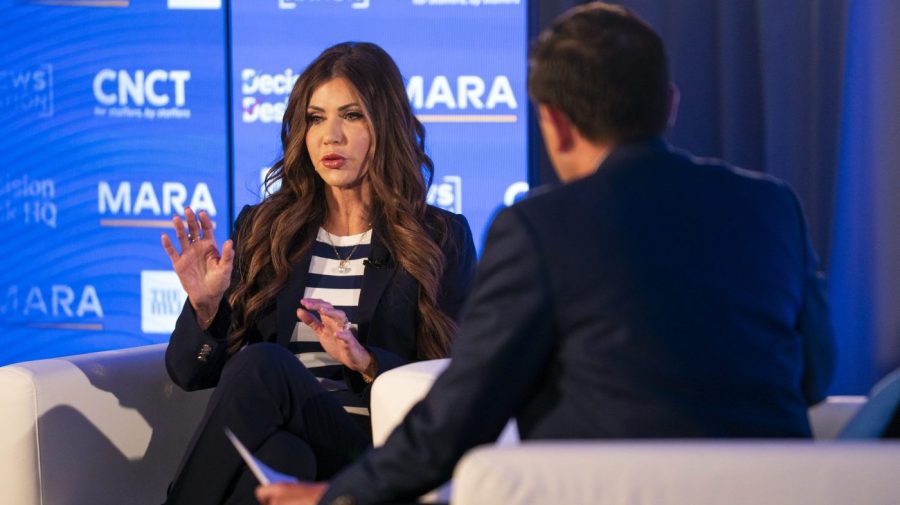
The Department of Homeland Security (DHS) has been exploring ways to lighten the Transportation Security Administration’s (TSA) rules governing airport travel, DHS Secretary Kristi Noem told host Blake Burman at the Hill Nation Summit on Wednesday.
Noem teased a potential easing of regulations on the size of liquid containers allowed through airport security in carry-ons and said the “future of an airport,” in her view, would allow travelers to essentially walk straight through security.
Noem’s remarks came shortly after the TSA announced it would allow travelers to keep their shoes on during security screening.
She claimed that since Day 1, she started “questioning everything TSA does.”
It’s not clear when new changes, if any, would be announced or what their implementation would look like.
“It’s not certainly anything we’ll be announcing in the next week or two, but we’re working to see what we can do to make the traveling experience much better and more hospitable for individuals, but also still keep safety standards,” Noem told The Hill after her appearance at the summit.
Here’s what to know about the changes to airport security the DHS might be weighing.
Considering allowing more liquid
Liquids in carry-on items are restricted to small containers of 3.4 ounces (100 milliliters) or less, generally packed together in a 1 quart plastic bag. Travelers may pack more liquids in their checked luggage.
“I will tell you I mean the liquids I’m questioning. So that may be the next big announcement is what size your liquids need to be,” Noem said at the Hill Nation Summit.
The TSA’s liquid regulations were instituted in response to a 2006 plot thwarted by British authorities to allegedly blow up a U.S.-bound plane with liquid explosives. The agency initially banned liquids and gels in carry-on bags altogether before revisiting to adopt the current size restrictions.
The liquid regulations also apply to aerosols, gels, creams and pastes ranging from shampoo to hair spray to peanut butter.
No more shoes off at the airport
A big change was announced July 8 when the TSA said it would allow travelers to keep their shoes on during security screening.
This could decrease the wait times in security lines and avoid the well-known pileup after the TSA checkpoint, where everyone is scrambling to tie their laces. However, travelers will still be asked to remove other items such as electronics or belts.
The nearly 20-year-old law was introduced because Richard Reid tried to detonate a bomb hidden in his shoe in Miami in December 2001, just after 9/11.
A TSA pilot program, however, demonstrated that new screening technology could detect threats even if individuals kept their shoes on.
“Thanks to our cutting-edge technological advancements and multi-layered security approach, we are confident we can implement this change while maintaining the highest security standards. This initiative is just one of many the Trump administration is pursuing to usher in the President’s vision for a new Golden Age of American travel,” the DHS wrote in a press release.
What is next for TSA rules?
Noem also touted the possibility of new technology that would simplify the overall process.
The DHS chief said she is “working with several different companies with technologies to give us competitive bids on what they actually do.”
The new services would be piloted in select U.S. airports and, if successful, deployed nationwide, she said.
“It is still a process that is protecting people who are traveling on our airlines. But it has to make sense. It has to actually do something to make you safer,” Noem told Burman.
She continued by criticizing the Biden administration for not seeing the changes as a priority.
“I kept wondering if we were doing things just to slow people down, or what it was, but TSA is working on the technology that we have available to us if we deploy it correctly,” Noem said.
And she sketched an ambitious view of what airport security could look like.
“The future of an airport, where I’m looking to go, is you walk in the door with your carry-on suitcase, you walk through a scanner and right to your flight. Takes you one minute,” Noem said.