
Share this @internewscast.com
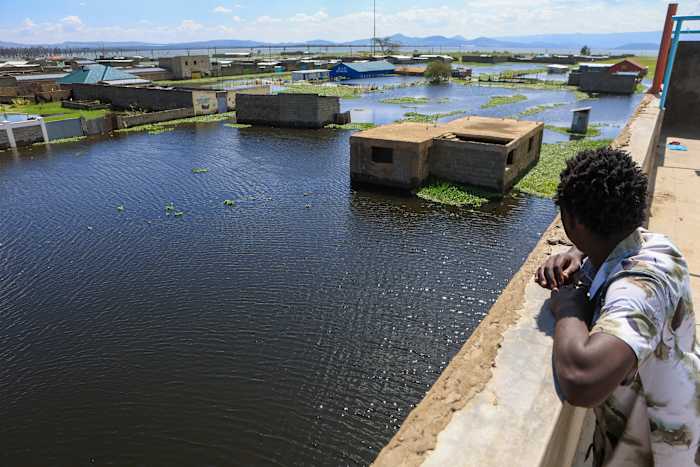
NAIVASHA – Back in 2008, Dickson Ngome began leasing a farm situated over two kilometers from Lake Naivasha’s shores in Kenya’s Rift Valley. On this 1.5-acre plot of fertile ground, he cultivated vegetables for local market sales.
At that time, concerns loomed as the lake’s waters were steadily retreating, with fears that it might eventually vanish. However, since 2011, the shoreline has been creeping closer. This year, the rains arrived unusually early in September and persisted for several months.
Late one October morning, Ngome and his family awoke to a startling sight—their home and farm were submerged under Lake Naivasha. Overnight, the lake’s water levels had surged, leaving their property under about a foot of water.
“It always felt like the lake was a safe distance from our homes,” recounted Ngome’s wife, Rose Wafula, to The Associated Press. “But one night, we were shocked to find our homes inundated. The water seemed to appear out of nowhere.”
Scientists attribute the increased rainfall to climate change.
Ngome, his wife, and their four children have been forced to evacuate their home. They are currently seeking refuge on the upper floor of a nearby abandoned school.
Some 5,000 people were displaced by the rise in Lake Naivasha’s levels this year. Some scientists attribute the higher levels to increased rains caused by climate change, although there may be other factors causing the lake’s steady rise over the past decade.
The lake is a tourism hot spot and surrounded by farms, mostly growing flowers, which have gradually been disappearing into the water as the lake levels rise.
Rising levels have not been isolated to Naivasha: Kenya’s Lake Baringo, Lake Nakuru and Lake Turkana — all in the Rift Valley — have been steadily rising for 15 years.
“The lakes have risen almost beyond the highest level they have ever reached,” said Simon Onywere, who teaches environmental planning at Kenyatta University in Kenya’s capital Nairobi.
Rising lake levels displaced tens of thousands
A study in the Journal of Hydrology last year found that lake areas in East Africa increased by 71,822 square kilometers (27,730 square miles) between 2011 and 2023. That affects a lot of people: By 2021, more than 75,000 households had been displaced across the Rift Valley, according to a study commissioned that year by the Kenyan Environment Ministry and the United Nations Development Program.
In Baringo, the submerged buildings that made headlines in 2020 and 2021 are still underwater.
“In Lake Baringo, the water rose almost 14 meters,” Onywere said. “Everything went under, completely under. Buildings will never be seen again, like the Block Hotels of Lake Baringo.”
Flower farms taking a beating
Lake Naivasha has risen steadily too, “engulfing three quarters of some flower farms,” Onywere said.
Horticulture is a major economic sector in Kenya, generating just over a billion U.S. dollars in revenue in 2024 and providing 40% of the volume of roses sold in the European Union, according to Kenya’s Ministry of Foreign Affairs.
Significant research has gone into the reasons behind the rising lakes phenomenon: A 2021 study on the rise of Kenya’s Rift Valley lakes was coauthored by Kenyan meteorologist Richard Muita, who is now acting assistant director of the Kenya Meteorological Department.
“There are researchers who come up with drivers that are geological, others with reasons like planetary factors,” Muita said. “The Kenya Meteorological Department found that the water level rises are associated with rainfall patterns and temperature changes. When the rains are plentiful, it aligns with the increase in the levels of the Rift Valley lake waters.”
Sedimentation is also a factor. “From the research I have read, there’s a lot of sediment, especially from agricultural related activities, that flows into these lakes,” says Muita.
‘A mess’ made by the government years ago
Naivasha’s official high water mark was demarcated at 1,892.8 meters (6,210 feet) above sea level by the Riparian Association in 1906, and is still used by surveyors today. That means this year’s flooding was still almost a meter (3 feet) below the high mark.
It also means that the community of Kihoto on Lake Naivasha where the Ngomes lived lies on riparian land — land that falls below the high water mark, and can only be owned by the government.
“It’s a mess established by the government … towards the late 1960s,” said Silas Wanjala, general manager of the Lake Naivasha Riparian Association, which was founded some 120 years ago and has been keeping meticulous records of the lake’s water levels since.
Back then, a farmer was given a “temporary agricultural lease” on Kihoto, said Wanjala. When it later flooded and the farmer packed up and left, the farmworkers stayed on the land and later applied for subdivisions, which were approved. In the 60-odd years since, a whole settlement has grown on land that is officially not for lease or sale.
This also isn’t the first time it’s been flooded, said Wanjala. It’s just very rare that the water comes up this high. That’s little consolation for the people who have been displaced by this year’s floods and now cannot go home without risking confrontations with hippopotamuses.
To support those people, the county is focusing its efforts on where the need is greatest.
“We are tackling this as an emergency,” says Joyce Ncece, chief officer for disaster management in Nakuru County, which oversees Lake Naivasha. “The county government has provided trucks to help families relocate. We have been helping to pay rent for those who lack the finances.”
Scientists like Onywere and Muita are hoping for longer-term solutions. “Could we have predicted this so that we could have done better infrastructure in less risk-prone areas?” Onywere said.
Muita wants to see a more concerted global effort to combat climate change, as well as local, nature-based solutions centered on Indigenous knowledge, such as “conservation agriculture, where there is very limited disturbance of the land,” to reduce sedimentation of the lakes.
But all of this is of little help to Ngome and Wafula, who are still living at the school with their children. As the rest of the world looks forward to the holidays and new year, their future is uncertain. Lake Naivasha’s continuous rise over the past 15 years does not bode well: They have no idea when, or if, their farm will ever be back on dry land.
___
For more on Africa and development: https://apnews.com/hub/africa-pulse
The Associated Press receives financial support for global health and development coverage in Africa from the Gates Foundation. The AP is solely responsible for all content. Find AP’s standards for working with philanthropies, a list of supporters and funded coverage areas at AP.org.
Copyright 2025 The Associated Press. All rights reserved. This material may not be published, broadcast, rewritten or redistributed without permission.