
Share this @internewscast.com
CAIRO – In a significant diplomatic push, American officials met Israeli Prime Minister Benjamin Netanyahu on Saturday to advocate for progression into the next stage of the ceasefire agreement that halted the conflict in Gaza.
The meeting included President Donald Trump’s envoy, Steve Witkoff, and Jared Kushner, Trump’s son-in-law and adviser on Middle East affairs, as confirmed by Netanyahu’s office. This engagement underscores the U.S. commitment to advancing the Trump-brokered peace initiative.
However, Netanyahu finds himself in a delicate position. While international pressure mounts to advance the peace process, he faces domestic calls to withhold further steps until Hamas returns the body of an Israeli hostage still held in Gaza. A critical part of this progression is the opening of the Rafah border crossing, a poignant symbol of moving into the next phase, which is eagerly anticipated by many outside of Israel.
Ali Shaath, head of a forthcoming technocratic government in Gaza, announced plans to open the Rafah crossing in both directions next week. Despite this announcement, Israel has not confirmed this action, indicating that a decision will be made in the coming week. Currently, the Israeli military controls the Gaza side of this crossing, which links Gaza with Egypt.
The family of Ran Gvili, the last hostage whose body remains in Gaza, has urged international attention to focus on Hamas. “President Trump has acknowledged that Hamas knows the location of our son,” the family stated on Saturday. “Hamas’s refusal to release our son is a blatant breach of the agreement it signed, deceiving the international community.” Their plea highlights the emotional and political complexities entangled in the ceasefire’s implementation.
Meanwhile, Egypt remains a pivotal player, pressing for the opening of the Gaza crossing as part of broader efforts to stabilize the region and facilitate humanitarian aid and movement.
Egypt’s top diplomat pressed for an immediate opening of the crossing with the director of Trump’s Board of Peace in Gaza, the Egyptian Foreign Ministry said Saturday, including the ability of Palestinians to enter and exit Gaza.
Foreign Minister Bader Abdelatty spoke by phone with Bulgarian diplomat Nickolay Mladenov, the high representative for Gaza, the ministry said in a statement. They discussed the implementation of the second phase of the October ceasefire that stopped the war, including the deployment of an international monitoring force, the opening of the Rafah crossing, and the withdrawal of Israeli forces from the strip, the statement said.
The Egyptian minister said that implementing the second phase is a “key entry point” to launch Gaza’s reconstruction.
The statement didn’t say when the crossing, a crucial part of the ceasefire deal, will open for travelers and the evacuation of sick and wounded.
An official associated with the Board of Peace, Trump’s coalition of international leaders who will oversee the Gaza ceasefire, said that he was “hopeful” the last issues concerning the opening of the Rafah crossing could be overcome in the coming days. The official spoke on the condition of anonymity because he was not authorized to speak to the media. “The idea is to move on with the next phase of the ceasefire, which includes this,” he said.
Israel did not comment on Shaath’s declaration but is expected to discuss opening the Rafah crossing during the Cabinet meeting on Sunday.
2 children killed in Gaza while searching for firewood
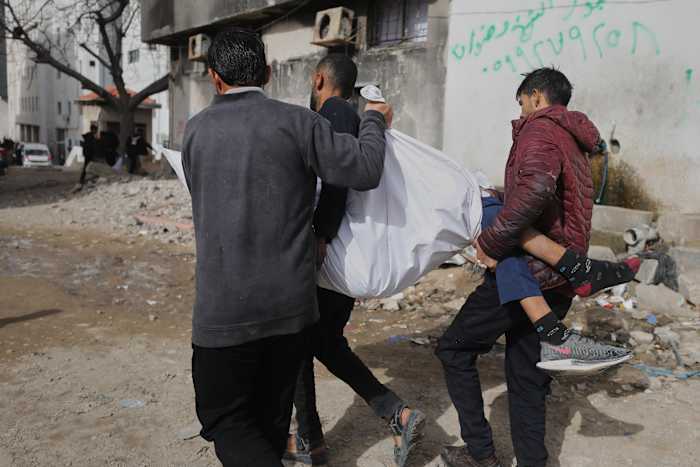
Also on Saturday, an Israeli strike killed two Palestinian children in the Gaza Strip, according to hospital authorities.
The children, aged 13 and 15, were searching for firewood, according to Shifa Hospital in Gaza City, which received the bodies.
The children were cousins and killed in the area where the Israeli military has said is safe for Palestinians, about 500 meters (yards) away the Yellow Line, which separates the Israeli-controlled areas in eastern Gaza from the rest of the strip, said their uncle Arafat al-Zawara.
“They were targeted directly, not through any fault of their own,” he told The Associated Press outside the hospital morgue.
The Israeli military said it had targeted several militants that crossed the Yellow Line and planted explosives, threatening troops. It denied that those killed were children.
Yusuf Zawara, covered in blood, desperately begged for his son, Mohamed, to wake up. “No, he is not dead,” he said as he hugged his body. “Mohamed, oh Mohamed, come on, get up.”
“They hit you with a missile. You couldn’t escape? Run, people, run! Why didn’t you run away?” he sobbed, bending over his son’s lifeless body.
Arafat al-Zawara, the uncle of the second boy who was killed, tried to wipe the blood from his nephew’s face, pleaded with him to get up so they could go get some grilled chicken wings.
The desperate search for firewood is forcing many Palestinians to approach areas close to the Israeli withdrawal line, as they search for anything that can be burned, including garbage and plastic, in order to cook and warm themselves. There’s been no central electricity in Gaza since the first few days of the war, and fuel for generators is scarce.
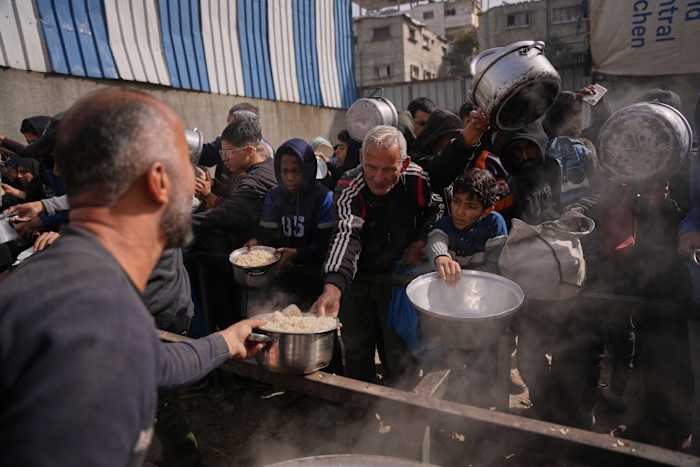
Hundreds of thousands of people are living in tent camps and war-damaged buildings in Gaza as temperatures drop below 10 degrees Celsius (50 degrees Fahrenheit) at night and storms blow in from the Mediterranean. At least nine children have died of severe cold in the past weeks, according to the Gaza Health Ministry.
Since the Oct. 10 ceasefire, more than 480 Palestinians were killed by Israeli fire, according to the ministry. The ministry, which is part of the Hamas-led government, maintains detailed casualty records that are seen as generally reliable by U.N. agencies and independent experts. Israel disputes its figures but has not provided its own. ___
Shurafa reported from Deir Al-Balah, Gaza Strip, and Lidman reported from Tel Aviv, Israel.
___
Find more of AP’s coverage at https://apnews.com/hub/israel-hamas-war
Copyright 2026 The Associated Press. All rights reserved. This material may not be published, broadcast, rewritten or redistributed without permission.