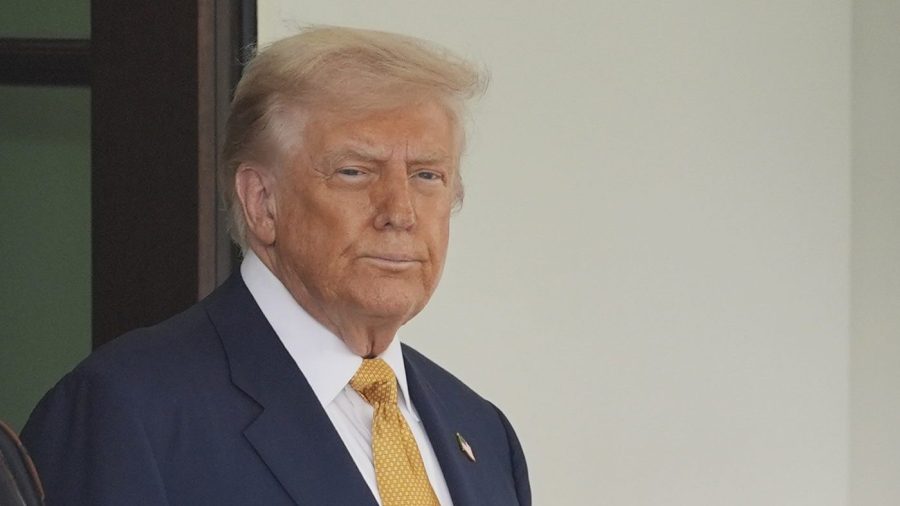


President Trump signed the first major cryptocurrency bill into law Friday, marking a key milestone for an industry that has found a crucial ally in the president.
He touted the GENIUS Act, which establishes a regulatory framework for dollar-backed digital tokens called stablecoins, as “a giant step to cement the American dominance of global finance and crypto technology.”
“This could be perhaps the greatest revolution in financial technology since the birth of the internet itself,” he said at the signing ceremony, flanked by congressional and industry leaders.
The stablecoin bill faced a lengthy and sometimes halting path to the White House.
After sailing through the Senate Banking Committee earlier this year, the GENIUS Act Guiding and Establishing National Innovation for U.S. Stablecoins ACT hit its first snag in the upper chamber in May, when a group of crypto-friendly Democrats pulled their support from the legislation and blocked a procedural vote on the floor.
Several weeks of negotiations produced an updated version of the bill that won back support from most of the crypto-friendly contingent on the left.
After initially promising an open amendment process, GOP leadership scrapped plans to move the bill via so-called regular order when several controversial amendments threatened to derail progress. The GENIUS Act ultimately passed the Senate by a 68-30 vote in late June.
Trump, who has become a key ally to the crypto industry in his second term, urged the House to quickly pass a “clean” stablecoin bill and send it to his desk.
The president’s request frustrated efforts by some in the House who had hoped to tie the GENIUS Act to a broader crypto framework, allowing the lower chamber to put its stamp on legislation and preventing additional crypto legislation from losing momentum.
House leadership ultimately opted to move the GENUIS Act to the floor alongside two other crypto bills without formally tying them together in what it labeled “crypto week.”
However, crypto week proved much more tumultuous than expected. A group of hard-line Republicans blocked a procedural vote Tuesday, bringing the House floor to a standstill and leaving the trio of crypto bills in limbo.
The key frustration for the GOP holdouts was the lack of a clear pathway into law for a measure blocking the creation of a central bank digital currency (CBDC).
One of the three bills up for consideration in the House was the Anti-CBDC Surveillance State Act, which would bar the Federal Reserve from issuing a central bank digital currency. However, the bill seems unlikely to garner enough support to clear the Senate.
Trump reached a deal with the hard-liners late Tuesday in which they agreed to support the procedural vote in exchange for adding anti-CBDC provisions to a third crypto bill the Digital Asset Market Clarity Act.
That legislation is the House’s crypto market structure bill, laying out regulatory rules of the road for the broader market by drawing bright lines between oversight by the Securities and Exchange Commission (SEC) and the Commodity Futures Trading Commission.
Trump recalled his late-night push to get the hard-liners on board at Friday’s bill signing.
“I am so tired of making phone calls at 2 ,3, 4 o’clock in the morning, getting calls from our great Speaker, ‘Sir, we have 12 hard no’s.’ I say, ‘Mike, Mike, it’s 2 o’clock in the morning,’” he said.
However, the president’s deal failed to appease all the holdouts and created new pushback from members of the House Financial Services Committee. A procedural vote remained open on the floor for more than nine hours Wednesday, breaking the record for longest House vote.
After hours of negotiations, GOP leadership reached a new deal with the various factions of the conference to add the anti-CBDC language to the National Defense Authorization Act (NDAA), boosting its chances of reaching Trump’s desk by tying it to the must-pass legislation.
The House voted 308-122 to pass the GENIUS Act on Thursday, with 102 Democrats supporting the legislation. Twelve Republicans, including several of the original hard-line group, voted against it.
The chamber also passed the Digital Asset Market Clarity Act in a 294-134 vote, while the Anti-CBDC Surveillance State Act cleared the House in a 218-210 vote Thursday.
The GENIUS Act’s signing marks a key win for the crypto industry, which has seen its circumstances improve significantly under the second Trump administration.
“This signing is a massive validation of your hard work and your pioneering spirit and your ability to never give up, because a lot of people would have given up two, three years ago,” Trump said to crypto leaders Friday.
The industry had a tenuous relationship at best with the Biden administration. Former SEC Chair Gary Gensler brought numerous enforcement actions against crypto firms, which accused him of failing to set clear rules and attempting to regulate by enforcement.
Trump embraced crypto during his 2024 campaign, despite once dismissing it as a “scam.”
After taking office, he made the industry a key priority, naming David Sacks as his artificial intelligence and crypto czar, inviting crypto leaders to the White House and signing an executive order creating a bitcoin strategic reserve and digital asset stockpile.
His administration also vowed to pass two key pieces of legislation long sought by the industry a stablecoin bill and a crypto market structure bill.
While administration officials initially sought to get both across the finish line before Congress leaves for its August recess, it became increasingly clear that only the GENIUS Act would be able to clear both chambers.
The White House and key GOP senators have since said they hope to pass crypto market structure legislation by the end of September, as the upper chamber moves at a slower pace.