
Share this @internewscast.com
Standing around 10 feet tall, weighing roughly 220 pounds, and boasting an axe-like beak capable of delivering devastating blows, the terror bird would have been a formidable adversary for most creatures.
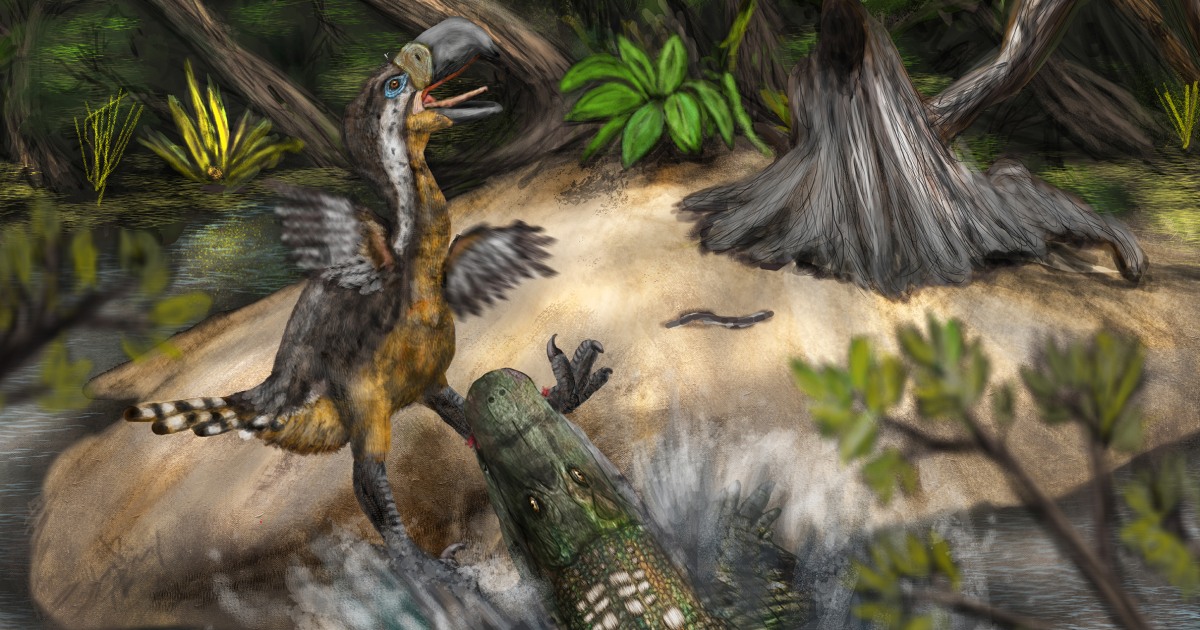
However, about 13 million years ago, one of these birds might have become the victim of an even larger predator. A team of paleontologists in Colombia uncovered this possibility after examining bite marks on a fossilized bone of one of these fearsome birds.
Their findings, published in the peer-reviewed scientific journal “Biology Letters,” suggest that the terror bird was either killed and eaten or consumed after death by scavenging, by a medium-sized caiman, a crocodile-like reptile.
“This is a fascinating story of the interaction of two very iconic animals in the past,” Andrés Link, the study’s lead author, told NBC News in an email Wednesday. “We actually found not only the first record of a terror bird in northern south America, but the tooth marks of a large caiman that has probably fed on it,” he added.
Terror bird fossils, which are rare, have mostly been identified in the southern part of the continent.
While tooth marks are “not uncommon” in the fossil record, it’s “exciting” to find evidence that indicates an apex predator being hunted or scavenged by another, said Link, an associate professor of biological sciences at the Los Andes University in Colombia.
Writing in “Biology Letters,” the team said the teeth marks showed no signs of healing, suggesting that the attack was fatal.
Based on the finding, they added that terror birds might have faced higher risk of being killed and eaten than previously expected.
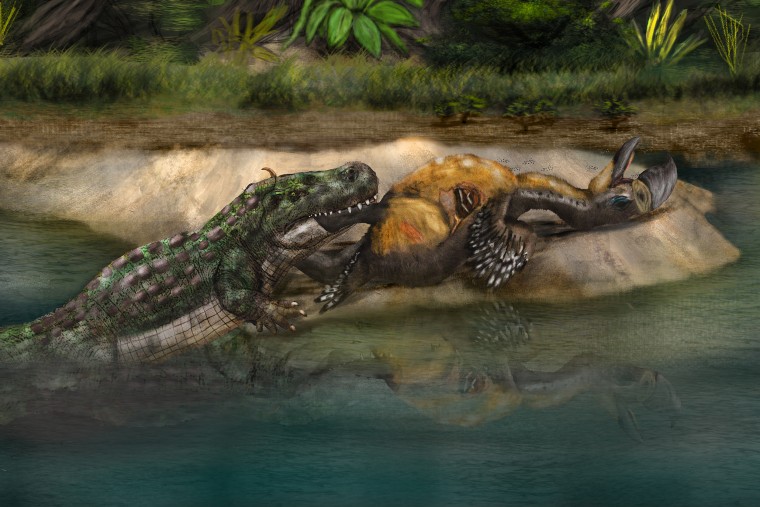
To identify the attacker, Link and his team scanned the fossil and analyzed the size, shape and spacing of the tooth marks. After comparing those marks with teeth of crocodyliforms from the region, they concluded that the trace maker was likely a juvenile caiman about 15 feet long.
It remains “very difficult” to know if the caiman ate the terror bird after killing it or whether it scavenged the carcass, Link said. If the bird was alive, it was likely attacked while drinking at a river, researchers wrote, and conversely, if it was dead, the caiman found and fed on its body near water.
“This story will not be told completely as we have no further evidence to choose between these two hypotheses.” Link said.
The discovery challenges the assumption of “a linear relation between predators feeding on herbivores feeding in plants,” he added. “The food web is really much more complex.”
The lower part of the bird’s left leg bone used in the study was unearthed in the renowned La Venta fossil beds of Colombia two decades ago by Cesar Perdomo, a local paleontologist.