
Share this @internewscast.com
The toxic cousin of a gourmet delicacy could put foodies at risk of a devastating and irreversible neurological disorder.
A true morel stands among the most luxurious and sought-after wild mushrooms, frequently highlighted in high-end dishes ranging from risotto to a delectable cream sauce over steak. Its earthy, nutty flavor paired with exclusive seasonal availability boosts its allure.
Cherished in culinary circles, morel mushrooms are rich in vitamin D, crucial for immune and brain function. They are also low in fat, making them a fitting component of a heart-healthy diet. Nonetheless, caution is necessary due to their deceptive, toxic lookalikes.
False morels have misled novice foragers while attracting true aficionados in a French Alpine village named Montchavin, celebrated for their reputed ‘rejuvenating’ qualities. However, they are from an entirely different fungi family, the Gyromitra.
False morels harbor compounds known as hydrazines, posing a threat to the nervous system. Consumption can lead to symptoms like abdominal pain and diarrhea, while severe instances may result in seizures and multi-organ failure. Gyromitrin, the mushroom’s primary toxin, is also a carcinogen.
In recent developments, scientists suspect a connection between false morels and Amyotrophic Lateral Sclerosis (ALS) in Montchavin, following a mysterious cluster of cases emerging over the past decade.
Also referred to as Lou Gehrig’s disease, or motor neuron disease in certain regions, ALS is a deadly neurological disorder that gradually leads to patient paralysis.
Montchavin has a permanent population of about 200 people, and the average global diagnosis rate of ALS is two to three diagnoses per 100,000 people annually. Yet in the last decade, there have been 16 cases reported in Montchavin, far more than what would be expected.

Over a period of about 10 years, 16 residents of a ski village in the French Alps, out of a population of 200, had ALS
If made comparable to a rate in 100,000 people per year, Montchavin’s rate would be 800 cases per 100,000 residents per year.
The search for answers was led by Dr Emmeline Lagrange, a neurologist practicing at Grenoble University Hospital, 84 miles southwest of the village. A resident of Montchavin who had been experiencing neurological issues had been referred to Lagrange, who diagnosed them with ALS.
She would later learn on a call with the patient’s referring physician in Montchavin that this was one of several ALS cases in the small mountain village.
None of the patients had a gene mutation making them more susceptible to ALS or a family history of the disease, which causes continuously worsening paralysis over time, leading to death after two to five years.
Scientists are still investigating the cause of ALS, which affects roughly 33,000 Americans.
Genetics are behind between 10 and 15 percent of cases, while the rest could be tied to environmental exposures, including toxic pollution, smoking, exposure to heavy metals like lead and mercury, and a history of head injuries.
Lagrange published an abstract summarizing her investigation into the unusual ALS cluster, which caught the eye of environmental neuroscientist Dr Peter Spencer of the Oregon Health & Science University in Portland.
Spencer is the leading proponent of a separate theory linking food to the degenerative disease.
His theory was that toxins in cycad seeds, once a staple of Guam’s Chamorro people, triggered an epidemic of Western Pacific ALS-Parkinsonism dementia (ALS-PDC).
At its peak, ALS-PDC was 50 to 100 times more common in Guam than ALS rates worldwide. In the 1950s, incidence rates reached about 200 per 100,000 among Chamorro adults.
He has investigated the link for over four decades, arguing that a compound in cycad seeds called cycasin metabolizes into a neurotoxic DNA-damaging byproduct called methylazoxymethanol (MAM).
MAM is also formed when the body metabolizes hydrazine, a volatile chemical used in rocket fuels and also found in false morels.

A true morel is a gourmet delicacy, though it must be properly cooked or could be poisonous. True morels are often featured in Michelin-starred restaurants and in high-end cuisine
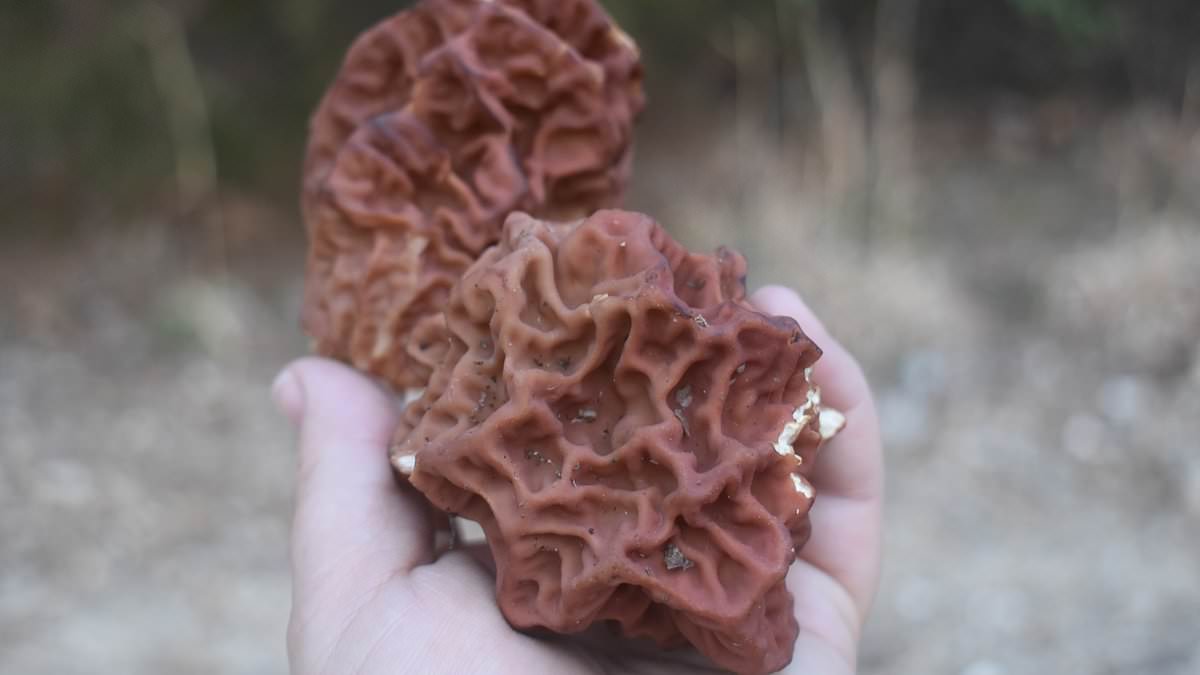
![The false morel [shown] is often reddish-brown, whereas true morels are typically green or gray. False morels are also a different shape and has brain-like folds and ridges](https://i.dailymail.co.uk/1s/2025/08/07/17/101014253-14979829-The_false_morel_shown_is_often_reddish_brown_whereas_true_morels-a-2_1754583368361.jpg)
The false morel [shown] is often reddish-brown, whereas true morels are typically green or gray. False morels are also a different shape and has brain-like folds and ridges
When Spencer saw a presentation of Lagrange’s abstract, his mind lingered on one line.
He told Knowable Magazine: ‘I noted that among the foodstuffs they reported were mushrooms.
‘And I asked them what type of mushrooms, because one particular type contains poisons associated with the Guam problem.’
They began collaborating on a study. Lagrange had learned that the ALS patients in Montchavin had been purposely seeking out false morels, believing they had rejuvenating properties, despite their illegal status.
A villager told Lagrange: ‘They are always in a group, a secret group, a social network, and they eat the mushrooms. And they all knew that it’s forbidden.’
The researchers included those patients in their study, as well as 48 villagers without the disease who ate wild mushrooms, but not false morels.
Some ALS patients had a history of collecting up to six pounds of the poisonous fungi during the spring and summer and eating them throughout the year. People who had been diagnosed with ALS had been eating the mushrooms for as long as 20 years before ALS symptoms arose.
‘All ALS cases but none of the controls had a history of consuming acutely poisonous False Morels, notably the Snow Morel Gyromitra gigas,’ Lagrange concluded.

Neuroscientist Emmeline Lagrange spearheaded the investigation into the ALS cluster in the French Alps, determining from a lengthy investigation that ALS patients shared something in common: their love for false morels
‘Since no other significant chemical or physical exposure was found, the primary risk factor for ALS in this community appears to be repeated ingestion of these neurotoxic fungi.’
Despite the false morel’s toxicity, it is a delicacy in parts of Scandinavia, where Michelin-starred restaurants incorporate it on seasonal menus for its tang and nuttiness.
The Finns are such big fans that the species was featured on a 1974 postage stamp.
False morels are also endorsed by the Finnish Food Authority, which advises people to repeatedly boil and rinse fresh or dried specimens before eating.
Despite their differences in appearance, amateur foragers often confuse true morels with false ones, which resemble a reddish brain.
A June 2024 Toxicon study identified 118 false morel poisonings in Michigan between 2002 and 2020.
Most of the patients suffered from vomiting, diarrhea, and abdominal pain, while over a dozen developed liver damage. One sustained a kidney injury, and others reported neurological effects such as headaches and dizziness.