
Share this @internewscast.com
An extraordinary discovery has been made in West Norfolk, where a fascinating collection of Iron Age artifacts, dating back 2,000 years, was unearthed. Among the treasures is a battle trumpet, which might have been used by the warriors of the legendary Boudica.
These metal relics emerged during a standard archaeological dig and have since been recognized as ‘hugely significant’ for shedding light on ancient British culture. Their significance extends beyond local history, offering insights into the broader Celtic world.
At the heart of the collection is a nearly complete Iron Age battle trumpet, known as a carnyx. This instrument, famed for its use by Celtic tribes across Europe, was designed to rally and inspire warriors as they faced the might of the Roman Empire.
The artifacts were discovered on land once inhabited by the Iceni tribe, which famously rebelled against Roman domination in 60 AD under the leadership of the warrior queen, Boudica.
In addition to the carnyx, the collection features a sheet-bronze boar’s head, likely part of a military standard, and five shield bosses, which are the rounded metal centers of shields. These items not only enrich our understanding of British history but also hold rare significance across Europe.
Experts said the finds are rare – not only in a British context, but across Europe.
‘This extraordinary find will add enormously to our understanding of the Iron Age world,’ Dr Fraser Hunter, Iron Age and Roman curator at National Museums Scotland and a leading authority on carnyces, said.
‘I’ve looked at carnyces from around Europe, and the full research and conservation of these incredibly fragile remains will reshape our view of sound and music in the Iron Age.’

A remarkable collection of Iron Age objects dating back 2,000 years has been discovered in West Norfolk. Pictured: Stacks of shield bosses covering the head of the carnyx

The near-complete Iron Age battle trumpet, also known as a carnyx, which was used by Celtic tribes across Europe to inspire their warriors in battle against the expanding Roman empire


A separate carnyx war horn that was previously put on display at the British Museum in an exhibition on Celts (left). The newly discovered carnyx (right) has been hailed as ‘hugely significant for our understanding of ancient British culture’
The battle trumpets used by Iron Age Celts were elongated, vertical, S-shaped bronze wind instruments.
They were typically two metres (6.5 feet) tall and held upright so the loud, harsh and piercing sound would project over the heads of the warriors.
Its most distinctive feature was the upward-facing bell, which was often sculpted in the shape of an open-mouthed animal’s head.
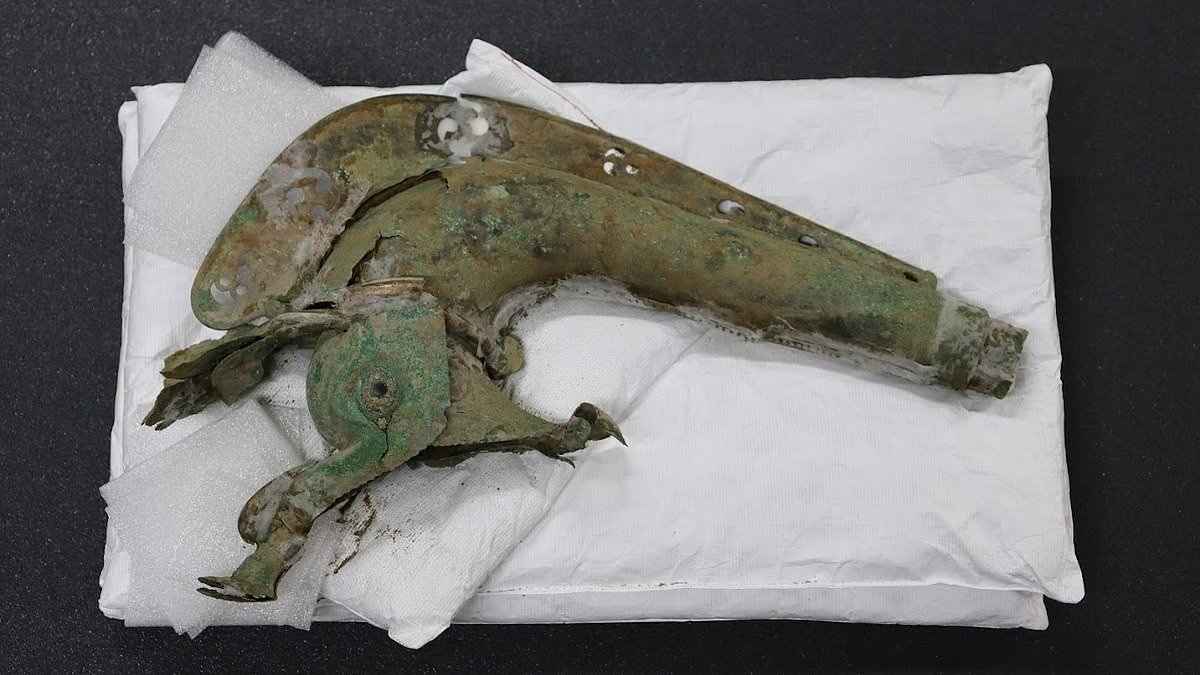
The bronze boar head was originally part of a military standard and would have been held aloft to represent a unit’s identity or rallying point during battle.
Dr Tim Pestell, Senior Curator of Archaeology for Norfolk Museums Service, said: ‘This find is a powerful reminder of Norfolk’s Iron Age past which, through the story of Boudica and the Iceni people, still retains its capacity to fascinate the British public.’
The excavation was carried out by a company called Pre-Construct Archaeology on privately owned land in West Norfolk as part of standard planning procedures.
Following their discovery, the objects were carefully lifted within a block of soil from the site and scanning revealed how the items were positioned.
Conservation experts at Norfolk Museums Service were then able to remove each object for preliminary examination. The items are in a very fragile condition and require extensive stabilisation work before detailed research can begin.

The bronze boar head was originally part of a military standard and would have been held aloft to represent a unit’s identity or rallying point during battle

The battle trumpets used by Iron Age Celts were elongated, vertical, S-shaped bronze wind instruments

Senior conservator Jonathan Clark, undertaking the micro-excavation of the hoard. This delicate process involves carefully removing the objects from the block, securing and stabilizing the fragile material, documenting both the process and the finds and ensuring that no evidence is lost
Claudia Kenyatta CBE and Emma Squire CBE, Co-CEOs of Historic England, said: ‘This remarkable discovery is hugely significant for our understanding of ancient British culture.’
As the find consists of two or more base metal prehistoric items from the same find, it has been reported to the coroner as potential Treasure under the terms of the Treasure Act 1996.
Mark Hinman, Chief Executive at Pre-Construct Archaeology, said: ‘Before this dig began our Project Manager had “a feeling” that this site would be special.
‘We are so impressed with the team responsible for this find. They discovered something completely unexpected, paused for breath, then followed best excavation practice to recover these rare and fragile objects.’
Where the objects will be housed long-term is yet to be determined.
The initial discovery will be featured on the second episode of the new series of Digging for Britain which will be broadcast on BBC Two on 14 January at 9pm.