Share this @internewscast.com
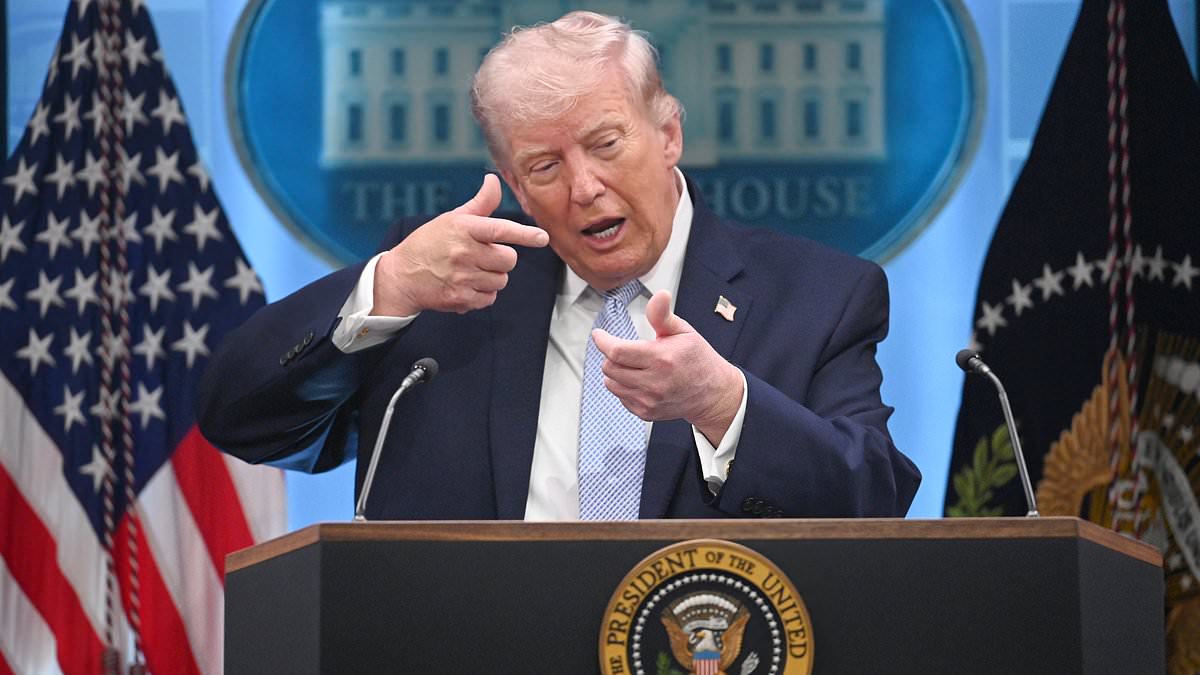
At the beginning of his presidency, Donald Trump famously dubbed himself a “genius” and went even further by declaring he was a “very stable genius,” seemingly to reassure both himself and the public.
This self-proclaimed brilliance, however, appeared to be a manifestation of his own inflated ego. Outside of his staunch supporters, known as the MAGA base, few took the claim seriously, including many of his own voters.
The idea of “stability” has also come into question, especially given his recent behavior. This week alone, Trump’s actions have been as erratic as ever, marked by sudden shifts in policy that have left many observers bewildered.
For instance, on Tuesday morning, Trump issued a bold threat to devastate Iran and send the nation back to the Stone Age. Yet, by that evening, he had shifted dramatically, praising a two-week ceasefire with Iran as the dawn of a “new Golden Age for the Middle East.”
Such abrupt reversals have raised concerns among White House insiders, with some questioning his mental acuity.
What catalyzed this significant change in Trump’s stance on Tuesday? The reality is, there was little to justify the shift. Trump suddenly embraced a ten-point “peace plan” proposed by Tehran, touting it as a “workable basis on which to negotiate.”
But this plan had been available before he threatened civilisational destruction. Neither, if you take the trouble to read it, can it be regarded as a credible basis for peace.
It’s no more than the familiar Iranian wish list of demands: an end to economic sanctions; the withdrawal of all US forces and closure of all US bases in the region; continued Iranian control over the Strait of Hormuz; no more attacks on Iran’s terrorist proxies (like Hamas and Hezbollah); reparations for all the damage Trump’s War has inflicted on Iran; and the freedom to continue enriching uranium for its nuclear programme (which, interestingly, appears only in the Farsi version of the plan).

Donald Trump knows America has no stomach for another Middle East land war, especially if led by a President elected on a promise never to wage one
No US president could agree to any of that – not even Trump at his most deranged. Of course, it’s just the starting point for negotiations.
But the gulf between Iran’s demands and America’s own 15-point peace proposal (which is the antithesis of everything in the Iran plan) is a chasm so enormous it has no chance of being bridged in the course of a two-week ceasefire.
Indeed, even two years might not be enough. The Iranians are masters at spinning out talks. It took President Obama two-and-a-half years to conclude a deal with Tehran in 2015, and that was largely confined to Iran’s nuclear enrichment programme.
Yet Trump insists Iran’s ten-point plan is a ‘workable basis’ for peace.
In fact, it’s his escape route from a war most of those around him wish he hadn’t started and from which he has struggled to find an acceptable exit. He is faced with no good options.
Behind the bluster and bravado of claiming ‘total and complete victory – one hundred per cent – no question about it’ this is his least worst option.
Trump knows that America has no stomach for another Middle East land war, especially if led by a President elected on a promise never to wage one. He admitted as much this week when he said his preference was to seize Iran’s oil – as he had Venezuela’s – but he realised the American public wouldn’t wear it.
So, the current two-week ceasefire will doubtless be extended – and extended again after that. That’s if it last two weeks. As I write there are numerous reports of continued hostilities, with some saying it could quickly fall apart.
But the ceasefire is popular with Americans. Trump will come under pressure to make it permanent.
With Republican control of the House and Senate at stake in November’s crucial mid-term elections, Trump is likely to oblige.
Talks, scheduled to start on Friday, will drift on. There will be reports of ‘progress’ but ‘much still dividing the parties’. Both sides will have an incentive to play it long – Iran because it’s in the driving seat and that’s how the Iranians operate, the President because he’s counting on America, with its notoriously short attention span, to be too bored to notice what a disaster Trump’s War has been.

Pete Hegseth, Trump’s blowhard defence secretary, yesterday claimed that the US-Israeli attacks on Iran had been so devastating the regime had begged for peace
Disaster is not too strong a word. Regime change was one of Trump’s original war aims.
Now he will settle for a peace which doesn’t just leave a militaristic-theocratic dictatorship in place, but one that is even more extreme than before the war began. Revolutionary Guard hardliners are calling the shots, sidelining even the mullahs.
Trump is dealing with a regime that, only five weeks ago, he urged the Iranian people to overthrow – assuring them he’d be alongside to help. Now a cowed and repressed people braces itself for even more brutality. They will be in no mood to trust Trump again.
Denying Iran the ability to develop a nuclear arsenal was another war aim, even cited as the casus belli of the war in the run up to hostilities in late February. But Iran’s nuclear stockpile remains in place, including almost 1,000lb of near-bomb-grade material to be further enriched.
Trump insists Iran will not be allowed to hold on to its enriched uranium. But it is not clear how he can enforce that.
And now Iran has something more valuable than the Bomb: control of the Strait of Hormuz, which it did not have before war broke out. This gives it something of a stranglehold on the global economy, since not just Gulf oil and gas but essential petrochemicals by-products – from fertilisers for farming to helium for making microchips – pass through it.
Iran has given no indication it is ready to surrender this new economic weapon in peace talks.
It already operates a tiered system in which ships carrying stuff to and from Iran are given free passage, the ships of ‘friendly’ nations are charged $1 million each and those of ‘unfriendly’ countries are denied passage.
Yesterday Iran issued a warning to the 800 or so ships currently trapped in the Gulf and anxious to leave with their precious cargoes: ‘You must receive permission from Iranian Sepah navy [the naval wing of the Revolutionary Guard] for passing through the Strait. Any vessel that tries to transit without permission will be destroyed.’
Ships with Iran’s blessing now sail a transit corridor between two Iranian islands to the north of the regular shipping seaway that runs through the middle of the Strait.
They then hug the Iranian coast before heading out into the Gulf of Oman. This gives Iran control throughout the passage. Shipping operators have already designated it the Tehran Toll Booth.
Trump has veered from saying the Strait must be opened as it was before and arguing it’s up to European and Asian countries to do the job, since they depend on it much more than America.
Yet it’s not clear that anybody bar America has the military power to open the Strait. Indeed, it’s not even certain America could do it.
The Strait of Hormuz in Iranian hands is pretty much the worst nightmare of the Arab states on the other side of the Gulf from Iran. It gives Tehran the whip hand over the vast bulk of their exports, which they need to sell to keep their regimes stable. And for every day there’s uncertainty over who can and can’t use the Strait, the global economy is in more trouble.
Even if the ceasefire holds and the Strait gradually opens up, we are in for a pretty grim spring and summer.
Yesterday, Pete Hegseth, Trump’s blowhard defence secretary, claimed that the US-Israeli attacks on Iran had been so devastating that the Iranian regime had begged for peace.
There is no question the regime and its resources have taken a terrible pounding. But this is propaganda more befitting a dictatorship than a great democratic republic like America.
Hegseth did not explain why, if the regime was so degraded, it was still standing.
Or why, if it was on its knees, the US wasn’t insisting on ‘unconditional surrender’, as Trump did four weeks ago. Or why, despite US claims that Iran’s military was in ruins, it was still capable of launching on US and Gulf state targets between 15 and 30 ballistic missiles a day and 50 to 100 attack drones a day – plus take down two US planes. All that and control of the Strait, too.
Iran told the peace talk mediators it still had 15,000 missiles and 45,000 drones. That is likely to be an exaggeration.
But the idea its arsenals are empty is clearly nonsense.
Yesterday an Iranian drone hit the Saudi’s east-west oil pipeline to the Red Sea, built to circumvent the Strait.

There will be growing demands to explain who got America into this mess. There is only one answer: President Trump. But Israeli Prime Minister Benjamin Netanyahu played a pivotal role in convincing him
More credible than the Trump-Hegseth claims that Iran is a vanquished nation desperate to sue for peace is the unpalatable prospect that the tyrants of Tehran will emerge from Trump’s War with the regime’s power enhanced, at home and abroad.
More repressive than ever, a more important player on the world stage, more dominant over the Gulf states, thanks to its grip on the Strait – especially now it has demonstrated what these states long feared: that it has the power to undermine their safe haven status and economic success with missiles and drones.
Such an outcome looked inconceivable when Trump’s War began under six weeks ago. Now it is all too possible.
If and when this grim reality dawns on Americans, there will be growing demands to explain who got America into this mess. There is only one answer: President Trump.
But he was not entirely on his own. Israeli Prime Minister Benjamin Netanyahu played a pivotal role in convincing him. At a seminal meeting in the White House situation room on February 11, Netanyahu marshalled the latest intelligence findings of Israel’s formidable spy agency, Mossad, to brief the President and his most senior advisers.
The Iranian regime could be decapitated, the Israelis argued, in joint US-Israeli airstrikes. Further destruction of regime assets would encourage the people to rise up, provoking regime change.
All this could be done quickly and decisively, before Iran could close the Strait of Hormuz or attack its Gulf neighbours.
As intelligence went, it was up there in terms of unreliability with Iraq’s non-existent weapons of mass destruction in 2003.

Trump has always been particularly concerned that the Iranian regime was out to kill him after, in 2020, he had sanctioned the assassination of Qasem Soleimani, pictured, perhaps the second most important Iranian after the Supreme Leader
Not all the Americans present were fooled. The head of the CIA called it ‘farcical’. Secretary of State Marco Rubio was blunter: he dismissed it as ‘b*******’.
But Trump was minded to go along with Netanyahu. He was buoyed by last June’s US bombing of Iran’s nuclear facilities and the kidnapping of Venezuelan dictator Nicolas Maduro in early January.
That had resulted in regime change of a sort and given the US access to Venezuelan oil, which Trump craved. He saw the chance for a repeat in Iran.
The clincher came when his son-in-law, Jared Kushner, and a crony from his property developer days, Steve Witkoff, whom Trump had tasked to negotiate with the Iranians, reported that there was no prospect of a deal with Tehran in the offing.
That tilted Trump in favour of war, even though it meant listening to two of those closest to him who were least experienced in Middle Eastern matters.
But for Trump it was also personal: he has always been particularly concerned that the Iranian regime was out to kill him after, in 2020, he had sanctioned the assassination of Qasem Soleimani, the head of the Revolutionary Guard’s foreign legion and perhaps the second most important Iranian after the Supreme Leader.
For Trump, attacking Iran was for his own good as well as America’s. Now, as it looks like unravelling, the rest of us will have to live with the consequences.
The best he can hope is to restore the way things were before the war – the status quo ante. But even that looks unattainable.
What Trump described as his ‘little excursion’ has all the hallmarks of being the disastrous defining act of his presidency – one that will haunt him for the rest of his time in the White House and undermine his reputation for long thereafter.