
Share this @internewscast.com
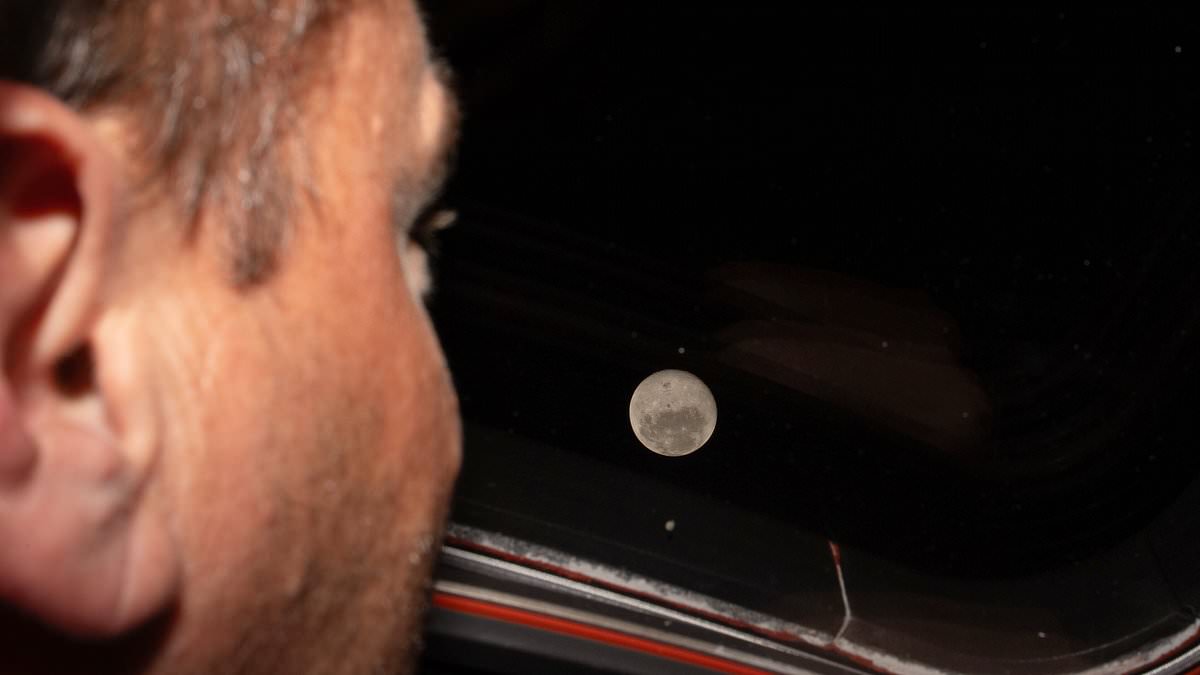
The Artemis II team has embarked on a groundbreaking journey, venturing to the moon’s far side—a view unseen by human eyes for over fifty years.
This six-hour mission signifies NASA’s return to lunar orbit, a feat not accomplished since the days of Apollo. The crew comprises astronauts Reid Wiseman, Victor Glover, Christina Koch, and Canadian astronaut Jeremy Hansen.
This landmark event follows the crew’s remarkable achievement of surpassing the Apollo 13 mission’s distance record. They traveled 252,757 miles from Earth at 1:57 PM ET, setting a new benchmark for human space travel.
Apollo 13’s record had stood since its dramatic mission in 1970 when it reached 248,655 miles from our planet during its emergency return.
While traversing the moon’s hidden hemisphere, the astronauts observed intriguing geometric patterns, winding formations they referred to as ‘squiggles,’ and unexpected hues of green and brown across the rugged terrain.
The moon’s far side, always facing away from Earth, is distinct from the near side, characterized by its heavily cratered surface, a denser crust, and a scarcity of the dark volcanic plains familiar from Earth.
The astronauts have spotted newer craters on the lunar surface, which are standing out like tiny holes in a lampshade. Koch told the NASA control room as the Artemis II crew conducted its flyby of the moon.
‘All the really bright, new craters, some of them are super tiny, most of them are pretty small, there’s a couple that really stand out, obviously, and what it really looks like is a lampshade with tiny pinprick holes and the light shining through,’ she said.

The Artemis II crew has begun a historic flyby of the moon’s far side, marking the first time humans have witnessed the hidden hemisphere in more than five decades

Each of the crew members are tasked with looking out a window of the capsule and reporting back what they see on the moon
Glover has been relaying what the team has witnessed from the windows, telling Mission Control that they are seeing ‘an island of terrain completely surrounded by darkness.’
‘Up to the north, there is a very nice double crater. It looks like a snowman just sitting there,’ he continued.
‘On the southern edge, there is a hole. Just blackness and a wall of brightness. It looks like there is a gigantic hole right there.’
The Artemis II milestones are just several historic moments on Monday, as the astronauts will also be just 4,070 miles from the lunar surface.
Later in the mission, the crew is also set to witness a rare solar eclipse from lunar orbit, beginning at 8.35pm ET and lasting roughly one hour.
Capsule Communicator Jenni Gibbons radioed to the Artemis II crew from Mission Control: ‘On April 15, 1970, during the Apollo 13 mission, three explorers set the record for the farthest distance humans have ever traveled from our home planet.
‘At that time, over 55 years ago, Lovell, Swigert and Haise flew 248,655 statute miles away from Earth. Today, for all humanity, you’re pushing beyond that frontier.’
NASA Flight Director Brandon Lloyd and others also marked the milestone by emailing the crew with ‘the longest person-to-person message ever sent in human history.’
Wiseman’s family watched the historic moment unfold from the viewing gallery on the ground.

Reid Wiseman’s family watched the historic moment unfold from the viewing gallery on the ground. When mission control told him his two daughters were smiling as they saw their dad on a big screen, the commander responded by forming his hands into a heart

Reid Wiseman, commander of Artemis II, is a single parent to his daughters Ellie and Katherine. They lost their mother, Carroll, in 2020 to cancer

Weisman lost his wife Carroll (left) to cancer in 2020
When mission control told him his two daughters were smiling as they saw their dad on a big screen, the commander responded by forming his hands into a heart, a quiet sign of love sent across more than 250,000 miles of space.
Weisman then radioed to NASA’s Mission Control: ‘From the cabin of Integrity, as we surpass the farthest distance humans have ever traveled from planet Earth, we do so in honor of the extraordinary efforts and achievements of those who came before us in human space exploration.
‘We will continue our journey even farther before Mother Earth succeeds in pulling us back to everything we hold dear, but we must use this moment to challenge this generation and the next to ensure this record is not long-lived.’
Moments after breaking the Apollo record, Hansen got on the radio to announce two newly named craters.
One crater was named ‘Integrity,’ after the Orion capsule used by the crew during the historic mission.
‘If you were to look at Orientale on the far side and then draw a line straight up to Ohm on the far side, relatively in the middle is an unnamed crater, and we would like to suggest it be called Integrity,’ Hansen said.

The crew embraced each other after Hansen told Mission Control about the new crater named Carroll after Wiseman’s wife, who passed away in 2020
But the most emotional moment came when Hansen revealed the name of a second crater. ‘It’s a bright spot on the Moon, and we would like to call it Carroll,’ he said.
Wiseman and Koch could be seen wiping away tears.
The announcement prompted the astronauts to embrace, while mission control in Houston fell silent in a rare moment of reflection.