
Share this @internewscast.com
Last summer, the prevailing thought among foreign policy experts on both sides of the Atlantic was that any military action by President Trump against Iran’s nuclear facilities would only serve to strengthen the country’s faltering regime. However, as is often the case, these predictions proved to be incorrect.
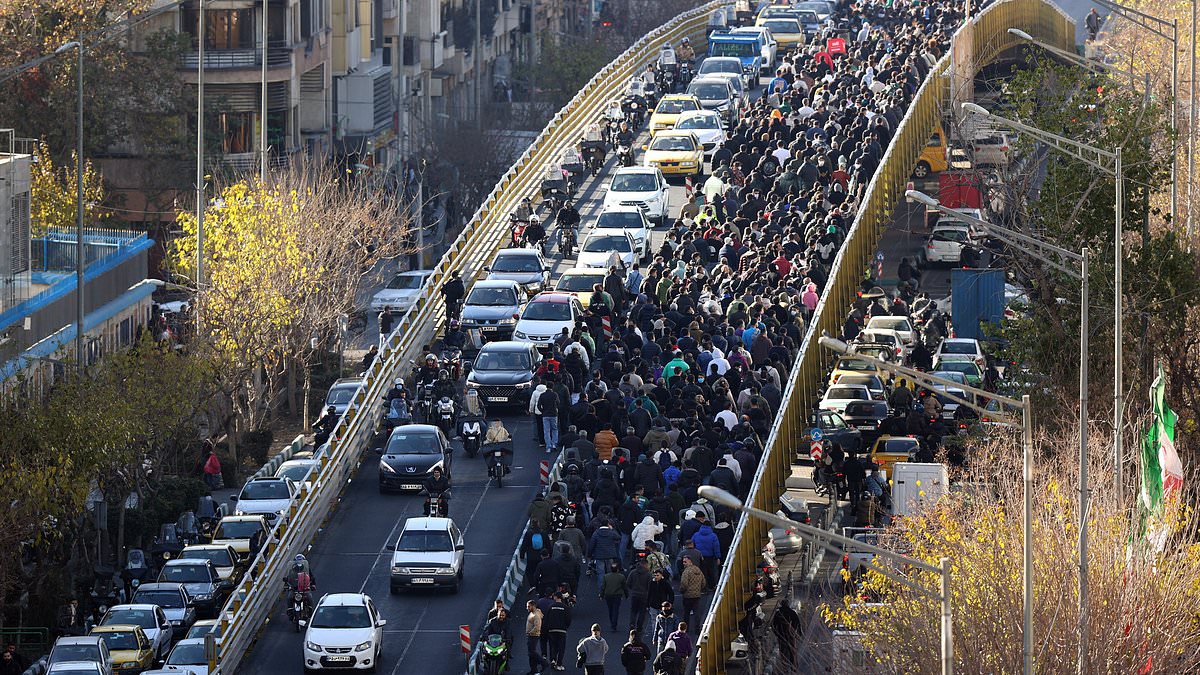
Defying these expectations, Trump proceeded with the bombing of Iran. The result? As the new year dawns, Iran is engulfed in widespread anti-regime protests across more than 30 major cities, with participation from a diverse cross-section of society, including shopkeepers and students.
Now, the global diplomatic community is cautiously suggesting that, similar to past uprisings, this latest wave of unrest may also fail to dismantle the regime. They predict it will eventually fizzle out under the regime’s harsh crackdown.
There is a possibility that this assessment is accurate. Initially, the regime responded to the protests with a cautious approach, but as the demonstrations intensified, they reverted to their usual tactic of violent suppression.
On the sixth day of protests, seven fatalities were reported as riot police opened fire on demonstrators, and security forces conducted sweeping arrests.
The Basij, a group of state-sanctioned enforcers, are patrolling the streets on motorbikes. In a display reminiscent of historical acts of defiance, one viral video captured a young man crouched defiantly in front of this two-wheeled militia, refusing to budge. This scene echoed the iconic image of an anonymous protester who stood resolutely before a column of tanks during the 1989 Tiananmen Square protests in Beijing.
You have to be extraordinarily brave to defy an evil regime of medieval mullahs and cruel military men whose brutality knows no bounds. But there does seem to be a lot of courageous Iranians prepared to do just that, despite the risks.
Since Trump bombed Iran’s nuclear facilities and Israel humiliated the regime by taking control of the country’s skies while assassinating its leaders almost at will, more than 20,000 suspected dissidents have been arrested and up to 2,000 summarily executed, usually in secret (500 since November 1).

Iranian shopkeepers and traders protesting against the country’s dire economic conditions

A demonstrator sitting on a road despite the presence of the notorious motorbike militia
There’s also been a suspicious spike in prison suicides. So it’s perfectly possible the current uprising will be brutally put down like its predecessors.
But maybe, just maybe, this time it will be different.
The last regime-threatening protests broke out in September 2022 after Mahsa Amini, a young Kurdish woman, was beaten to death in custody by Iran’s so-called morality police for not covering her head with a hijab. Widespread outrage turned into nationwide protests during which more than 500 were killed before the unrest ran out of steam.
Back then, those who took to the streets were driven by social and cultural issues – the barbaric treatment of women, widespread repression, an increasingly remote and corrupt religious-military elite.
This time economic grievances are to the fore, which is much more dangerous for the regime because it means the protests are likely to be more broad-based.
They’ve already spread like wildfire – the escalation far faster than during previous unrest.
Residents report a heavily armed military presence on streets across the country, road blocks and regular clashes with protesters, some attacking government buildings.
By the end of the week there were even anti-regime demonstrations in Qom, perhaps Iran’s holiest city and hitherto a regime stronghold.

Police opening fire on protesters in Lordegan. Tensions are incredibly high in Iran at present
This latest round of protests began with shopkeepers and merchants in Tehran’s Grand Bazaar last Sunday rebelling against soaring prices and widespread shortages of even the most basic necessities of life, including cooking oil and rice – an essential ingredient for Iranian kitchens. By last October food prices had risen on average 64 per cent compared with a year ago, according to the World Bank.
Across the world, only war-torn South Sudan has suffered higher food inflation.
Students quickly joined in, followed by lorry drivers, bus drivers and other workers shouting ‘Death to the Dictator’ (a reference to the Supreme Leader, Ayatollah Khamenei). They carried placards saying ‘Neither Gaza nor Lebanon. I give my life to Iran’ (a protest against the regime’s fierce hostility to Israel, a hatred most Iranians don’t share, and expensive support for anti-Israeli proxies like Hamas and Hezbollah).
The Iranian economy is a basket case. Daily life is made intolerable by growing water shortages, interminable power cuts (in a country with massive oil and gas reserves), suffocating smog in the major cities and a collapsing currency. You now need 1.45 million Iranian rial to buy one US dollar (yes, 1.45 millon, that is not a typo). Iran’s currency is – literally – worth less than confetti.
Per capita incomes have fallen 20 per cent in the 2020s and more than a third of the population now lives below the poverty line, which is set at only $400 a month. Teachers these days earn a mere $250 a month, a fraction of their salaries before the mullahs seized power in 1979.
So the professional middle classes are starting to suffer as much as blue-collar workers — another danger for the regime because most revolutions are led by the bourgeoisie. Yet amid the pauperisation of the population, the officer class of the Iranian Revolutionary Guard Corps (IRGC), the military wing of Iran’s ruling theocracy, lives the life of Riley.
The generals handsomely line their own pockets from a sprawling IRGC-run business empire, whose tentacles spread across the land, and numerous lucrative smuggling ventures to boot.
They even impose tariffs on basic necessities, which Iran increasingly has to import, so that the stuff they sell is more profitable. The stench of high-level corruption is everywhere in Iran. A country of enterprising, educated people with a long and impressive history and culture is effectively being run by a kleptocracy.
The new president, Masoud Pezeshkian, talks vaguely of dialogue with the protesters. Western media regularly bigs up his supposedly ‘reformist’ credentials. They’re overblown.
But even if they weren’t it wouldn’t matter. Power lies not with the president but with the mullahs and the IRGC.
Nor is the Supreme Leader in a position to do anything about the people’s plight, even if he was minded. Khamenei is 86, frail, partially paralysed. When Israel and America attacked the country last summer he hid deep in a bunker. The IRGC, though discredited by the impunity with which its enemies could attack Iran, used Khamenei’s invisibility to increase its own power.
It looks as if the IRGC has even thwarted Khamenei’s plan to have his son succeed him. But the fact there is no clear line of succession is yet another vulnerability for a regime for whom circumstances are already perilous enough.
There is no way out for the mullahs and the military bar more repression. The economy is too far gone for any possible reforms to make much of a difference for the foreseeable future. The president has admitted as much.
Indeed, if America tightened the sanctions screw it could tilt the economy over the edge – and regime change might even become a reality.
Iran still manages to produce 3.25 million barrels of oil a day, despite all its economic woes (though it was six million under the Shah, pre-1979), and manages to export about two million barrels daily, much of it to China, despite supposedly tough sanctions. So much for American promises of ‘maximum pressure’ on Iran.
Oil remains by far the regime’s main source of revenue. Without it, the government could not buy off all those it needs to maintain its grip on power, such as the officers it needs to stay loyal and the troops it needs to stay in line.
On Friday, Trump warned that America was ‘locked and loaded and ready to go’ should Iranian security forces continue to kill demonstrators. It is not clear what this means. The people of Iran don’t need or want US military intervention. They need a different kind of helping hand to remove the regime.
At a time when it looks increasingly vulnerable, Trump should go in for the kill, not with bombs or troops but with ruthless sanctions on Iranian oil exports, coupled with disruptive Israeli action on the ground. I have no doubt Israeli intelligence is already there ready to stir things up and make life even more uncomfortable for the mullahs and the generals, when the situation demands. It seems to have penetrated much of the regime’s power centres as it is.
One week into these latest protests and it cannot be said there is any sign of imminent regime collapse. On the other hand, there is no sign of the unrest abating. Last night some of the protests had turned into rioting, with cars overturned and police stations and other official buildings on fire. A dictatorship always looks stable and solid – until it’s not.
Some think the Iranian regime has the ability to reform itself. They take comfort from a little liberalisation before the current demonstrations. The wearing of the hijab, for example, is being less rigorously enforced outside government buildings. But in its way, that’s just another risk for the regime. Despotic governments are often at their most vulnerable when they loosen up a little. It merely whets the appetites of the repressed for more freedom.
Tyranny may yet still win the day in Tehran. The IRGC commands formidable resources for internal repression. But the current protests have as good a chance as any – and perhaps better than most – of producing political change for the better.
And even if that is thwarted yet again, I’m in no doubt it is only a matter of time before the Iranian people emerge from their current subjection into a freer and more prosperous state.
That is to be wished not just for the sake of Iranians or even for the wider cause of peace in the Middle East. The whole world would be a better place with an Iran which concentrated on improving the condition of its people, who have so much promise and just need the opportunity to realise it, rather than building nuclear bombs or rebuilding its arsenal of ballistic missiles or trying to wipe out Israel.
Last year Iran’s international reputation hit rock bottom as the combined power of America and Israel struck it with impunity, and the proxies through which it waged war and spread mayhem in the Middle East were brought low.
Let us hope 2026 is the year things start to go right for the Iranian people inside their own borders — and with a little help from their friends, it just might.