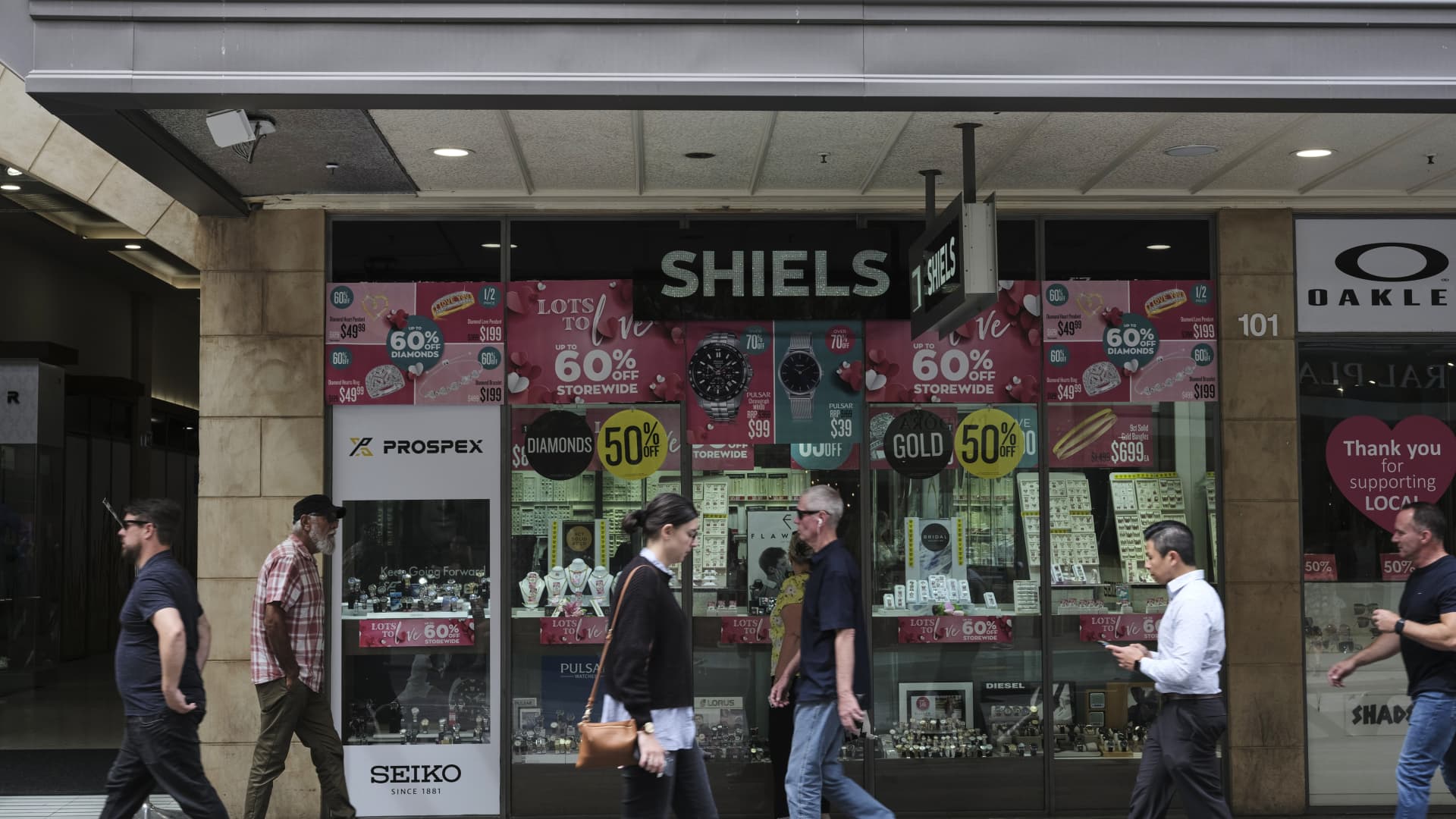
Shoppers and pedestrians walk past a Shiels store at Rundle Mall in Adelaide, Australia, on Thursday, Feb. 11, 2021.
James Bugg | Bloomberg | Getty Images
Australia’s first-quarter inflation rose 2.4% compared to the same period last year, staying at a four-year low.
This was higher than the Reuters expectations of a 2.3% climb, and unchanged from the 2.4% rise in the previous quarter.
Data from the Australian Bureau of Statistics said that the most significant price rises this quarter were in housing, education, as well as food and non-alcoholic beverages.
This was partially offset by falls in the prices of recreation and culture activities, as well as furnishings, household equipment and services.
Inflation in the country has largely been softening after hitting a multi-year high of 7.8% since the quarter ended December 2022, with the headline inflation rate declining for seven of the nine quarters since then.
The declining inflation has also afforded the Reserve Bank of Australia room to cut rates to 4.1% from 4.35%, which was its highest level since December 2011.
For 2025, growth in Australia’s economy is expected to pick up and the labor market will remain strong, the RBA said, but also added that “it is unclear what will happen globally.”
Sean Langcake, head of macroeconomic forecasting at Oxford Economics, noted after the CPI release that “underlying inflation measures paint a better picture, with trimmed-mean inflation falling back to within the RBA’s target range.”
Trimmed mean inflation, which excludes extreme price changes in consumer goods and services, rose 0.7% on a quarter-on-quarter basis and 2.9% on an annual basis. The RBA has an inflation target range of 2%-3%.
“With underlying inflation within the RBA’s target range, the Bank has greater scope to help support the economy through this coming shock,” Langcake pointed out.
He projected a 25-basis point cut in May, and two more cuts in the second half of the year.
In an April 22 note, Commonwealth Bank of Australia senior economist Stephen Wu projected that
The release also comes as Australia gears up for an election on May 3, with all 150 seats in the lower House of Representatives, and 40 of the 76 seats in the country’s Senate up for grabs.
Reuters, citing Newspoll, reported on April 28 that the Labor Party, led by current Prime Minister Anthony Albanese, currently holds a four-point lead over the conservative Liberal-National opposition when votes from smaller parties are redistributed.