
Share this @internewscast.com
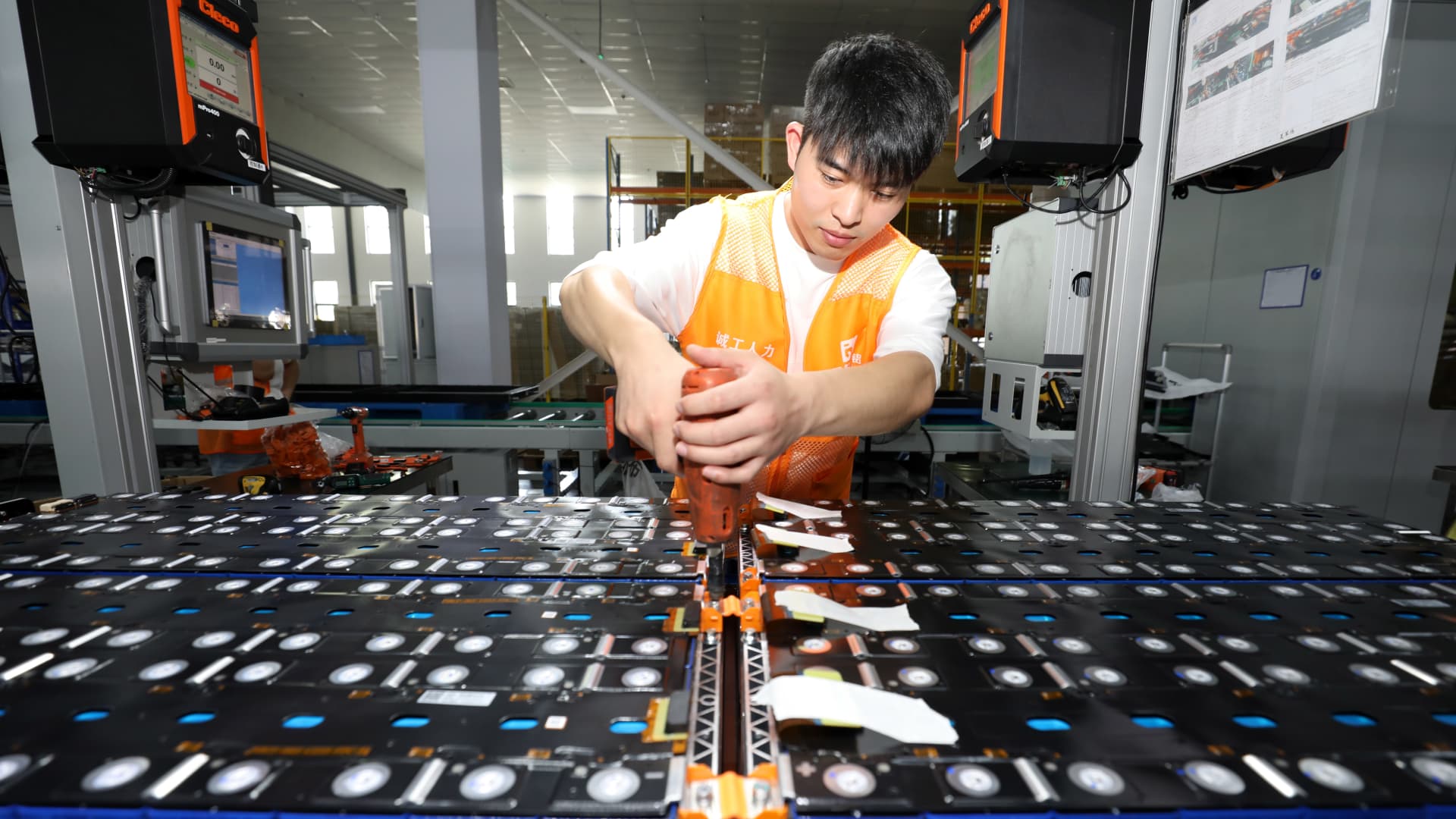
In the bustling city of Huaibei, Anhui Province, China, an employee diligently assembles power batteries and box chassis for new energy vehicles. This scene, captured on July 11, 2025, underscores a pivotal moment in the nation’s industrial landscape.
Photograph by Li Xin | Visual China Group | Getty Images
As the year drew to a close, China’s economic outlook brightened slightly, with factory activity making an unexpected turnaround in December. According to official data released on Wednesday, the manufacturing sector expanded for the first time since March, surpassing analysts’ predictions.
The official manufacturing purchasing managers index (PMI) rose to 50.1 in December, outperforming the 49.2 forecasted by economists surveyed by Reuters and marking an increase from November’s 49.2. A PMI reading above 50 signifies expansion, indicating a positive shift in the sector.
Additionally, the composite PMI—a broader gauge that encompasses both manufacturing and services—improved to 50.7 from November’s 49.7, suggesting a widespread uplift across the economy.
China’s non-manufacturing PMI, which includes services and construction sectors, also saw growth, rising to 50.2 from 49.5 in the preceding month. This recovery highlights a broader economic resilience as the nation steps into the new year.
Huo Lihui, chief statistician from China’s National Bureau of Statistics, said that new orders rose in December, signaling a “significant expansion” in both production and demand in manufacturing.
Private-sector data showed a similar trend. A separate PMI from independent research firm RatingDog showed manufacturing activity rising to 50.1 from 49.9, beating expectations of 49.8.
Yao Yu, founder at RatingDog, said the reading indicated the manufacturing sector had returned to expansion. He noted that total new orders grew for a seventh consecutive month, supported by domestic new product launches and business development, leading to growth in production.
However, Yao said that while firms remain confident for 2026, optimism has eased and remained below the historical average.
Large enterprises drove the improvement, with their PMI rising to 50.8, up 1.5 percentage points from the previous month, data from China’s National Bureau of Statistics showed.
Activity among smaller firms remained weaker. The PMI for medium-sized enterprises rose to 49.8, while the index for small enterprises fell to 48.6, down 0.5 percentage points from November.
Markets were mixed after the release. Hong Kong’s Hang Seng index fell 0.83%, while the mainland’s CSI 300 rose 0.33%.
The data followed a decision by China’s central bank earlier this week to keep loan prime rates unchanged, despite weak economic data and an extended slump in the property sector plaguing the world’s second-largest economy.
November’s retail sales and industrial output missed expectations, while investment in fixed assets also contracted.
Hao Zhou, chief economist at securities company Guotai Junan International, told CNBC’s “Squawk Box Asia” Wednesday that the reading was a “very good, positive surprise to the market.”
“Maybe the market is concerned about China’s property market, China stock market, as well as the consumption,” Zhou said. “The data for now suggests that the economy is on the right trend, and the momentum remains solid.”