
Share this @internewscast.com
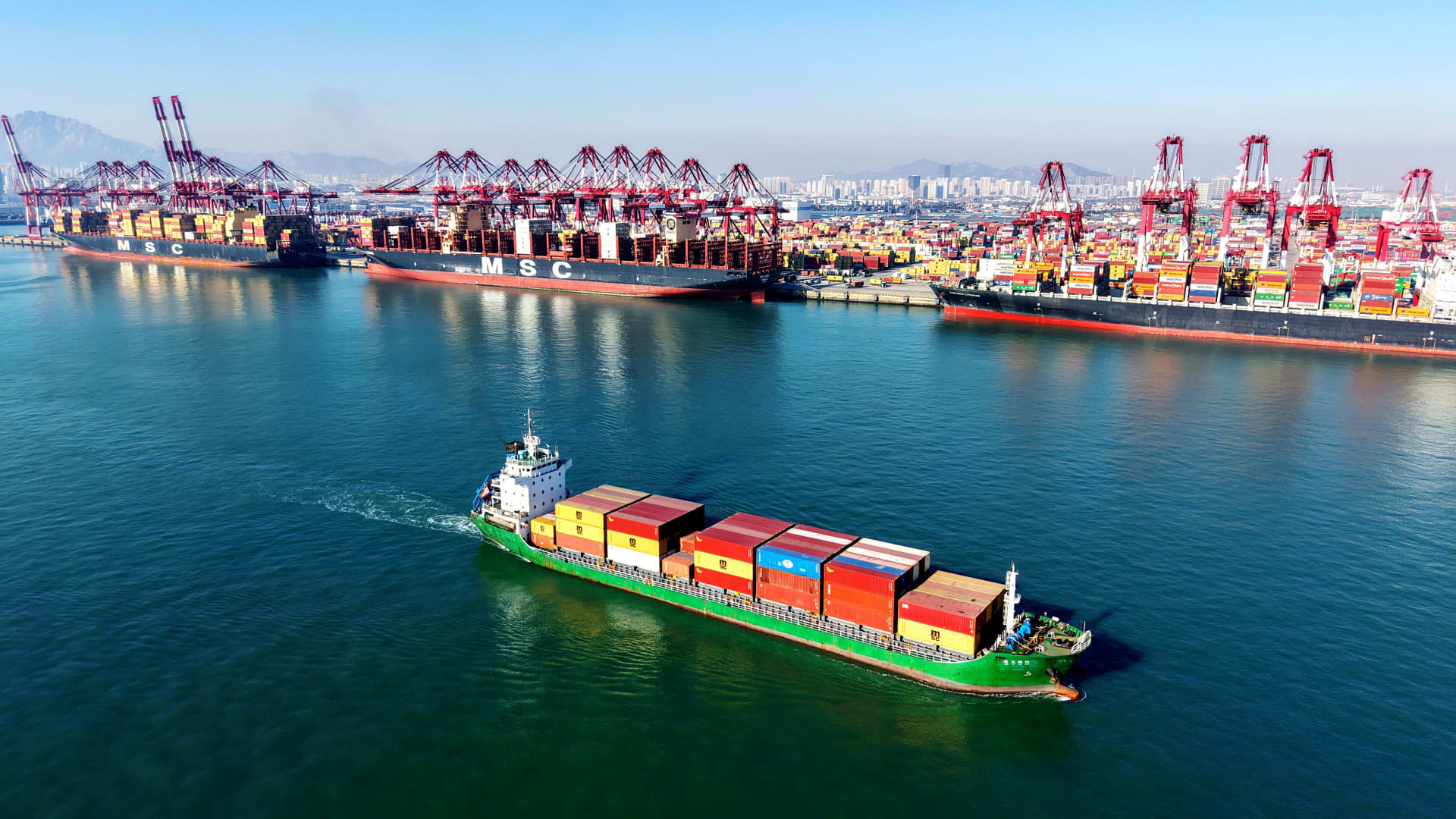
A cargo vessel brimming with containers set sail from Qingdao Port in Qingdao City, located in Shandong Province, China, on December 4, 2025.
Costfoto | Nurphoto | Getty Images
Despite a newly inked trade agreement between China and the United States, shipments from China to the U.S. have continued to decline for the eighth consecutive month. Meanwhile, China’s overall export figures for November exceeded market predictions, as manufacturers redirected their focus to other global markets.
According to customs data released on Monday, China’s exports in November saw a 5.9% increase in U.S. dollar terms compared to the previous year. This surpassed economists’ expectations of a 3.8% rise, as per a Reuters poll. The growth reversed the previous month’s unexpected 1.1% decline, which had been the first drop since March 2024.
Imports saw a 1.9% increase last month, falling short of the anticipated 3% growth. This shortfall is attributed to the ongoing housing slump and increased job insecurity, which have dampened domestic consumer spending. However, this was still an improvement from the 1% rise recorded in October.
In response to criticism over its aggressive export strategies, Chinese officials have reiterated their commitment to boosting imports and striving for a more balanced trade approach.

Exports to the U.S. plunged 28.6% in November, marking the eighth straight month of double-digit declines in shipments to the world’s largest consumer market, even after President Xi Jinping and his U.S. counterpart Donald Trump reached a deal in South Korea in late October. Imports from America shrank 19% from a year earlier.
“Despite the trade truce, the U.S. still imposes higher tariffs on China than on [many] other countries,” said Gary Ng, senior economist at Natixis, adding that Chinese exporters have likely continued to utilize their facilities in third markets to export to the U.S. “It can become a future norm,” Ng noted.
Levies on Chinese goods remain at around 47.5% according to Peterson Institute for International Economics. Beijing’s tariffs on imports from the U.S. stand at around 32%.
So far this year, China’s exports to the U.S. have declined 18.9% year on year, while imports have dropped 13.2%.
Shrinking U.S. exports in November were more than offset by surging shipments to other markets, particularly China’s two largest trading blocs, the European Union and the Association of Southeast Asian Nations. China’s exports to ASEAN and the EU rose over over 8% and nearly 15%, respectively.
In the first 11 months this year, China’s overall exports grew 5.4% compared to the same period in 2024 while imports fell 0.6%, taking its trade surplus to $1.076 trillion this year as of November, up 21.6% year on year.
Sluggish start under trade pact
Following the trade truce struck in October, Beijing and Washington agreed to roll back steep tariffs on each other’s goods, export controls for critical minerals and advanced technology, with China committing to buying more American soybeans and working with Washington to crack down on fentanyl flows.
China’s exports of rare earths accelerated in November, as it shipped out 5,494 tons of the critical minerals, up 24% from a year earlier and compared with 4,343.5 tons in October. The Ministry of Commerce has reportedly been designing a new rare earth licensing regime that could expedite shipments.
The country’s overall soybean imports grew 13% from a year earlier to 8.1 million metric tons in November, although down from the October level, signaling a slow start to fulfilling its promise of purchasing 12 million metric tons of U.S. soybeans by year-end.
Upcoming policy meeting
Chinese policymakers are expected to meet later this month for the annual Central Economic Work Conference, to discuss economic growth target, budget and policy priorities for next year. The specific targets will not be officially announced until the “Two Sessions” meeting in March next year.
The rebound of export growth would help mitigate the drag from weak domestic demand, putting the economy on track to deliver the “around 5%” growth target this year, said Zhiwei Zhang, president and chief economist at Pinpoint Asset Management.
Beijing is expected to keep the 2026 growth target unchanged at “around 5%,” according to Goldman Sachs, which would require incremental policy easing early next year to ensure a growth acceleration from a likely lackluster reading in the fourth quarter of 2025.
China’s factory activity shrank for an eighth month in November, an official manufacturing survey showed, with new orders staying in contraction. A private survey focused on exporters showed manufacturing activity unexpectedly fell into contraction.
The Wall Street bank expects Chinese authorities to lift the augmented fiscal deficit ceiling by 1 percentage point of GDP, cut policy rates by a total of 20 basis points and step up stimulus measures to rein in the housing slump.

Subscribe now
The strengthening yuan in recent weeks has not appeared to stem the flow of China’s exports. The offshore yuan has strengthened nearly 5% since April to 7.0669 per dollar at market open on Monday, according to LSEG data.
Despite a steady 5% annual GDP growth since 2023, China “urgently needs to curb its export dependence and pivot towards domestic consumption to ensure sustainable expansion,” Weijian Shan, chief executive of private equity firm PAG, said in an opinion piece last month.
A stronger yuan could boost consumption’s contribution to economic growth to the 2023 level of 86% from currently 53%, as it would lower costs of imports and enhance household purchasing power, Shan added.