Share this @internewscast.com
According to revelations from the Daily Mail’s Photo Evidence series, Iranian drone attacks have reportedly obliterated critical U.S. military resources and inflicted significant harm on essential energy facilities.
Following the initial U.S. and Israeli airstrikes on February 28, which resulted in the death of Ayatollah Ali Khamenei, Iran has retaliated with a series of drone assaults on pivotal strategic locations throughout the region.
In a recent installment of Photo Evidence, journalist Catherine Barnwell scrutinizes satellite images to evaluate the impact and extent of these drone strikes.
She identifies Al Muwaffaq Air Base, situated in central Jordan, as a crucial operational center for U.S. military activities in the area.
Prior to the escalation of hostilities, the base was observed to host over 60 U.S. aircraft, including some of the nation’s most sophisticated assets: the F-35 stealth fighters, F-16 fighter jets, and F-15 air superiority fighters.
This formidable fleet showcases the pinnacle of America’s military prowess, crafted to challenge Iran’s aerial defenses. While some of these aircraft were visible in open areas, others were presumably housed in shelters, obscured from satellite detection.
The base sits more than 500 miles from Iran, far enough to put it beyond many of Iran’s shorter range weapons.
And yet, the base was hit several times in the opening days of the war, with one of the most significant strikes taking out took a Terminal High Altitude Area Defense (THAAD) system – one of only eight in the world.

Reporter Catherine Barnwell has analysed newly released satellite images from Iran to assess the true scale of destruction wrought by Iranian’s drone bombing campaign

Before and after satellite imagary shows the destruction of two radar domes at the US’s Fifth Fleet headquarters in Bahrain.
Drone Strike Exposes Weakness in Advanced US Defence System
THAAD is a key part of the American air defence umbrella and is designed to protect high value bases by dealing with high-flying long range ballistics – the kind Iran would need to fire at this base because of how far away it is.
However, it appears to have a blind spot for slow moving, low flying incursions, suggesting Shahed kamikaze drones worth an estimated $35,000 each were able to take out a billion dollar air defence battery.
After images show the ruined remains of the system’s powerful radar, worth $500million alone, with two blast sites visible.
The lost of the anti-ballistics system means either Patriot missiles which work alongside THAAD are going to have to work overtime to compensate for the loss, or the US is going to have to pull another system from somewhere else, like the Pacific, where they’re supposed to be defending Taiwan.
This attack and others like it show that Iran isn’t just firing blindly at US bases. It is aiming for their weakest points and hitting damage successfully, Catherine explains.
That requires sophisticated intelligence gathering to provide targeting data, intelligence which may hint at the involvement of other US, rivals, namely Russia.
The show also looks at similar strikes on Prince Sultan Air Base in Saudi Arabia, where a significant number of American aircraft were seen gathering here before fighting broke out – including E-3 Sentry AWACS planes, which act as flying radar dishes, the eyes of America’s fighter jets – and KC-135 mid-air refuelers.
A second satellite photo taken on March, the first shows smoke rising from the nearby air defence site. We know this is where another Thad radar, costing another half a billion dollars, was previously located.

As well as striking US radar and command posts, Iran has added a third strategic target – the energy infrastructure of neighbouring countries with the goal of disrupting oil production. Pictured: Three distinct impact sites are visible at the Ras Tanura oil refinery in Saudi Arabia.

Scenes from the Ras Tanura refinery, owned by Saudi Aramco, after it was subjected to an Iranian attack that targeted one of the Kingdom’s most vital energy facilities.

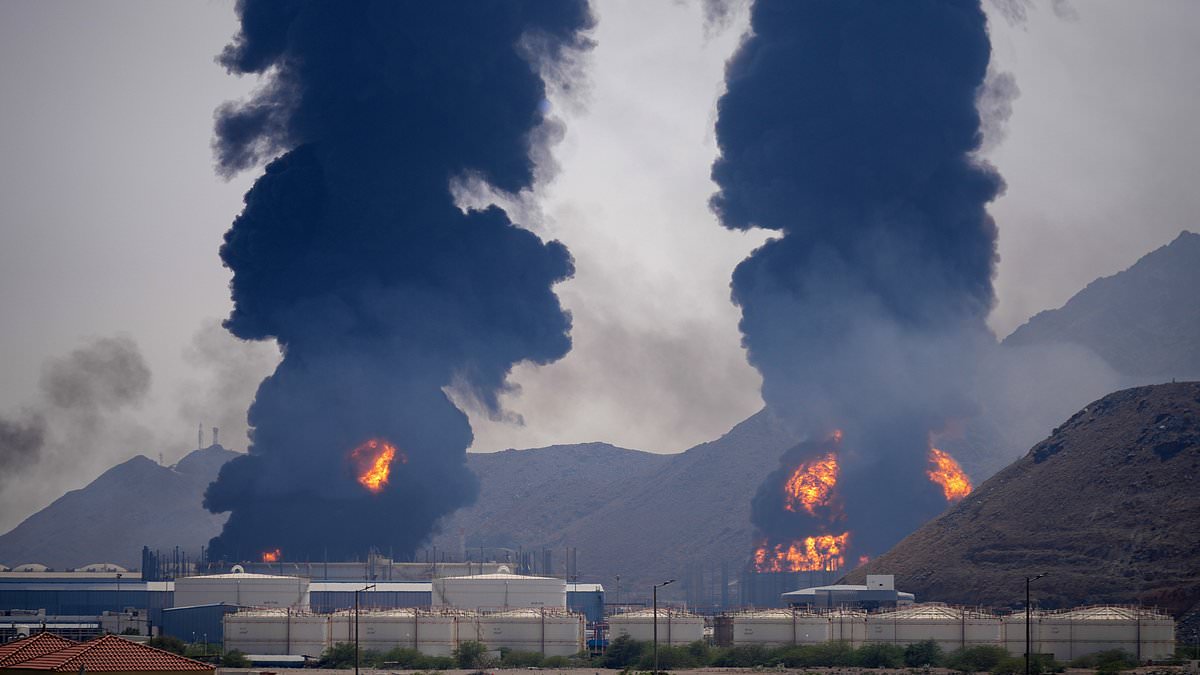
Two plumes of black smoke rise high into the sky from a fire at an oil refinery in UAE due to debris from an intercepted drone.
Iran Targets US Defences in Coordinated Strike Strategy
This attack and the one in Jordan suggest Iran is embarking on a strategy of suppressing of enemy air defences – the same tactics that America and Israel used on Iran in their opening strikes.
Another base hit was Fifth Fleet headquarters in Bahrain, which was bombed at the very beginning of the Iran war.
The target was two white circular structures known as radomes – radar domes – which satellite ‘after’ images showed to be obliterated.
One appears to have been destroyed by a very precise strike, probably the one caught on camera featuring the drone.
There is a single blast crater with a blackened patch on the ground, likely carbon left behind by the fire the explosion caused.
The second row dome was not such a clean kill. There seemed to be at least two separate impact areas where the dome used to be, as well as destroying the dome, these explosions seem to have seriously damaged nearby buildings as well.
‘So far, we’ve seen evidence of two Iranian strategies running in parallel, strike US radar, thereby hurting its ability to see and stop future attacks, and attack US command posts, thereby reducing its ability to prosecute the war,’ Catherine explains.
‘Both strategies that would be familiar to any military commander. But now we’re about to see evidence of a third less conventional strategy that is proving far more effective than either.’

Energy Infrastructure Becomes New Frontline in Conflict
That strategy is the targeting of energy infrastructure in neighbouring countries with the goal of disrupting oil production – and so heaping pressure on President Trump to end the war.
On March 2, 2026 Iran hit the oil refinery in Ras Tanuna, Saudi Arabia, which is capable of refining half a million barrels of oil every single day – making it key to global energy security.
Satellite imagery shows scorch marks can clearly be seen on the ground in at least three sections of the plant.
This is likely carbon residue left behind by oil which set alight after sparks from multiple explosions, and down here you can see hose is still trying to douse a fire in this section of the plant.
The culprit was again thought to be Iranian drones, which were reportedly shot down by Saudi Arabian air defences – but the burning wreckage fell into the refinery and caused the fires.
As a result of this attack, Ras Tanura had to shut down operations for almost two weeks, costing the global economy an estimated five and a half million barrels of oil.
The tactic of targeting energy infrastructure appears to have been successful for the Iranians.
With the Strait of Hormuz closed for shipping and oil refineries under attack, the price of a barrel of Brent crude rose to $119 – although it has since dropped to sub-$100.
Drones appear to have acted as the great equaliser in this conflict. While Iran cannot hope to match the US’s aerial might, the cheap and easily-manufactured aerial vehicles have caused untold damage across the region.
For Barnwell’s full breakdown of Iran’s devastating drone attacks, subscribe to the Daily Mail World channel on YouTube.