
Share this @internewscast.com
On the fateful day of October 7, 2023, Batsheva Yahalomi found herself confronting a heart-wrenching dilemma, one that no parent should ever encounter.
Batsheva, along with her husband and three children, was at their home in Kibbutz Nir Oz when an unexpected and violent assault by Hamas gunmen shattered the peace of southern Israel. This tragic event claimed the lives of 1,200 civilians in a devastating wave of terror.
Amid the chaos, approximately 500 militants descended upon the kibbutz, invading the sanctuary of the family’s safe room. In a terrifying turn of events, Batsheva’s husband, Ohad, and their then-12-year-old son, Eitan, were abducted.
Batsheva, along with her two daughters—one just 20 months old and the other 10 years old—was captured and forced onto a motorbike, heading toward the Gaza Strip in the clutches of a gunman.
Yet, in this dire situation, fate intervened. Amid the turmoil, Batsheva and her daughters fell from the motorbike, offering them a fleeting chance to evade their captor’s grasp.
Faced with an excruciating choice, Batsheva had to decide whether to seize this moment to flee with her daughters to safety or to pursue her young son, who was being whisked away to an uncertain and perilous fate.
Having only seconds to make the choice, she decided to save her daughters, and committed to rescuing Eitan – who was one of 253 people abducted by Hamas terrorists that day – whenever possible.
Her son was kept hostage for 52 days before he was released in the November 2023 in an exchange, while her husband, Ohad, was murdered in Gaza.
Ohad’s body was returned 510 days after he was kidnapped.
When asked if she thinks she made the right decision, two years after the massacre, Batsheva told the Daily Mail: ‘Not always.’
‘It was very, very hard to run the other way from Eitan, knowing he was being driven inside…that he was there without me. It’s very hard to think about it, to this day,’ she added.
Batsheva’s story is one of several that has been told in the new Israeli series Red Alert, streaming on Paramount Plus in the UK. It was released on the two-year anniversary of the cross-border attack, the single deadliest day for Jews since the Holocaust.

Batsheva Yahalomi, survivor of the attack on Kibbutz Nir Oz and mother of released hostage Eitan Yahalomi, poses for a picture with a sign identifying her deceased husband Ohad Yahalomi

Batsheva Yahalomi with her late husband Ohad, son Eitan and daughter Yael

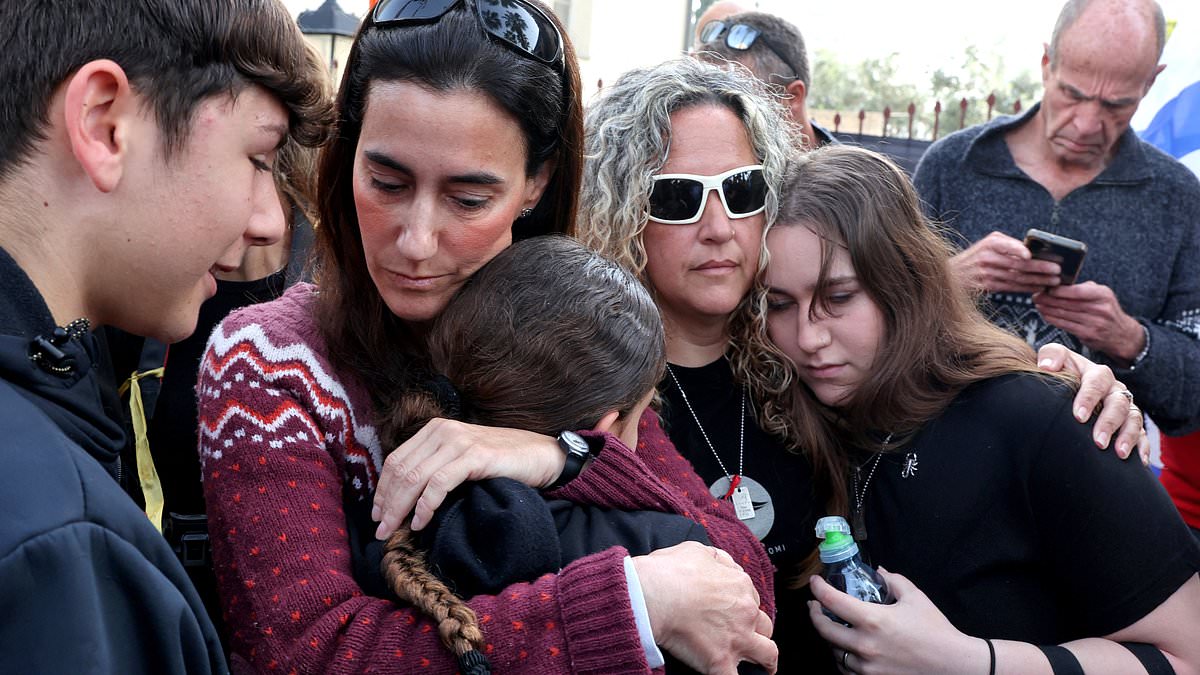
Batsheva Yahalomi (C-L), the wife of French-Israeli Ohad Yahalomi, one of the Israeli hostages taken captive by Palestinian militants in the Gaza Strip during the 2023 October 7 attacks, mourns with his sister Effie
The mother remembers the morning of the massacre as if it were yesterday: a blaring alarm, gunshots outside, and cries of Allahu Akbar.
The attack began at around 6.29am with widespread rocket barrage, before hundreds of militants invaded and wreaked havoc at the kibbutzim on the Gaza border and the Supernova music festival.
Kibbutz Nir Oz, founded in 1955, was one of the worst-impacted border communities, where 76 people were taken hostage and 47 were murdered out of a population of 420.
When Hamas militants and gunmen from Palestinian Islamic Jihad stormed the kibbutz, the Yahalomi family immediately hid in their safe room, but a malfunction with the lock meant the door wouldn’t close properly.
In a bid to save his family, Ohad made the decision to step outside the safe room and secure the door.
‘But at 10 o’clock, they succeeded [in breaking in]. They rolled grenades into the house and shot Ohad. We heard him screaming; he was injured, and four of them entered the safe room.’
Batsheva was sitting on the couch holding her baby, while 10-year-old Yael and Eitan hid under the table.
‘I called them to come near me. They took our phones immediately, and they started to shout in Arabic. The children asked what they wanted, and I told them they wanted to take us to Gaza.’
The family screamed for help, sure that the Israel Defence Forces (IDF) were on their way to help them. But help didn’t arrive until around 2.00pm, some 40 minutes after the last militants left the devastated kibbutz.
‘It’s a big failure,’ said Batsheva. ‘We were alone, totally alone. I think Hamas were surprised that they could do whatever they wanted… There were so many people there without uniform, killing and kidnapping people, because it was open and the army was not there.’
A probe into the IDF response to the massacre concluded that there was a ‘systematic failure’ to protect the citizens of Nir Oz, largely because the military had never prepared for such an unprecedented event.
‘The army and the government couldn’t imagine such a scenario. We knew there was a danger of terrorists entering Israel, but we didn’t understand that it could be such a huge event,’ said Batsheva.

The family of Ohad Yahalomi, his wife Batsheva and his children are seen during the funeral procession

Batsheva Yahalomi holds a picture of her kidnapped son as she attends an event held by Academy of the Konrad Adenauer Foundation, Germany, November 15, 2023
‘It was so strange for me that they were taking children, breaking all of the laws of humanity,’ said Batsheva, describing the horrors she witnessed that day.
She was especially astonished that the militants were taking photos of the massacre, after terrorists received top-level orders that day to record and publish as much sickening footage as possible in order to spread terror.
Eitan, her son, was forced onto one motorcycle with a terrorist and the baby, while Batsheva was placed on a second vehicle with Yael. Before long, the 20-month-old infant started crying, so a militant gave the mother the baby to hold.
‘I was begging them to free the children and take only me, but they didn’t respond,’ she said.
‘We started to drive through the kibbutz and the houses were on fire, everything was burning and there were hundreds of terrorists travelling freely. No one stopped them.’
She saw scores of militants in plain clothes, even children, many of whom were looting items from the kibbutz, including televisions, computers, and even the community’s tractor.
Then, on their way to Gaza on the back of the motorcycle, she and her daughters fell off the vehicle and immediately ran to a field in an attempt to hide from the militants.
They played dead and desperately covered themselves with a blanket, but Batsheva could hear voices fast approaching.
A terrorist arrived and asked her where they were going, and she replied they wanted to go back to their kibbutz.
‘He told me: “There is nothing left at Nir Oz. Everybody is dead and all the houses are burning.”‘
With her baby and 10-year-old child, Batsheva ran through the field for four hours, finally making it back to the kibbutz, and that’s when she realised the level of destruction that had been inflicted on her community.
The youngest resident to be murdered from Kibbutz Nir Oz was Kfir Bibas, who died at nine months old, after he was kidnapped with his mother Shiri, 32, and brother Ariel, four, all of whom were killed in captivity in Gaza.
It was when she was back at the kibbutz that Batsheva realised her husband Ohad was gone, but she didn’t yet realise he had been kidnapped to Gaza too.
‘We saw him bleeding and injured, and I didn’t [think] they would be kidnapping people in such a condition. I thought maybe he went outside by himself and died. We even thought he got outside and took a car and was looking for us in Gaza.’

A passionate environmentalist, Ohad Yahalomi earned both a bachelor’s and a master’s degree from the University of Haifa’s School of Environmental Sciences

With her baby and 10-year-old child, Batsheva ran away from the terrorists through the field for four hours, making it back to Kibbutz Nir Oz

Ohad Yahalomi was laid to rest in Kibbutz Nir Oz on March 5, 2025
Eitan spent over a month in captivity, where he was subjected to starvation and forced to watch violent footage filmed by terrorists during the massacre.
‘He ate only one pita bread and one cucumber per day. They told him Israel and his kibbutz don’t exist anymore… He was sure that I was in Gaza with his sisters, and they always told him that they would take him to me as soon as possible, and it didn’t happen, of course,’ Batsheva said.
Despite the pain of knowing her son went through living hell as a hostage in Gaza, Batsheva thought that maybe it would be easier to save Eitan ‘from the outside’, rather than chasing him to the Strip – where she now knows parents were forcefully separated from their children.
For the first 16 days in captivity, he was kept without any other Israelis, before he was transferred to a children’s hospital in Khan Yunis where he slept in a small room with 10 other people, all women and children, without a bed.
He was beaten by the militants and only allowed to shower twice in 53 days.
‘They couldn’t open the windows. The terrorists told them if they open the windows, the civilians will hear them and they will come to kill them,’ Batsheva said.
The hostages were deprived of going to the toilet for hours, and were forced to urinate in cans and bottles to relieve themselves.
Eitan was too scared to sleep in the centre of the room, so he slept under the chairs of fellow female hostages, often too afraid to fall asleep.
In November, he was released as part of a truce that saw 105 people, mostly women and children, set free. But for months after captivity, Eitan struggled with nightmares following the trauma he had endured.
When he was finally freed, his mother told him Ohad was still alive, not knowing yet that he was murdered in captivity.

Avihai Brodutch, whose wife and three children were abducted, Gilad Korngold, whose son, daughter-in-law and two grandchildren were kidnapped and Batsheva Yahalomi, whose husband and son were kidnapped

Hostage families attend an event held by Academy of the Konrad Adenauer Foundation, amid the ongoing conflict between Israel and Hamas, in Berlin, Germany, November 15, 2023
On January 19, 2024, Ohad’s captors – the military wing of the Popular Resistance Committees terror group – published footage showing him wounded and declaring that he had died.
But still, the family held on to hope, not knowing what had happened to the 49-year-old father of three.
It wasn’t until February 27, 2025, that the body of Ohad was released by Hamas as part of the first phase of the second ceasefire-hostage release deal, confirming his death in captivity.
Authorities later confirmed that he is believed to have been shot the same day his captors filmed their sadistic video. Intelligence indicates he was kept alone, without any other Israeli hostages.
For 510 days, the family had to cope with the pain of not only being displaced from their home, but the agony of not knowing what had happened to Ohad, about whether he was suffering alive or dead.
‘They murdered him after they kidnapped him alive and we don’t know why,’ Batsheva said.
‘The children don’t know. They think he’s dead because of his injury [on October 7, 2023] and I’m leaving it at that. I prefer them to think that the evil was only on October 7 and that it didn’t continue after. For now, they don’t know. I will tell them some day, but not now.’
The mental toil on the family during the period when they didn’t know Ohad’s fate was unbearable.
‘It was very, very hard to live like that, without knowing about Ohad. It totally broke us to live like that,’ she said. ‘We had hope that Ohad would come back alive, and he didn’t.’

Shay-Lee Keren Sharvit as Tamari, Rotem Sela as Batsheva Yahalomi and Libi Atia as Yael in Red Alert, episode 3, streaming on Paramount+, 2025

When the producer of Red Alert reached out to Batsheva to take part in the series, she was immediately eager to tell her story
When the producer of Red Alert reached out to Batsheva to take part in the series, she was immediately eager to tell her story, despite the unimaginable pain of the past two years.
For the mother of three, taking part in the series was a way to combat the ‘denial’ that she said had emerged very soon after the massacre, about its scale and the true reality of the brutal violence.
‘I know that normal people, or people who don’t live here, can’t understand what happened on that day, because it was a massacre, it was very cruel and barbaric
‘But it happened, and I want to invite people to come to Israel, to come to my kibbutz, and see what happened.
‘Imagine a terrorist entering your neighbourhood and taking you from your house, and it’s not only you, it’s the whole neighbourhood that they’re burning and looting and raping.’
In Red Alert, the four part scripted series directed by Lior Chefetz, Israeli actress Rotem Sela plays Batsheva, but the show also tells the stories of several other people whose lives turned upside down during the massacre.
It follows Israeli mother Tali Hadad, who transforms into a hero as she searches for her son, Itamar, an off-duty soldier, who grabs his gun to combat terrorists in their Ofakim neighborhood.
Hadid springs into action herself, driving wounded residents to the town’s Magen David Adom unit.
Another episode centres on grieving Bedouin father Ayoub, who hides with his infant son behind enemy lines after losing his wife to violence.
‘It happened, so I want people to remember it,’ said Batsheva.
The series, produced by Keshet Media Group and Oscar nominee Lawrence Bender, was recently nominated for a Critics Choice Award in the Best Foreign Language Series category.
The awards will be presented on January 4 next year in a star-studded ceremony in Santa Monica, California.
The series was the most viewed drama on all Israeli TV channels in the past decade, with around one in three of the Israeli population having now tuned in, according to the Keshet Media Group.

For the mother of three, taking part in the series was a way to combat the ‘denial’ that she said had emerged very soon after the massacre
Ohad was laid to rest in Kibbutz Nir Oz on March 5, 2025.
A passionate environmentalist, he earned both a bachelor’s and a master’s degree from the University of Haifa’s School of Environmental Sciences, and spent the last 19 years of his life working for the Israel Nature and Parks Authority.
In 2018, he co-wrote a guide to Israeli scorpions published by the INPA. ‘He loves scorpions,’ Batsheva said, showing me a scorpion brooch that she hands out to people to encourage them to think about and remember Ohad’s legacy.
In October, Hamas and Israel signed Donald Trump’s 20-point peace plan to end the brutal war, which has killed more than 70,000 people in Gaza, according to the Hamas-run health ministry.
After the proposal was signed, Hamas agreed to return the final 20 living Israeli hostages and the bodies of the 28 dead Israeli and foreign hostages still in Gaza within 72 hours.
Even though she is not optimistic, ‘I really wish for peace,’ Batsheva said, speaking for her community near the border. She adds that many people on her kibbutz have previously volunteered to take wounded and sick Gazans to hospital.
However, as long as Hamas retains governance and controls education in the Strip, nothing will change, she warned.
‘Hamas is holding Gaza right now, and they educate the children to hate and kill,’ she said. ‘Because of that, there is no hope, because even if there is a ceasefire now, Hamas is still there and everything will start again in a few months or years.’
According to Batsheva, ‘Hamas is the problem, including for the innocent civilians of Gaza’.
‘We must get rid of them and maybe then we will have peace. We want peace, we are praying for peace, always.’
Red Alert is streaming on Paramount Plus in the UK now