
Share this @internewscast.com
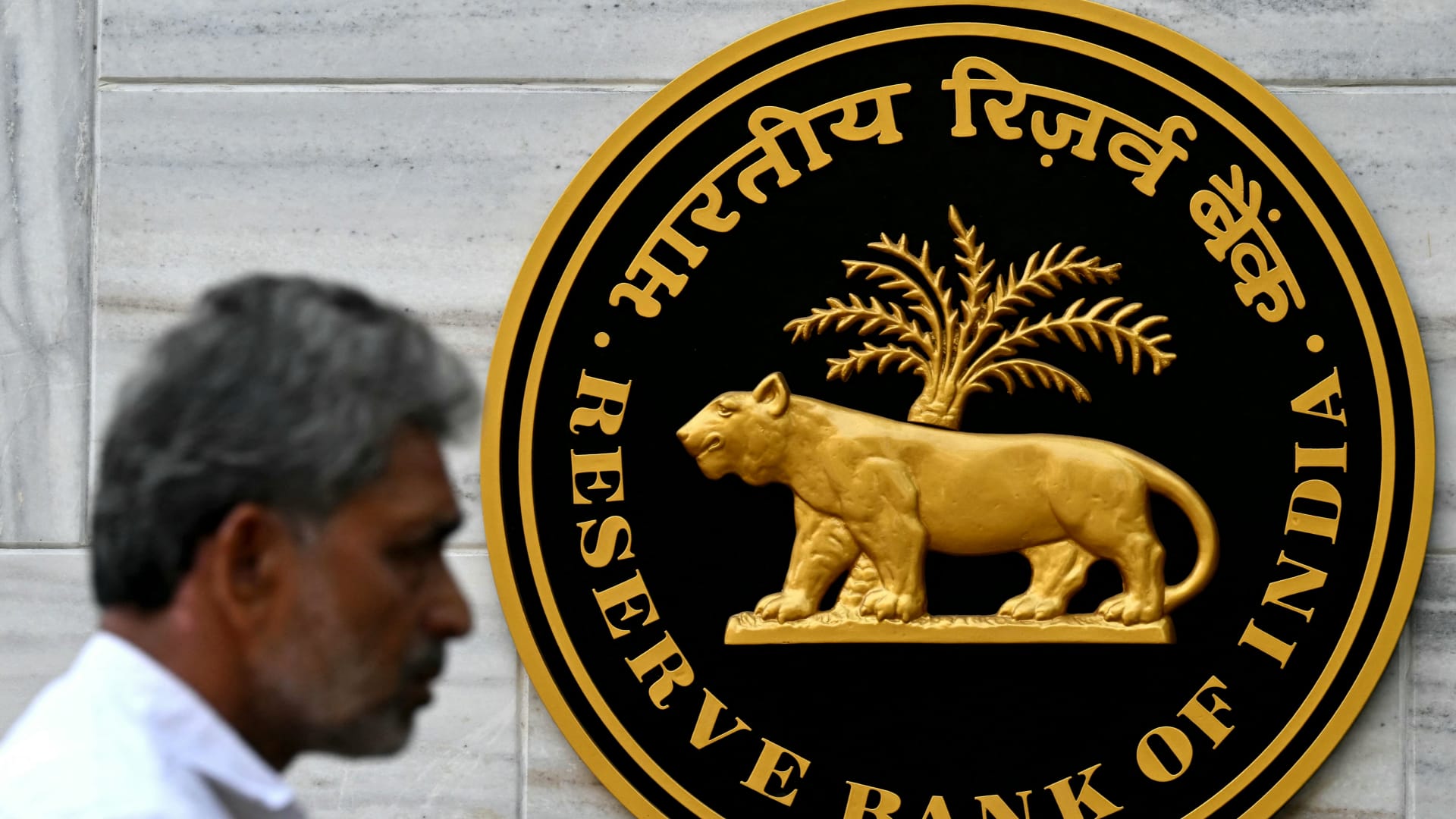
On February 7, 2025, the emblem of the Reserve Bank of India was prominently displayed outside its Mumbai headquarters.
Photograph by Indranil Mukherjee | AFP | Getty Images
In a move anticipated by economists surveyed by Reuters, India’s central bank lowered its policy interest rate by 25 basis points, bringing it down to 5.25% on Friday.
The decision by the monetary policy committee was unanimous, driven by “weakness in some key economic indicators,” even though inflation has significantly decreased and is projected to decline further in the first quarter of 2025, according to RBI governor Sanjay Malhotra.
The Indian economy grew by 8.2% between July and September, surpassing expectations, while inflation remained low.
Malhotra remarked, “In spite of a difficult and challenging global environment, the Indian economy has demonstrated impressive resilience,” highlighting indications of “strong growth.”
“The headroom provided by the inflation outlook has allowed us to remain growth supportive. We will continue to meet productive requirements of the economy in a proactive manner,” he said in his closing remarks.
Rupee weakness
The central bank on Friday said it will buy 1 trillion rupees ($11 billion) of government bonds on the open market and carry out a three-year, $5 billion buy-sell swap of the U.S. dollar and the Indian rupee this month.
These steps will “ensure adequate durable liquidity in the system and further facilitate monetary transmission”, Malhotra said.
The RBI routinely carries out dollar-rupee swaps to offset the liquidity effects of its spot market interventions on the rupee.
The Indian rupee has weakened against the dollar in recent days, slipping past the important 90-rupee-per-dollar level on Wednesday before paring losses.

India’s foreign exchange reserves on Nov. 28 stood at $686.2 billion, providing more than 11 months of import cover, the central bank said in a statement.
Today’s rate cut is “timely” given that the economy is doing well, but the outlook remains uncertain, said Anubhuti Sahay, head of India economics research at Standard Chartered Bank. She added that the rate cut is even more significant given the rupee’s weakness.
Given the sharp moves in the exchange rate, had the RBI not delivered a rate cut today, “one couldn’t have ruled out the possibility of a sell-off in the bond market,” Sahay added, which would not have been desirable from the RBI’s point of view.
Weak data, strong growth
RBI’s Malhotra, explaining the rationale for keeping rates unchanged at the last policy meeting in October, warned that although inflation moderated significantly in the first quarter, growth could still slow in the second half of the financial year due to global trade uncertainties.
Concerns about the slowdown in growth are showing up in key economic indicators. Industrial activity in October fell to a 14-month low, and indicators such as HSBC’s manufacturing PMI fell to a nine-month low in November, suggesting an economic slowdown.
Exports to the U.S., one of India’s major trading partners, fell for a second straight month in October, sliding 8.5% from a year earlier to $6.3 billion. Overall outbound shipments in October also fell 11.8% to $34.38 billion.
“External uncertainties continue to pose downside risks to the [growth] outlook, while speedy conclusion of various ongoing trade and investment negotiations present upside potential,” the governor said.

Washington has imposed a 50% tariff on Indian goods since August. While trade negotiations are ongoing between the two countries, a deal has yet to be finalized.
To offset the impact of the tariffs, New Delhi cut goods and services tax rates in September ahead of a month-long festive season to lift domestic demand.
GST tax collections showed a sharp improvement in October to 1.95 trillion rupees ($21.7 billion), up 4.6% from a year earlier, but the growth was muted in November with gross collection of 1.7 trillion rupees, a modest 0.7% increase.
The Indian rupee has weakened against the dollar in recent days, slipping past the important 90-rupee-per-dollar level on Wednesday before paring losses.
Despite a policy rate cut earlier this year, there has not been a “major pick up in bank lending,” said Sanjay Mathur, ANZ’s Chief Economist for India and Southeast Asia. He added that while there is also no clarity on the conclusion of a U.S.-India trade deal, the impact of tariffs is visible on the economy.