
Share this @internewscast.com
Having reported on the influence of propaganda for over ten years, I’m acutely aware of how disinformation can sway political landscapes and societal norms. This experience makes me particularly concerned about a new form of information warfare being conducted by terrorist organizations and rogue states, which could pose a greater threat than anything we’ve encountered before.
The latest target for these malevolent forces is a resource many of us use daily: Wikipedia. This popular online encyclopedia is under siege by some of the world’s most notorious governments and extremist ideologues. Their goal? To portray their agendas as benign and their leaders as heroic “resistance” fighters, rather than the violent operatives they truly are.
What heightens the risk is that the world’s leading artificial intelligence platforms, including Claude, Gemini, and ChatGPT, depend heavily on Wikipedia to develop their large language models. These AI systems are rapidly emerging as pivotal media sources in our digital era.
To examine this trend in action, I prompted ChatGPT with a hypothetical question intended for American middle school students: “What is Hezbollah?”
The accurate response should identify Hezbollah as a group designated by the U.S. as a terrorist organization responsible for hundreds of civilian deaths.
Instead of acknowledging Hezbollah’s long history of violence, which includes notorious bombings, hijackings, and kidnappings, ChatGPT described Hezbollah merely as “a Lebanese political party.”
And it offered just one citation: Wikipedia.
The Hezbollah example is hardly an outlier. The same thing happened when I asked ChatGPT about Palestinian Islamic Jihad commander Abu al-Walid al-Dahdouh, who was killed by Israel in 2006. ChatGPT described him as a ‘prominent commander’ responsible for military operations—rather than the head of a terror network which waged a campaign of deadly suicide bombings in Israel.

Former Iranian leader Ali Khamenei oversaw more than three decades of state-sanctioned terror and repression against his own citizens

AI platforms such a Claude, Gemini and ChatGPT heavily rely upon Wikipedia to train their large language models

ChatGPT’s reliance on Wikipedia as a source is problematic because Wikipedia articles often use information provided by the terror groups and government that the articles describe
Surprised? I’m not. As with Hezbollah, ChatGPT lists Wikipedia as the primary source for its al-Dahdouh entry. Same with former Iranian leader Ali Khamenei, who for more than three decades oversaw state-sanctioned policies of terror and repression against his own citizens. And same with former Hamas leader Yahya Sinwar, the architect of the October 7th attacks against Israel.
ChatGPT’s reliance on Wikipedia as a source is obviously problematic because Wikipedia articles often rely on information provided by the terror groups and government they describe.
It’s a process you might call ‘information laundering:’ By exploiting weak Wikipedia editorial standards, militant groups produce entries that are absorbed into a trusted knowledge platform, and then redistributed across search engines and AI systems,
The result is subtle but powerful.
Students learn from Wikipedia, journalists quote it, and policymakers reference it. Most worryingly, AI systems repeat it – and repeat it and repeat it. By the time the information makes its way downstream to you or I or our children, the original sources—the propaganda outlets that produced the information in the first place—have long since faded from view.
The ways in which terror groups shape Wikipedia entries is determined both by what they help get onto the site – often lifted verbatim from terror propaganda sources – as well as by what is left out.
Take the Wikipedia article on that Islamic Jihad commander al-Walid. The entry states that Dahdouh was ‘one of the most prominent commanders of al-Quds Brigades, the military wing of the Islamic Jihad movement in the Gaza Strip during the Intifada.’
The wording closely mirrors language published by Palestinian Islamic Jihad itself:
‘Khaled al-Dahdouh, known as Abu al-Walid, emerged as one of the most prominent leaders of the Al-Quds Brigades, the military wing of the Islamic Jihad Movement in the Gaza Strip during the current uprising.’

Wikipedia used information provided by Hamas as a basis for its entry on their former leader, Yahya Sinwar, who was killed by Israel in Gaza

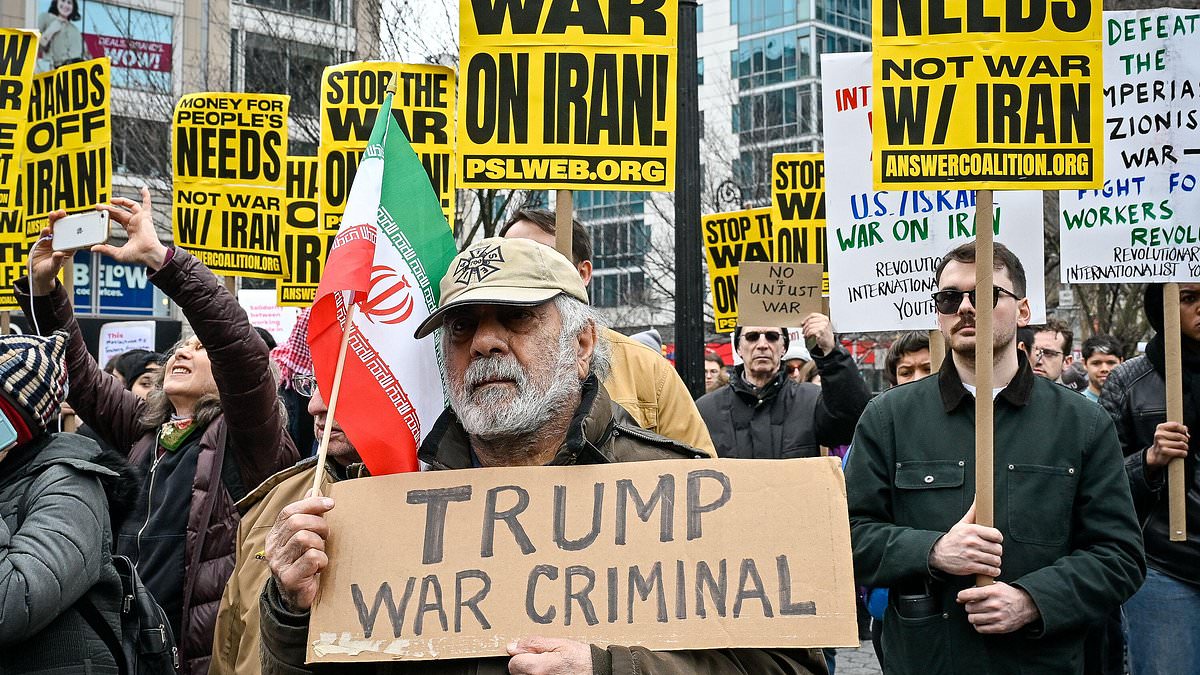
I am terrified by a new type of information warfare now being waged by terror groups and rogue nations that may ultimately prove far more dangerous than any that has come before it (Pictured: Anti-war protest in New York City on March 7)
The overlap is not coincidental. Three of the four sources cited in al-Walid’s Wikipedia entry come directly from Palestinian Islamic Jihad websites. That entry includes a section titled ‘Role in the Resistance,’ which adopts the language used by militant groups to describe attacks on Israeli civilians as legitimate political tactics – not cold-blooded murder. THIS is the image Islamic Jihad hopes to project about itself.
Missing from al-Walid’s Wikipedia page is any of the reporting detailing his trail of death – such as an attack on an Israeli bus in 1989 that claimed 14 lives – attributed to Islamic Jihad, along with its formal designation as a terrorist group.
True, you can’t blame a terror group for wanting Wikipedia to obscure its long history of terror. But you can blame Wikipedia for failing to introduce more stringent gatekeeping to ensure this type of exploitation cannot flourish.
Absent such gatekeeping, terror groups exploit these weaknesses to replicate this pattern of selective inclusion across hundreds of different Wiki articles. This includes entries detailing the most despicable terror leaders, such as Hamas commanders Mohammed Deif and Yahya Sinwar – the latter known as the architect of the October 7th massacre on Israel.
Both of their entries rely heavily upon sourcing from the Palestinian Information Center, a known Hamas-affiliated propaganda operation, which – among other indecencies — has described October 7 as restoring ‘legitimacy to the Palestinian cause.’
In total, my research has revealed more than 29,000 examples of Wikipedia citing Iranian state media outlets. Wiki’s favorite appears to be Tasnim News, an affiliate of Iran’s Islamic Revolutionary Guard Corps, which took part in the brutal January crackdown that left tens of thousands of anti-regime protestors dead.

Author Ashley Rindsberg has been studying the impact of propaganda upon society for more than a decade
Media outlets tied to Iran’s proxy organizations—including Hamas and Hezbollah—are also cited across Wikipedia, here more than 8,400 times. Media linked to the Muslim Brotherhood – which has carried out deadly terror attacks across the Middle East — appear nearly 1,000 times as sources on Wikipedia. And outlets affiliated with Al-Qaeda—including Shada News Agency and Radio Furqaan —show up over 100 times.
A Wikipedia article on the 2025 Shabelle offensive— a bloody campaign in Somalia led by Al-Qaeda affiliates al-Shabaab — cites Radio Furqaan, the official media arm of al-Shabaab nearly 50 times. It also includes more than a dozen citations from Shahada News Agency, an al-Shabaab–aligned jihadist propaganda outlet. In effect, al-Qaeda’s own media outlets serve as sources shaping the version of the war that will live on Wikipedia as part of the historical record.
Back when I first began covering propaganda operations, the worry was on the ways they were infiltrating our radio, movies and TV. Now, in the digital age, disinformation is even more insidious precisely because it does not always look like disinformation, even to the trained eye.
Sometimes disinformation – and propaganda and information warfare — arrives these days disguised as a Wikipedia citation.
Ashley Rindsberg is an investigative journalist covering Wikipedia manipulation and information warfare and the founder of NPOV, an investigative outlet focused on online narrative manipulation.