
Share this @internewscast.com
In a swift escalation of tensions, Iran launched missile strikes on Tel Aviv just a day after President Donald Trump described recent peace talks with the nation as ‘good and constructive.’
The Iranian missile attack involved several waves directed at Israel, and came shortly after a source from the state-run Fars News Agency hinted at significant developments for Tel Aviv and some U.S. and Israeli regional allies, which they claimed would extinguish any hopes for negotiations.
The missile barrage set off air raid sirens across parts of Israel, including Tel Aviv, where the sound of intercepting explosions filled the air.
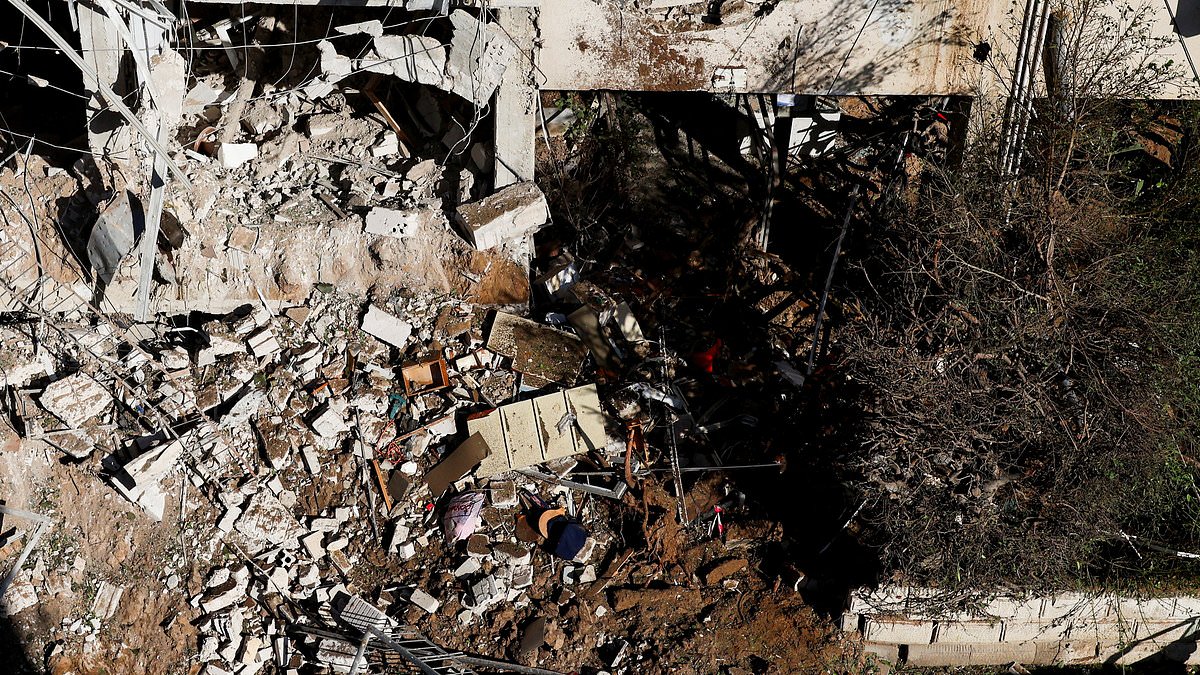
One of these attacks led to damage in northern Israel, where debris from an intercepted missile rained down, affecting residential areas.
According to Israeli police, six individuals sustained injuries in the incident.


100kg of Destruction
The authorities reported that a munition carrying approximately 100 kilograms of explosives struck the city, resulting in extensive damage to both buildings and vehicles.
Iran also hit Eilat in southern Israel, as well as the cities of Dimona and Yeruham. Residents in the Jerusalem area last night reported hearing loud explosions.
Trump wrote on his Truth Social platform on Monday that the US and Iran had held ‘very good and productive’ conversations about a ‘complete and total resolution of hostilities in the Middle East’.
As a result, Trump said he was postponing for five days a plan to hit Iran’s power plants, which he had threatened if Iran did not reopen the Strait of Hormuz.
However, the pause only applies to Iran’s energy sites and US strikes on the country continue.
Meanwhile, Israeli Prime Minister Benjamin Netanyahu has vowed to continue strikes in ‘both Lebanon and Iran’.

The 20% Blockade
‘We are smashing the missile programme and the nuclear programme, and we continue to deal severe blows to Hezbollah,’ he said.
‘Just a few days ago, we eliminated two more nuclear scientists – and we are still active.’
An Israeli strike on Bshamoun, south of Beirut, killed two people on Tuesday, Lebanon’s health ministry said, while strikes on the capital’s southern suburbs continued throughout the night.
More than 2,000 people have been killed in the deadly conflict that continues raging across the region.
Meanwhile, Iran has effectively closed the key strait, which sees around 20 per cent of the world’s oil and liquefied natural gas pass through, since the U.S. and Israel launched their war on February 28.

Manipulation of Oil
Trump warned Tehran on Saturday it had 48 hours to allow cargo through the vital global shipping lane ‘without threat’ or he would ‘obliterate’ their power plants.
Iran responded to the threat, on Sunday saying if its plants were targeted then energy infrastructure ‘across the entire region’ would be ‘irreversibly destroyed’.
This morning the regime, via Iran’s Fars News Agency, revealed the eight Persian Gulf energy sites it will strike.
The strikes come as last night Iran said it was planning ‘special events’ for the US and Israel which it says will ‘completely remove the hope of negotiations from the minds of the aggressors’, state media reported.
Information on the talks described by Trump remain in dispute with Iran, which denied discussions had been held.
‘No negotiations have been held with the US,’ Iranian parliament Speaker Mohammad Bagher Qalibaf posted on X, adding that ‘fake news is used to manipulate the financial and oil markets’.
In a message posted on Telegram by Fars News Agency, sources further appeared to reject Donald Trump’s claims of ‘major points of agreement’ between the US and Iran.

No Sane Official
The message reads: ‘Informed officials in Iran announced that there were no negotiations and emphasized that until the US completely withdrew, evacuated its bases in the region, paid compensation, and received valid guarantees not to repeat the aggression, neither would the war end nor would the Strait of Hormuz be reopened.’
‘According to this report, even after the possible end of the war, the situation in the Strait of Hormuz will not return to the pre-war situation.’
In an interview with Fars, an unnamed foreign policy analyst added ‘no sane official in Iran would indulge in such foolishness’ in regards to negotiating with the US.
Trump meanwhile said if upcoming talks go well the war could end within a week, before later adding: ‘Otherwise, we’ll just keep bombing our little hearts out.’
But Iranian officials told Fars that even if the roiling war ended, ‘the situation in the Strait of Hormuz will not return to the pre-war situation.’
Iranian state television boasted Trump ‘backed down’ in the war over fears of Iran’s response to blowing up the country’s power plants.

Targeting the Arteries
However, Fars claimed that attacks were carried out against energy infrastructures in Isfahan and Khorramshahr, despite Donald Trump’s promise to pause on attacks for five days.
Overnight, it was claimed that the gas administration building and the gas reduction station in Isfahan, as well as a gas pipeline at the Khorramshahr power plant, were targeted.
Speaking on state TV on Tuesday, however, Iran’s energy minister appeared to downplay threats of an attack.
He said he believed the country was less vulnerable than others in the region to any attacks on its energy infrastructure.
‘We produce electricity in a spread out way in several places, unlike the countries of the Persian Gulf or the Zionist regime, where production is centralised and very vulnerable,’ Energy Minister Abbas Aliabadi said, referring to Iran’s Gulf neighbours and Israel.
‘We have more than 150 power plants across the country,’ he added.

Automatically a Regime Change
Meanwhile yesterday, Trump suggested he could jointly run the Strait of Hormuz with the Iranian Ayatollah when it fully reopens to the world.
Asked who would in charge of the key waterway in any deal to end the conflict, Trump said: ‘maybe me, me and… whoever the next ayatollah (is).’
The President also admitted he does not know if Iran’s Supreme Leader Mojtaba Khamenei is alive and that the US was pushing for a ‘very serious form of a regime change.’
He added: ‘We’re dealing with some people that I find to be very reasonable, very solid. The people within know who they are. They’re very respected. Maybe one of them will be exactly what we’re looking for.’
EU chief Ursula von der Leyen called on Tuesday for an immediate end to hostilities in the region.
‘We all feel the knock on effects on gas and oil prices on our businesses and our societies,’ von der Leyen said alongside Prime Minister Anthony Albanese in Canberra.
She added: ‘It is of utmost importance that we come to a solution that is negotiated, and this puts an end to the hostilities that we see in the Middle East.’
Share your thoughts with us in the comments