
Share this @internewscast.com
An Iranian drone attack on Abu Dhabi has led to the closure of one of the largest oil refineries globally, raising concerns that the resulting surge in oil prices could trigger a worldwide economic crisis.
In a wave of aggression, Iran has launched missiles at the United Arab Emirates, Israel, and other U.S. allies in the Middle East. The strikes have zeroed in on oil depots, causing gasoline prices to escalate at a rate not seen since 2022.
The price of a barrel of oil soared to nearly $120 on Monday, climbing from approximately $72 prior to the U.S. and Israeli operations that resulted in the death of Ayatollah Ali Khamenei. This price hike has fueled fears of a renewed cost-of-living crisis.
Tehran seems to be aiming to disable key Gulf refineries as it seeks to tighten its grip on the Strait of Hormuz, aiming to exert maximum strain on the global economy.
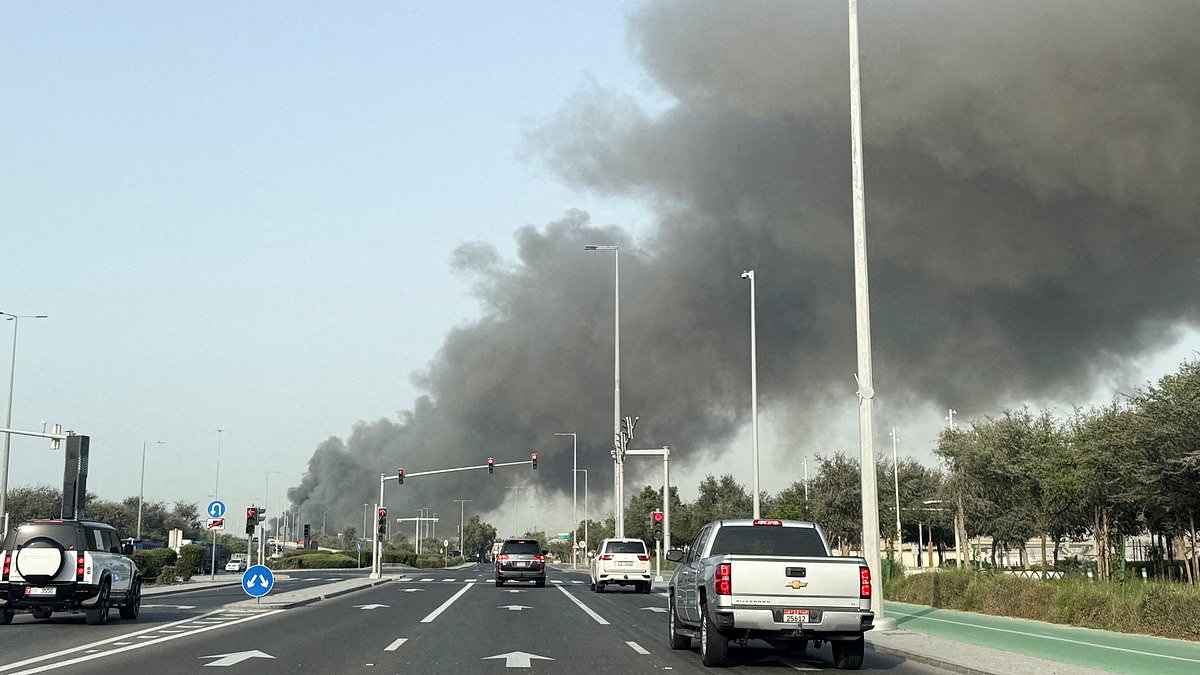
The Ruwais oil refinery, targeted by Iranian drones, caught fire, prompting its shutdown as a precaution on Tuesday.
As the largest refinery in the Middle East, Ruwais is capable of processing 922,000 barrels per day and serves as a critical hub for the region’s chemical, fertilizer, and industrial gas sectors.
‘The Ruwais refinery has halted operations out of precaution,’ a source said.
Earlier, the Abu Dhabi Media Office said a drone attack caused a fire in Ruwais Industrial City.
State-owned oil company Adnoc describes its Ruwais facility as ‘the world’s fourth-largest single-site refinery’.

Iranian drones struck Ruwais oil refinery, causing a fire and forcing its closure as a ‘precaution’ on Tuesday

Abu Dhabi in the United Arab Emirates has been targeted by Tehran as they look to attack US allies in the region
A driver working at the Ruwais industrial complex said he was picking up staff who were ordered to evacuate.
‘Just as we were about to leave, we saw two more bursts of fire rising from the complex, with loud sounds like explosions.’
It closure could cause further chaos for oil markets which are already reeling from the ongoing closure of the Strait of Hormuz – a vital passageway used to transport around 20 per cent of the world’s oil.
The increase in petrol prices has seen Brits urged to drive less following warnings that petrol could hit £2 a litre for the first time.
Natural gas prices have surged to above 120p per thermal unit, up from between 70 to 90p before the war.
While the average cost of a litre of unleaded petrol is up by 3.5p since last week, while diesel rose 6.9p.
AA and RAC have advised drivers to cut non-essential journeys and avoid harsh acceleration and braking to conserve fuel.
Keir Starmer is desperately trying to calm fears of another 2022-style cost of living squeeze, hinting at another bailout despite the fragile state of the government’s finances.
Meanwhile, Saudi Arabia has warned of a ‘catastrophe’ if the Strait of Hormuz remains shut.
Aramco CEO and president Amin H. Nasser said the war will have ‘catastrophic consequences and the more drastic the consequences for the global economy,’ as he called for the reopening of the strait.
The Middle East war has now severely destabilised oil supplies.

The US has continued to pound Tehran while Israel has also extended its attacks to Beirut (pictured) as it looks to destroy the Iranian-backed Lebanese terror group Hezbollah
Iran has fired at energy installations across the Gulf, including Aramco’s sprawling Ras Tanura facility, which halted some operations.
The massive complex on the Gulf coast is home to one of the Middle East’s largest refineries and is a cornerstone of the Saudi energy sector.
Saudi oil fields have also been targeted.
The oil-rich Gulf has borne the brunt of Iran’s attacks in response to US-Israeli strikes that sparked the Middle East war, with Tehran targeting US assets but also civilian infrastructure, including energy facilities and airports.
Oil prices have swung wildly over supply disruptions, rocketing 30 percent on Monday before plunging again on comments from US President Donald Trump that the war may soon end.
‘The Gulf energy sector is getting whacked from multiple angles,’ said Robert Mogielnicki, a scholar at the Arab Gulf States Institute.
‘Energy facilities being targeted, export capability though the strait is hampered, and storage capacity filling up,’ he added.
Earlier on Monday, Iran warned it would not allow ‘one litre of oil’ to be shipped from the Middle East if US and Israeli attacks continue.
But it did little to quell US attacks, with Defence Secretary Pete Hegseth claiming Tuesday would see the ‘most intense day’ of shelling against Iran yet.
He said the US was ‘crushing the enemy’, adding: ‘Today will be yet again, our most intense day of strikes inside Iran. The most fighters, the most bombers, the most strikes. Intelligence more refined, and better than ever.’
Mr Hegseth also claimed Iran has fired its fewest number of missiles in the past 24 hours since the start of the war.
Massive airstrikes thumped Tehran with explosions last night as Donald Trump promised the world the war would end ‘very soon’ and claimed the US has ‘already won’.
The sky above the Iranian capital glowed amid the latest wave of US-Israeli attacks proving the US President’s vow to ‘go further’ in the conflict was serious.
Mr Trump had earlier insisted war in the Middle East was ‘pretty much’ over and claimed the operation launched 10 days ago was ‘very far’ ahead of schedule.
The US President even described the massive US and Israeli onslaught as a ‘short-term excursion’ which will be ‘finished pretty quickly’.
But further remarks betrayed Mr Trump’s willingness to keep the war with Iran going, as he added: ‘We’ve already won in many ways but we haven’t won enough…we’re going to go further.’
He said: ‘We could call it a tremendous success right now… or we could go further, and we’re going to go further. We will not relent until the enemy is totally and decisively defeated.’