
Share this @internewscast.com
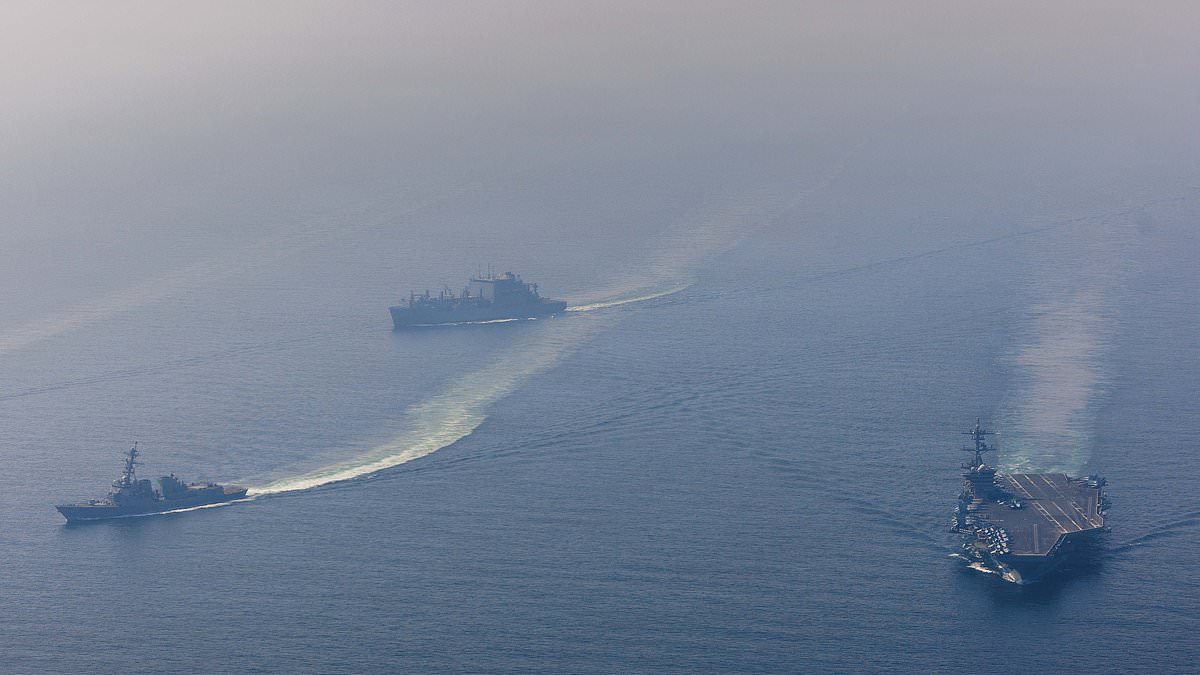
![Iran's supreme leader Ayatollah Ali Khamenei threatened to sink a US warship deployed in the Gulf and sent a warning to Donald Trump as nuclear talks between the two countries begin. The two countries are holding indirect talks in Geneva on Tuesday aimed at resolving their long-running nuclear dispute. Donald Trump continues to build up his battle force in the Middle East following tensions over Iran's military programme and its recent deadly crackdown on protesters. Khamenei warned the US president in a speech this morning: 'We constantly hear that they [the United States] have sent a warship toward Iran.](https://i.dailymail.co.uk/1s/2026/02/17/15/106445765-0-Iran_s_supreme_leader_Ayatollah_Ali_Khamenei_threatened_to_sink_-a-59_1771341387683.jpg)
The stage is set for a tense showdown between Iran and the United States, as nuclear negotiations between the two nations are rekindled amidst heightened military tensions. Iran’s supreme leader, Ayatollah Ali Khamenei, issued a stark warning to the U.S., threatening to sink American warships stationed in the Gulf. This comes at a time when indirect talks in Geneva aim to resolve the longstanding nuclear dispute between the two countries.
Khamenei Warns US: ‘You Will Not Succeed’

Addressing the nation, Khamenei emphasized the gravity of the situation, noting, “A warship is certainly a dangerous weapon, but even more dangerous is the weapon capable of sinking it.” He further challenged U.S. President Donald Trump, referencing a declaration that America has failed to dismantle the Islamic Republic for decades, adding, “I tell you: you will not succeed either.” These comments are set against a backdrop of escalating tensions, marked by the U.S.’s expanded military presence in the Middle East following Iran’s recent internal conflicts and military activities.
US Carriers Move as Iran Tensions Escalate

The Geneva talks, mediated by Oman, bring together U.S. envoys Steve Witkoff and Jared Kushner, alongside Iranian Foreign Minister Abbas Araqchi. President Trump, while not directly participating, expressed confidence in the negotiation process, stating, “I don’t think they want the consequences of not making a deal.” He noted the potential for a peaceful resolution rather than military confrontation, referencing the deployment of B-2 bombers as a measure of last resort.

Iran itself began a military drill on Monday in the Strait of Hormuz, a vital international waterway and oil export route from Gulf Arab states, who have been appealing for diplomacy to end the dispute. Tehran and Washington renewed negotiations on February 6 on their decades-long dispute. Washington and its close ally Israel believe Iran aspires to build a nuclear weapon that could threaten Israel’s existence. Iran says its nuclear program is purely peaceful, even though it has enriched uranium far beyond the purity needed for power generation, and close to what is required for a bomb.

Since the June strikes, Iran’s Islamic rulers have been weakened by street protests, put down at a cost of thousands of lives, against a cost-of-living crisis driven in part by international sanctions that have strangled Iran’s oil income. Unlike last time, the US has now placed what Trump calls a massive naval armada in the region. Washington has sought to expand the scope of talks to non-nuclear issues such as Iran’s missile stockpile.

Tehran says it is willing only to discuss curbs on its nuclear program – in exchange for sanctions relief – and that it will not give up uranium enrichment completely or discuss its missile program. On Monday, US Secretary of State Marco Rubio said it was hard to do a deal with Iran, but the US was willing to try. Iran’s Araqchi on Monday met Rafael Grossi, head of the International Atomic Energy Agency, in Geneva to discuss cooperation with the IAEA and technical aspects of the impending talks with the US. On Tuesday afternoon, Witkoff and Kushner will participate in three-way talks with Russia and Ukraine as Washington attempts to coax Ukraine and Russia into an agreement to end Moscow’s four-year-old invasion of Ukraine.

Tehran says it is willing only to discuss curbs on its nuclear program – in exchange for sanctions relief – and that it will not give up uranium enrichment completely or discuss its missile program. On Monday, US Secretary of State Marco Rubio said it was hard to do a deal with Iran, but the US was willing to try. Iran’s Araqchi on Monday met Rafael Grossi, head of the International Atomic Energy Agency, in Geneva to discuss cooperation with the IAEA and technical aspects of the impending talks with the US. On Tuesday afternoon, Witkoff and Kushner will participate in three-way talks with Russia and Ukraine as Washington attempts to coax Ukraine and Russia into an agreement to end Moscow’s four-year-old invasion of Ukraine.

Want more stories like this from the Daily Mail? Visit our profile page here and hit the follow button above for more of the news you need.