
Share this @internewscast.com
Jared Kushner, Donald Trump’s son-in-law, alongside Middle East envoy Steve Witkoff, has crafted an ambitious $112.1 billion vision to transform the Gaza Strip into a high-end tourist hotspot.
Following a recently brokered ceasefire between Israel and Hamas, the President pledged to revitalize Gaza, hinting at its potential to become the ‘Riviera of the Middle East.’
Kushner and Witkoff are moving forward with this vision through ‘Project Sunrise,’ a strategic proposal they’ve been developing over the past six weeks, aiming for a comprehensive overhaul of the region.
The proposal includes opulent ventures such as luxury beachfront hotels, a high-speed railway, and AI-driven electricity systems, as reported by the Wall Street Journal.
Utilizing Kushner’s extensive real estate background, he and Witkoff collaborated with senior White House advisor Josh Greenbaum, seeking insights from Israeli authorities and private sector experts.
The plan outlines a decade-long investment of $112.1 billion, with the United States anticipated to contribute approximately half of the funding through grants and debt assurances.
In turn, the debt pushed on Gaza would be repaid via the profits made from the revamp.
If approved, the plan could begin in two months, according to officials. However, they would first need to clear some 10,000 bodies under 68 million tons of rubble, while detoxifying the ground and removing unexploded bombs.

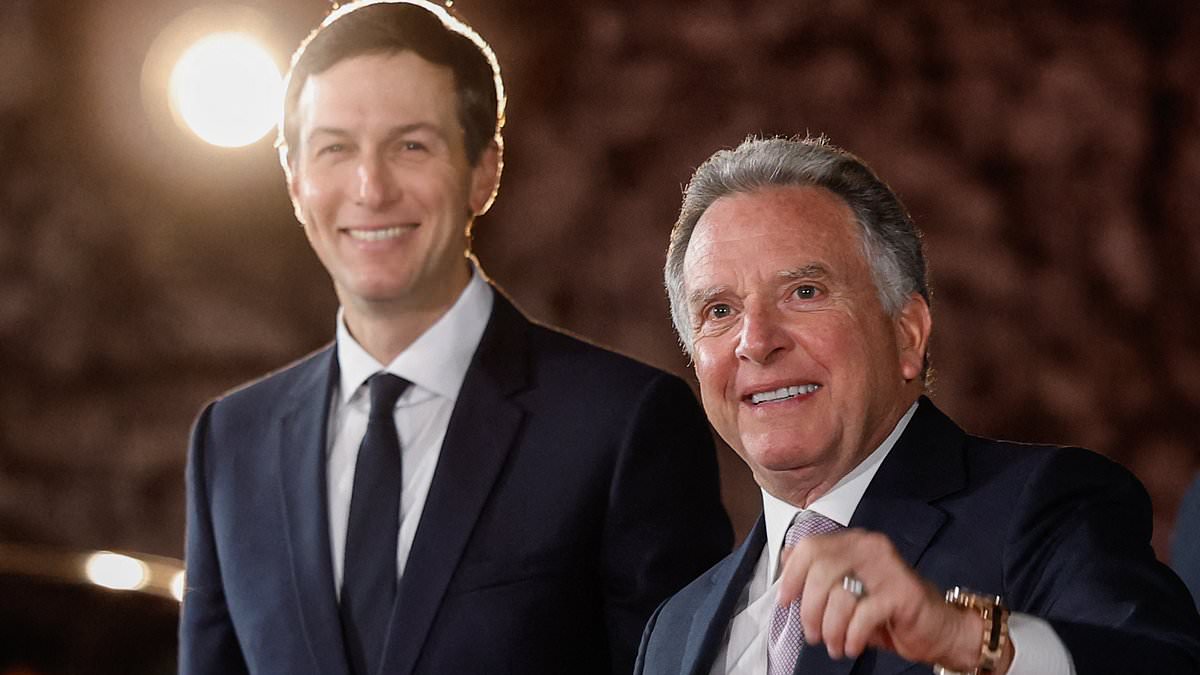
Donald Trump’s son-in-law Jared Kushner (pictured left) and Middle East envoy Steve Witkoff (pictured right) have developed a $112.1billion plan to reinvent the Gaza strip into a luxury destination
Hamas, which remains entrenched in Gaza, must also ‘demilitarize and decommission all weapons and tunnels.’
However, once it were to begin, the four-phase plan would feature temporary shelter, field hospitals and mobile clinics for those injured.
The basics would begin by building paved roads, new power lines and planting crops – before getting into the more futuristics aspects of the project.
While the US has shown its plan to Turkey and Egypt among other Gulf nations, the plan does not specify where the other half of the funding would come from for the project.
The plan also does not say whether the two million Palestinians who would be displaced by the construction would go, beyond the temporary shelter.
Officials have doubts that the project could be put in place, however, especially skeptical about Hamas disarming long enough to put the plan into action.
‘The Trump administration will continue to work diligently with our partners to sustain a lasting peace and lay the groundwork for a peaceful and prosperous Gaza,’ a White House spokesperson said in a statement.
Back in October, Trump claimed the Israel and Hamas peace deal would bring an everlasting peace to the Middle East, where residents have been dancing in the streets celebrating the anticipated end to the war.
Join the debate
Should Gaza’s future focus on luxury resorts or rebuilding homes and lives for its people first?

Back in October, Trump claimed the Israel and Hamas peace deal would bring an everlasting peace to the Middle East, where residents have been dancing in the streets celebrating the anticipated end to the war
The president also asserted not only that Gaza would be rebuilt, but also ‘the entire Middle East’ as part of the process – and claimed the rehabilitation of the war zone would be paid for by investments from neighboring Middle Eastern states.
Trump told his cabinet: ‘The whole world has come together for this. People who didn’t like each other, neighboring countries. This is a moment in time.
‘We reached a momentous breakthrough in the Middle East, something people said was never going to be done. We ended the war in Gaza. An everlasting peace.’
He added: ‘It’s really peace in the Middle East. You remember October 7 was terrible, but from the Hamas standpoint, they’ve probably lost 70,000 people. That’s big retribution. At some point, that whole thing has to stop.’
Trump pledged Hamas disarmament as part of the second phase, with hardline Israeli national security minister Itamar Ben-Gvir threatening to topple Benjamin Netanyahu’s government unless the promise is followed through.
Under the plan, a transitional committee of Palestinians and international experts would run the territory, overseen by a new Board of Peace chaired by Donald Trump.
Hamas and other militant groups would be banned from any role in government, and all weapons, tunnels, and military infrastructure would be dismantled under independent supervision.
However Hamas has vowed to keep its weapons despite Israel insisting on full demilitarization, the question of who will control the region remains unanswered.