Share this @internewscast.com

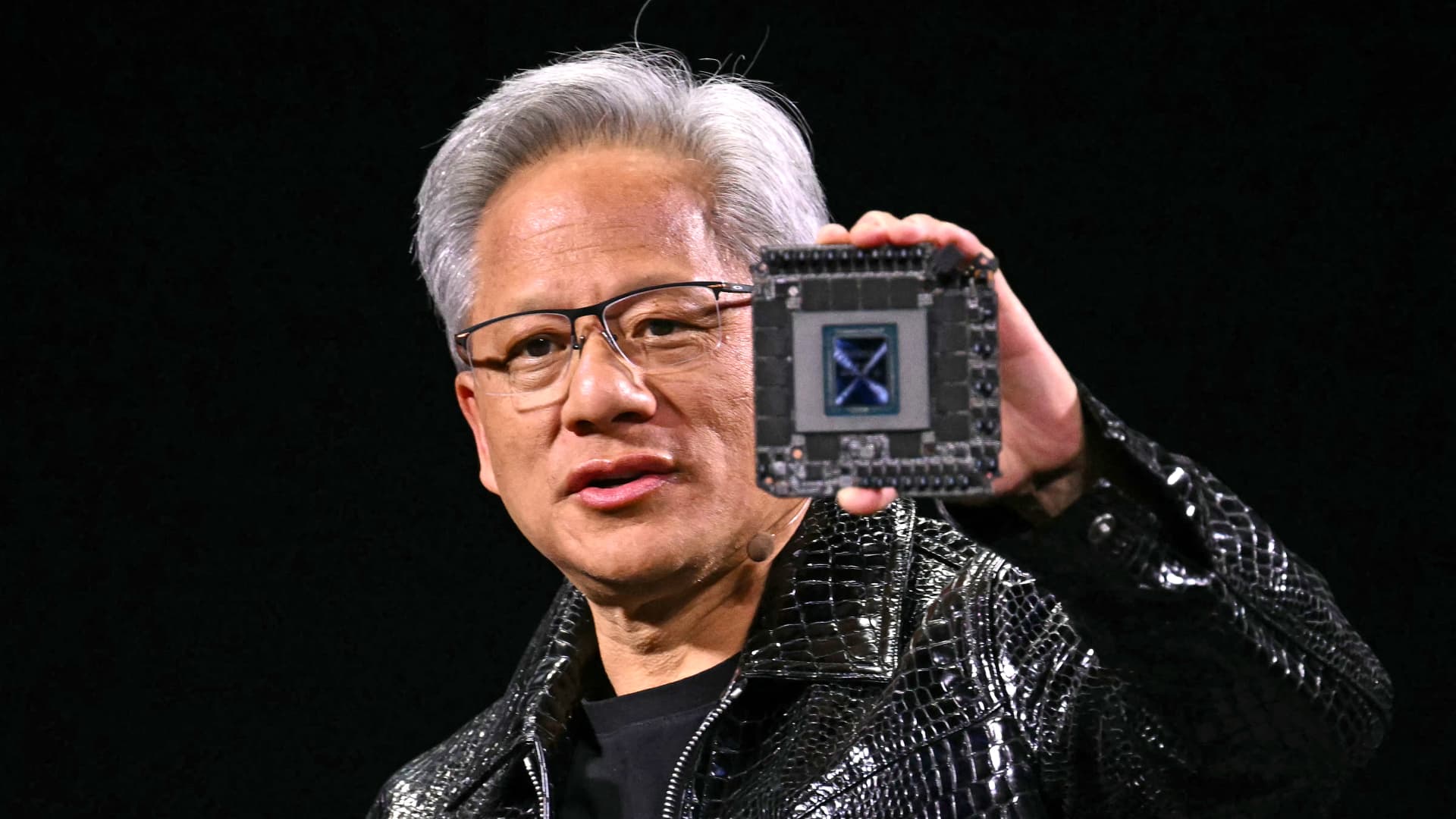
On Wednesday, Nvidia’s CEO, Jensen Huang, remarked that the financial markets have underestimated the potential impact of AI on software companies, just after the chip giant released an optimistic sales outlook driven by robust AI demand.
In a conversation with CNBC’s Becky Quick, Huang challenged the prevailing concern that AI agents might erode the enterprise software sector. “I believe the markets have misjudged,” he stated, addressing apprehensions about AI’s role in the industry.
Contrary to these fears, Huang predicts that a wide range of software companies will harness agentic AI to innovate and enhance productivity. He noted a seemingly “counterintuitive” point: AI agents will not replace existing software tools but will instead complement and utilize them.
“That’s why we refer to agents as tool users,” Huang elaborated, emphasizing the supportive role of AI in the software domain.
He pointed to internet browsers and Microsoft’s Excel as prime examples of platforms that AI agents are likely to leverage to augment their capabilities.
He cited the internet browser and Microsoft‘s Excel as examples of tools that AI agents will use.
“All of these tools that we use today, whether it’s Cadence or Synopsys or ServiceNow or SAP, these tools exist for a fundamentally good reason. These agentic AI will be intelligent software that uses these tools on our behalf and help us be more productive,” Huang added.
“Nobody’s going to service better than ServiceNow, and they’re going to come up with agents that are really fine-tuned and optimized for the work that uses the tools that they have.”
“In the end, we need the tools to finish their work and put the information back in a way that we can understand,” he said.
The comments came after Nvidia reported that its revenue for the fiscal fourth quarter climbed 73% to $68.13 billion from a year earlier, beating analysts’ estimates for $66.21 billion.
The company also issued an upbeat guidance with revenue for the fiscal first quarter to be $78 billion, plus or minus 2%, well above analysts’ forecast for $72.6 billion.
Investors had grown weary that the massive run-up in spending on AI hardware might not be sustainable, stoking fears of a bubble building in the sector.
Shares of software service providers have taken a beating in recent months. While analysts have sounded the alarm that AI will “eat” software over the long term, views on that risk and the fundamentals behind the latest sell-off appeared divided.
Software stocks were mixed in after-hours trading following Huang’s remarks. Synopsys tumbled 3.6% after market close, and Cadence dipped 0.9%. ServiceNow was little changed while SAP edged 0.3% higher.
“People need to remember that all everything — whether it’s the railroads, canals, the internet, all of these things tend to get overbuilt — and then we figure out who the winners and losers are going to be,” Dan Niles, founder and portfolio manager of Niles Investment Management, told CNBC after Huang’s interview.

Niles warned that not all companies will emerge unscathed as AI threatens to automate workflows, squeeze prices, and lower barriers to new rivals entering the market.
“There’s some real companies that are going to go to zero in the software space,” Niles said. He added that the most resilient players will be in the database and cybersecurity sectors.
Nvidia shares rose as much as 2% in extended trading after the quarterly earnings report.
The selloff in software stocks this year has weighed on the S&P 500 software and services index, which has lost nearly 23% as of Wednesday’s market close.
CNBC’s Jim Cramer, however, rejected the doomsday prediction, suggesting that fears over an AI-fueled existential threat for software companies were overblown and the reality is less dire.
“The software companies are survivors. They can merge. They can adapt. They can do whatever is really necessary to get it so they stay in business,” Cramer said Wednesday on “Mad Money.”
“They’re priced for perfection, though, and they do seem to have, let’s say, kind of a rugby-scrum feel about them — and we don’t pay up for scrum,” he added.