
Share this @internewscast.com
Recent classified intelligence reports indicate that Iran’s government remains stable and its leadership structure is largely unaffected, despite two weeks of intensive bombing by the US and Israel.
According to sources speaking to Reuters, a series of classified documents consistently conclude that the Iranian regime is not at risk of collapse and continues to maintain control over its populace. The most recent report was finalized just days ago.
In contrast to these findings, former President Donald Trump declared last night that the conflict had been “won” and would conclude “soon.” However, shortly after his statement, six tankers were attacked by Iranian suicide boats in the strategically crucial Strait of Hormuz, causing oil prices to surge past $100 per barrel.
The intelligence assessments confirm that Iran’s religious leadership structure remains operational following the death of Ayatollah Ali Khamenei, which occurred on February 28, the first day of the US-Israeli military campaign.
Mojtaba Khamenei, who has assumed the role of Iran’s supreme leader, delivered his inaugural statement on Thursday. He cautioned President Trump that US military bases would be targeted and pledged to keep the Strait of Hormuz closed.
“Iran will not hesitate to avenge the blood of its martyrs,” Mojtaba asserted in a televised speech, signaling a steadfast stance against foreign aggression.
Mojtaba is said to be in intensive care at Sina University Hospital in Tehran’s historic quarter, surrounded by security officials with a section of the building sealed off.
It is unclear whether he was injured in the same strikes which killed his 86-year-old father.

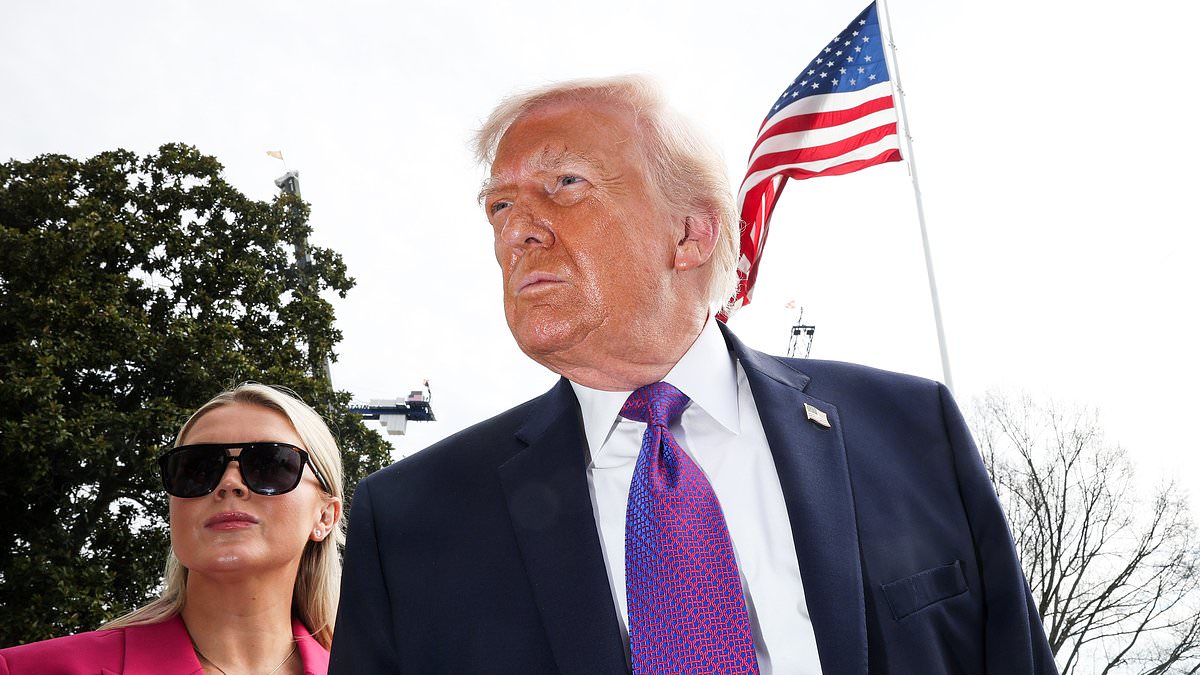
President Donald Trump speaks to reporters alongside White House Press Secretary Karoline Leavitt as he departs for Marine One on the South Lawn of the White House on March 11


Oil tankers burn in the Persian Gulf after being struck by Iranian suicide boats just hours after Trump claimed the US had ‘won’ the war
Mojtaba said the narrow passage through which a fifth of the world’s oil flows would remain closed as a ‘tool to pressure the enemy.’
A senior Israeli official acknowledged that there is no certainty the war will lead to the government’s collapse.
Three intelligence sources stressed the situation on the ground was fast-moving and could change at any time, they told Reuters on condition of anonymity.
The Office of the Director of National Intelligence and the Central Intelligence Agency declined to comment.
White House spokeswoman Anna Kelly told the Daily Mail the military was ‘meeting or surpassing all of its goals’ – which she defined as destroying Iran’s ballistic missiles and production capacity, demolishing its navy, ending its ability to arm proxies and preventing it from ever obtaining a nuclear weapon.
She pointed to a 90 per cent decline in ballistic missile attacks as evidence the regime was ‘getting absolutely crushed.’
The US and Israel say they have decimated Iran’s senior leadership.
Trump and Israeli Prime Minister Benjamin Netanyahu had called on Iranians to rise up and overthrow their government in the immediate aftermath of the first strikes.
But the Trump administration has since retreated from that message, arguing instead it seeks to dismantle Iran’s military infrastructure and obliterate its nuclear capacity.

Iran’s new supreme leader, Mojtaba Khamenei, the second son of late Iran’s Supreme Leader Ayatollah Ali Khamenei, attends a meeting in Tehran, Iran, March 2

Iranians attend the funerals of Iran’s Revolutionary Guards Corps (IRGC) commanders, army commanders and others killed in the early days of the United States and Israeli strikes on Iran, with a damaged building visible in the background, at Enghelab Square in Tehran on March 11

A plume of smoke rises after a strike on the Iranian capital Tehran, on March 3
Trump sent oil prices soaring last week when he demanded Iran’s ‘unconditional surrender.’
White House Press Secretary Karoline Leavitt later clarified that this meant ‘Iran will essentially be in a place of unconditional surrender whether they say it themselves or not.’
But the intelligence suggests Iran’s leadership remains steadfast.
The Assembly of Experts, a group of Shiite clerics, earlier this week declared Mojtaba Khamenei the new supreme leader.
Trump has expressed ‘disappointment’ at the choice of Khamenei’s son, saying ‘I don’t believe he can live in peace.’
Khamenei said in televised remarks that Tehran believes in ‘friendship’ with its Arab neighbors, adding that its forces would only strike US bases in the region.
‘We only targeted these military bases and we will continue,’ he said Thursday.
The 56-year-old referred to the strike on a girls’ school that killed 175 people, most of them children, on the first day of the war – for which a preliminary Pentagon report holds the US responsible.

USAF military ground personnel load Joint Direct Attack Munitions (JDAM) into a US Air Force (USAF) B-1 Lancer bomber on the tarmac at RAF Fairford in south-west England on March 11

This handout photo taken on March 11, 2026 and released by the Royal Thai Navy shows smoke rising from the Thai bulk carrier ‘Mayuree Naree’ near the Strait of Hormuz after an attack. A Thai bulk carrier travelling in the crucial Strait of Hormuz was attacked March 11

Personnel work on a US Air Force B-1 Lancer bomber parked on the tarmac at RAF Fairford in south-west England on March 12

USAF military ground personnel load Joint Direct Attack Munitions (JDAM) into a US Air Force (USAF) B-1 Lancer bomber on the tarmac at RAF Fairford in south-west England on March 11
‘We will be especially sensitive regarding the blood of our children,’ the ayatollah said as he promised revenge.
He also eulogized his father, who had a status akin to the Pope in the Shiite Muslim world.
‘I had the honor of seeing his body after his martyrdom. What I saw was a mountain of strength,’ he said.