
In the summer of 1941, just six weeks into Germany’s invasion of the Soviet Union, a diary entry from Hitler’s chief of staff revealed a significant miscalculation.
The entry noted triumphantly that the German forces had decimated 300 divisions of the Red Army. However, the downside was that German intelligence had initially estimated Stalin’s forces to consist of only 195 divisions.
This historical oversight came to mind recently as I considered the complexities in the Middle East.
During the joint military efforts by the US and Israel against Iran, they had impressively precise intelligence pinpointing the locations of Ayatollah Khamenei and his top aides.
However, it has since emerged that their knowledge of Iran’s broader military infrastructure, including the positions of mid-level commanders and the extent of Iran’s military resources, was lacking.
It is now apparent that the US significantly underestimated the size and capacity of Iran’s missile and drone arsenal.
In the succeeding weeks, Iran’s attacks on pro-Western Gulf States and the threat it poses to ships sailing through the Strait of Hormuz have shown the world that Iran doesn’t need an atomic bomb to unleash global chaos.
But it was a misjudgement by the Israeli intelligence agency Mossad that has proved to be even more serious.

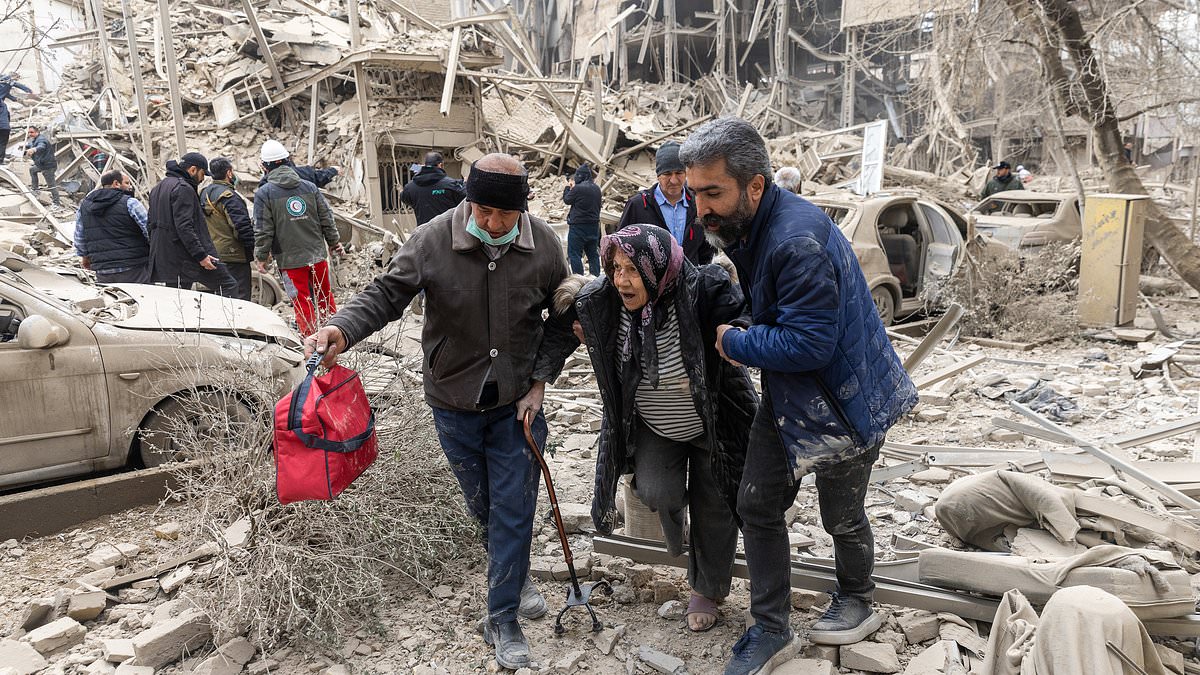
An elderly woman is helped from the scene of a strike on a residential building on March 16 in central Tehran, Iran
Before the war got under way, its director David Barnea predicted that Mossad could well bring about regime change in Tehran by inciting riots and other acts of rebellion.
Given that the government had been rocked by unrest shortly before, this sounded like a plausible argument.
But while street protests in January had quickly spread from the capital to provincial towns and cities, they were brutally put down, with a widely estimated 30,000 demonstrators being killed in one 48-hour period.
And far from prompting a fresh outbreak of revolutionary sentiment, the bombing seems to have rallied Iranians behind their government – and against the foreign attackers.
As the clock ticks down on Donald Trump’s ceasefire, which is scheduled to end on Wednesday, only renewed peace talks over the coming weekend offer a chance of avoiding not only more death and destruction but also more economic havoc around the world.
The truth is that since the US and Israel launched their attacks on Iran with a view to eradicating its nuclear threat, the war has taken on a dynamic of its own, with consequences which Washington did not plan for.
The new men running the Islamic Republic have only one overwhelming priority: survival. And they calculate that the longer they can face down US president Donald Trump and Israel’s prime minister Benjamin Netanyahu, the more stable their regime will be at home. The problem for America is that, while its enormous air power has devastated targets across Iran, it has not destroyed all of its military bases and munition industries.
As long as Iran can launch rockets and drones across the Persian Gulf at US allies in the region and even as far away as Israel, Tehran can carry on disrupting world energy supplies.
Before the current hostilities, 20 per cent of the global supply of oil and gas was transported by tankers passing through the Strait of Hormuz. All that traffic has been virtually halted.
The US blockade may be designed to bring the Iranian regime to its knees by cutting off its oil revenues but it has had the effect of driving energy prices through the roof. And in the long run that spells a worldwide economic recession.
Such an outcome plays into Tehran’s hands. Provoking a global downturn is Iran’s way of putting pressure on America’s economic partners and allies, like Britain, in the hope that they will cajole Donald Trump into going to the negotiating table.
Yesterday, European nations were warned by the International Energy Agency that their supplies of air fuel will last just six weeks. If plane travel seizes up, that will be a symptom of the global economy going into freefall. Meanwhile, leaks from inside Whitehall indicate that food shortages could be on the horizon, as not only fertiliser but plastic wrappings and carbon dioxide – both vital to the storage of meats and other foodstuffs – could become unavailable.
This means we can be sure that governments like our own across the West are privately pressing Donald Trump to find a way out of the war.
But that’s easier said than done. The President’s zig-zagging approach to international diplomacy is entirely unpredictable. One moment he is threatening fire and fury, an approach exemplified by the now-notorious social media post in which he vowed of Iran that a ‘whole civilisation will die tonight, never to be brought back again’.

President Donald Trump speaks with reporters from the South Lawn of the White House on Thursday, April 16
The next he is promising to ‘permanently reopen’ the Strait of Hormuz in response to a request from China. Adding rather incongruously that the Chinese leader, Xi Jinping, would ‘give me a big, fat hug when I get there in a few weeks’.
It is an open question whether he has the power to reopen the Strait in any case. The Iranians need only put a small number of mines on the southern – pro-American – side of the Strait to make it too hazardous for tankers to negotiate.
Yes, the US Navy can destroy mines when it finds them but, if the ceasefire breaks down, a combination of Iranian minelaying from small boats and a sporadic bombardment of passing shipping would be enough to stop the tankers once more.
Without taking control of the ports on the Iranian coast, such as Kharg Island, the US cannot really stop the Iranian threat to shipping. To do that would require boots on the ground and, inevitably, US casualties.
Even if there was the political will to pursue this option, it would take time to get sufficient manpower to the Gulf.
Powerful US warships like the aircraft carrier George H.W Bush are sailing all the way around Africa to avoid running the gauntlet of pro-Iranian Houthis firing missiles at them in the Red Sea.
And the Houthis are not the only group that could derail a peace deal between Washington and Tehran. The Islamic terrorists of Hezbollah in Lebanon are another.
Although President Trump yesterday persuaded the president of Lebanon to agree a ten-day ceasefire with Israel, in reality it is Hezbollah that has been fighting Israel – regardless of what the official Lebanese government wants.
If this proposed truce holds, maybe it is a sign that Trump and the new Ayatollah’s regime can make a deal.
The Pentagon isn’t taking anything for granted, however.
Yesterday, the US Secretary of War, Pete Hegseth, and his military chiefs insisted the US military had been winning before the ceasefire and could revive its domination in the air straight away if the conflict is renewed. ‘The war department is locked and loaded,’ said Hegseth.
With martial rhetoric like this rarely far from the lips of politicians in Washington it’s all too likely that any negotiated peace will be short-lived.
We should all be aware that whatever happens between now and next Wednesday, Round Three of the war between a resentful Iran and a frustrated USA will be on the horizon.
n Mark Almond is director of the Crisis Research Institute, Oxford


