
Share this @internewscast.com
The Shroud of Turin remains one of the most scrutinized and debated artifacts in history, sparking intrigue and controversy alike.
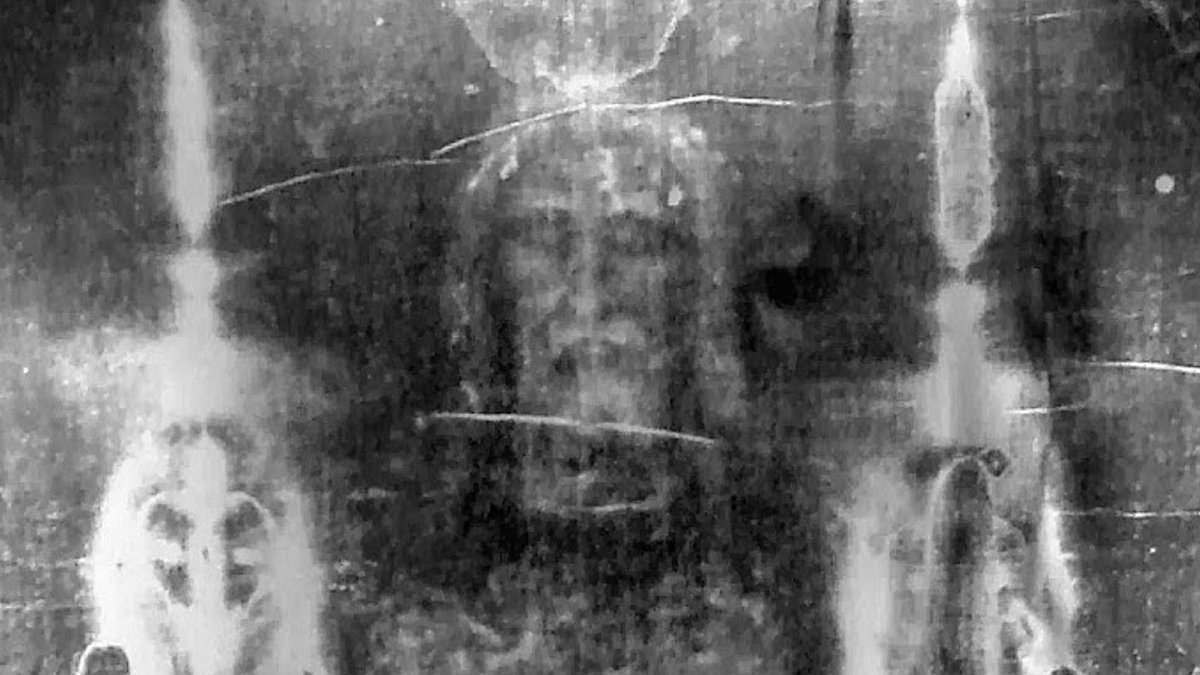
This 14-foot linen sheet, bearing what appears to be a negative image of a crucified man, is believed by some to be Jesus Christ’s burial shroud. In contrast, skeptics argue it’s a clever medieval fabrication.
Recently, a biblical scholar revisited an earlier study of the shroud that aligns it with the time of Jesus’ crucifixion.
In a discussion on the Shawn Ryan Show, Dr. Jeremiah Johnston brought attention to a forensic analysis conducted in the 1970s that examined the cloth and discovered 58 distinct pollen types.
He noted that 38 of these pollens are linked to species native to the Jerusalem area, many of which flower during the spring, coinciding with Passover.
“Pollen from plant species indigenous to the Middle East was detected in the dust samples,” Johnston explained to the Daily Mail.
‘Among them were plants that only grow in southern Israel, western Jordan, and the Sinai. Dust from the feet area of the Shroud contained a specific calcium carbonate from travertine aragonite limestone, similar to dust taken from a tomb in Jerusalem. ‘
He said the remaining pollen species trace the shroud’s documented journey over the past 2,000 years, suggesting it originated in Jerusalem before traveling through Europe to its current home in Italy.

The 14-foot linen cloth showing a photographic negative image of a crucified man is claimed by many to be Jesus’ burial cloth, while skeptics hold it is a medieval forgery
‘We know Jesus is crucified…It’s the best-established fact of the ancient world on April 3rd, AD 33,’ Johnston told podcast host Shawn Ryan.
The date of the crucifixion is based on Bible accounts stating that Jesus died during Passover and that the following day was the Sabbath or Saturday.
Because historical records show that Pontius Pilate, the Roman governor who sentenced Jesus to death, ruled Judea from AD 26 to AD 36, scholars examined those years.
They found that Passover fell on a Friday only on April 7, AD 30, and April 3, AD 33, now considered the two most likely dates for the crucifixion.
‘The pollen, which only blooms at Passover (springtime) in Judea, along with the travertine limestone on the shroud, leave it beyond all doubt that the Shroud of Turin is authentic,’ Johnston, who recently published ‘The Jesus Discoveries: 10 Historic Finds That Bring Us Face-to-Face with Jesus,’ told the Daily Mail.
‘I believe that based on the evidence, because I am not irrational.’
Researchers say the pollen evidence suggests the cloth was present in the Jerusalem region during the same time period traditionally associated with the crucifixion.
However, skeptics continue to point to earlier radiocarbon testing that dated part of the fabric to between AD 1260 and 1390, centuries after Jesus’ death.

On November 23, 1973, Max Frei was permitted to collect sticky-tape samples of dust from the shroud’s surface (PICTURED)

Pictured are images of the pollen take from the shroud
Johnston, who earned his PhD at Oxford, admitted on the Shawn Ryan Show that he was long conditioned to view the cloth as a medieval forgery, a belief rooted in a 1988 study that dated a corner sample of the fabric between AD 1260 and AD 1390.
‘I used to be the biggest skeptic of the shroud,’ said Johnston.
‘It turns out, when you look at it, the shroud of Turin is scientific proof of the physical bodily resurrection of Jesus Christ.
‘I believe that based on the evidence in the 102 academic disciplines that have studied over 600,000 research hours in it. So I went from skeptic to believing in it based on the science.’
Johnston discussed the work of forensic scientist Max Frei, who specialized in microscopy and forensic trace analysis and became known for applying adhesive tape sampling techniques to collect microscopic evidence, methods similar to those used in modern crime-scene investigations.
On November 23, 1973, Frei was permitted to collect sticky-tape samples of dust from the shroud’s surface. He collected 12 samples, which were later analyzed under a microscope in his Zurich laboratory.
The 38 types of pollen were linked to plants typical of desert regions surrounding the Jordan Valley, including species adapted to soils with high salt content found near the Dead Sea.
According to biblical accounts, Jesus was crucified near Jerusalem, located roughly 13 miles from the northern edge of the Dead Sea.
Many of the pollen types have also been identified as microfossils in sediment taken from the Dead Sea and Lake Gennesareth, also known as the Sea of Galilee.
Only 17 of the pollen species identified on the cloth are known to grow in France or Italy, regions associated with the shroud’s documented movement through Europe in later centuries.

Dr Jeremiah Johnston, who earned his PhD at Oxford, told the Daily Mail he was long conditioned to view the relic as a medieval forgery, but after doing his own researchers is now a believer it is the burial cloth of Jesus
Some researchers argue this distribution supports the idea that the cloth traveled from the Middle East to Western Europe over time.
A more recent study in 1999 by botanist Avinoam Danin of the Hebrew University of Jerusalem reanalyzed the pollen samples and identified a high density of pollen from the thistle Gundelia tournefortii.
This species has bloomed in Israel between March and May for thousands of years, aligning with the spring Passover season described in the Bible.
Danin also reported evidence of another plant, Zygophyllum dumosum, appearing in floral images visible on the shroud. This species is native to the region and known for its distinctive paired leaflets.
According to Danin, Gundelia tournefortii and Zygophyllum dumosum coexist in a geographically limited area defined by lines connecting Jerusalem and Hebron in Israel with Madaba and Karak in modern-day Jordan.
The identification of a third species, Cistus creticus, through pollen and floral image analysis further narrowed the possible location.
‘This combination of flowers can be found in only one region of the world,’ Danin stated. ‘The evidence clearly points to a floral grouping from the area surrounding Jerusalem.’