
Share this @internewscast.com
The global framework for arms control is crumbling, as many nuclear agreements are either obsolete, nearing expiration, or lacking ratification.
Amidst escalating geopolitical tensions, nations such as Japan and Saudi Arabia are seriously considering the pursuit of nuclear armament.
Historically, the United States has served as a security anchor for these countries, but skepticism about America’s reliability as an ally is on the rise.
At the same time, the security situation in East Asia and the Middle East is becoming increasingly precarious.
China and North Korea have adopted more aggressive postures, actively working to bolster their nuclear capacities.
In the Middle East, Iran remains a disruptive presence, continuing its nuclear ambitions despite the setbacks from attacks on its facilities in June 2025. Consequently, the risk of nuclear proliferation remains a pressing international concern.
There are currently nine nuclear weapons states: The United States, Russia, China, the United Kingdom, France—collectively known as the five possessor states, or P5—India, Pakistan, North Korea and Israel.
As the global security environment becomes more dangerous, the big question concerning policymakers and the public alike remains who will be next to go nuclear?

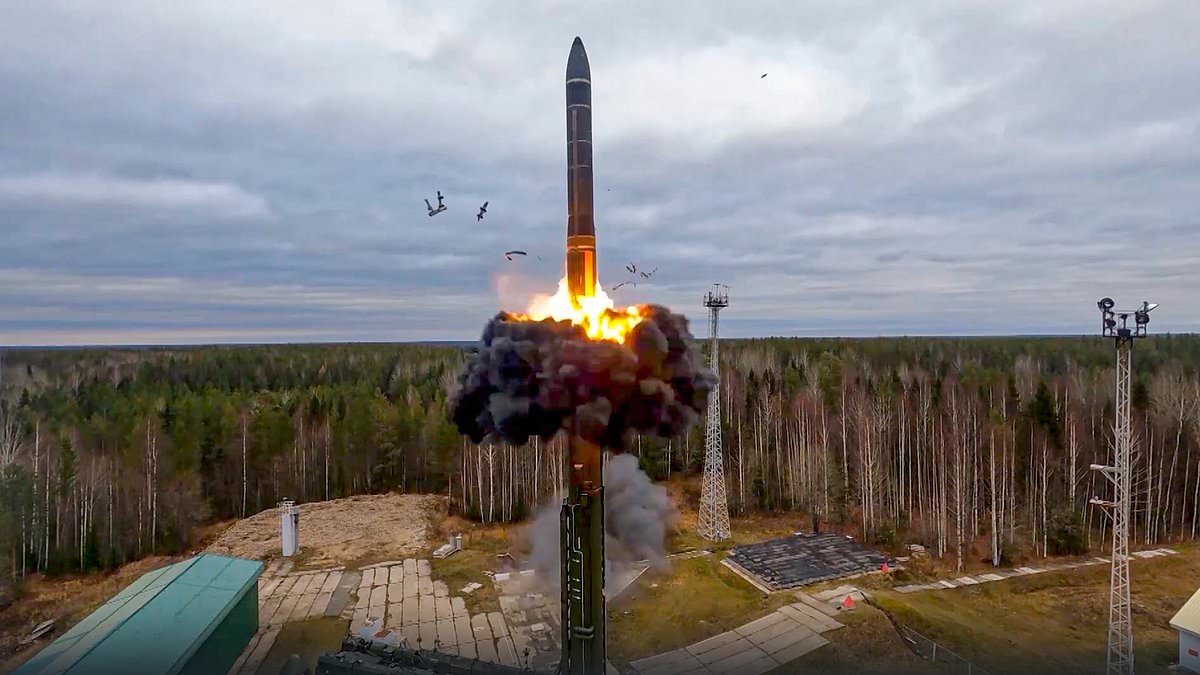
Russia is seen firing a Yars intercontinental ballistic missile as part of its nuclear drills in 2022
Iran
Iran is the greatest non-nuclear threat to the world. It is driven by a malicious ideology that seeks to undermine the global order. It exports terrorism, peddles in disinformation, and threatens neighbouring countries with subversion and the use of force.
Tehran’s mullahs continue to offer economic, political and military support to bad actors in the Middle East such as Hamas, Hizbullah, the Houthis, and other Islamist groups that sow havoc and terrorise civilian populations.
Since the October 7, 2023, attacks, Iran has employed ballistic missiles to strike targets in Israel, waging an all-out air warfare campaign against the Jewish state.
Tehran has made its goals very clear. The Iranian Revolutionary Guard Corps, commonly referred to as the IRGC, seeks to obliterate Israel.
As the Ayatollah Khamenei has said, ‘there is only one solution to the Middle East problem, namely the annihilation and destruction of the Zionist state.’
Based on what Iranian leaders have said, should Iran acquire nuclear weapons, there is a high probability that it would use them in anger against its enemies.
According to the Centre for International and Strategic Studies, a defence and security think tank based in Washington, DC, Iran possesses ‘the largest and most diverse’ missiles arsenal in the Middle East.
Its arsenal currently numbers some 3000 ballistic missiles, spanning ranges from 300 to 6000 kilometres, indicating that Iran can strike targets anywhere in the Middle East and Western Europe, including the United Kingdom.
Many of its missiles are potentially dual-capable, such as the road-mobile or silo-based Shahab-3 medium range ballistic missile. It has been in operation since 2003 and has a range of 800 to 1300 kilometres.
Its dual-capable nature means that the Shahab-3 can carry both conventional and nuclear payloads. Other ballistic missile capabilities, such as the Sejjil medium range ballistic missile can also carry nuclear payloads, and the Simorgh Space Launch Vehicle is an intercontinental ballistic missile that can strike cities as far as London, Paris or Berlin.
Besides seeking to acquire weapons grade fissile materials such as highly enriched uranium, the IRGC’s nuclear-capable missiles capabilities expose a desire to possess nuclear weapons. Having delivery systems capable of carrying nuclear payloads suggests that Iran has had and continues to have plans to develop nuclear weapons.
Iran adopts a hedging strategy with regards to its nuclear program. It has leveraged the threat to weaponise its latent nuclear capabilities to extract concessions from Western countries in the past.

Ayatollah Khamenei speaks during a televised address in Tehran in September this year
For example, in 2015, to stall Iran’s push for highly enriched uranium, the United States, France, Britain, Russia, China and Germany negotiated the Joint-Comprehensive Plan of Action, or JCPOA.
Known as the Iran nuclear deal, the five possessor states and Germany capped Iran’s nuclear enrichment levels to 3.67 percent in exchange for concessions such as the unfreezing of Iranian assets abroad, the partial lifting of economic and political sanctions, and the reintegration of Iran into the global banking system.
Iran leveraged the threat of weaponisation to compel these powers to negotiate the Iran nuclear deal. Concerns over whether Iran honoured the terms of the deal raised serious questions about the regime’s trustworthiness.
As early as 2016, the International Atomic and Energy Agency, the United Nation’s nuclear watchdog, reported that Iran was breaching the terms of the JCPOA and found heavy water and spent fuel at Iranian nuclear power plants, signs that Iran was still engaging in a weaponised nuclear program.
In 2018, the United States, under Donald Trump, abandoned the Iran nuclear deal, a move Iran took as an opportunity to resume its uranium enrichment program.
The JCPOA expired in October 2025, and today, there is no tangible framework in place to curb Iran’s nuclear program, despite reports that the United States and Iran could explore the prospect of negotiating a future deal.
Iran’s hedging strategy enabled it to maintain multilateral engagements with adversarial powers on the issue of nuclear proliferation.
Maintaining a degree of ambiguity and plausible deniability over its nuclear ambitions incentivised the West to maintain dialogue with the Iranian leadership.

Iran’s elite Revolutionary Guard tests the long-range Shahab-3 missile. The missile has been in operation since 2003 and could carry a nuclear warhead
However, the war with Israel and America’s attacks against its nuclear facilities in Operation Midnight Hammer have shattered the tenability of ambiguity and may alter Tehran’s nuclear strategic calculus.
Hedging had a deterring effect on countries such as the United States from taking kinetic action against Iranian nuclear targets in the past, for fear that such actions could jeopardise negotiations designed to prevent Iran from weaponising its nuclear program.
The American bombings against Iran’s nuclear facilities in the summer brought a temporary end to the viability of Iran’s hedging strategy and may have forced Iran to shift its approach and pursue adopting a viable nuclear deterrent instead.
The Iranian regime faces mounting challenges to its existence, both domestically and from Israel and the United States. With survival at stake, the rationale to develop an indigenous nuclear weapons capability has grown in salience, as the regime becomes increasingly desperate to protect its vital interests.
Iran, unlike the other countries on this list, is already a pariah state and is not a signatory to international treaties prohibiting the development of nuclear weapons, such as the Nuclear Non-Proliferation Treaty.
Iran poses the greatest and most dangerous proliferation risk of any other country on this list. The likelihood that Iran will continue to seek nuclear weapons remains high.
Saudi Arabia
The spectre of Iranian nuclear proliferation haunts Saudi Arabia’s strategic outlook and directly impacts the Kingdom’s thinking on the merits of nuclear weapons acquisition.
The two countries are locked in a bitter and enduring rivalry in the battle for regional hegemony. Competing religious ideologies—Iran is a Shiite state while the Kingdom of Saudi Arabia is Sunni—fuels the enmity between the countries.
For Riyadh, Iran’s backing of terrorist organisations across the region, especially in Yemen, has been a long-standing strategic concern. The two countries are engaged in a proxy war in Yemen since at least 2011.
Sectarian proxy wars between the two countries have also taken place in Iraq, Lebanon, and Syria. In addition to the state sponsoring of regional terrorism, Riyadh’s threat perception of Tehran is aggravated by the Shiite state’s extensive missile capabilities.
Iran’s missiles threaten Saudi Arabia’s vital interests. As a result, Saudi crown prince Mohammad Bin Salman, known as MBS, has expressed an interest in developing nuclear weapons in order to deter Iran. In the past, MBS has made it very clear that if Iran acquired a nuclear bomb, the Saudi’s ‘would have to get one’ too.
MBS has maintained this position since 2018, and Saudi Arabia’s history of involvement in the nuclear weapons enterprise dates back to at least the 1970s. Pakistan, a nuclear power with close diplomatic and defence ties to the Saudi’s, received help from Riyadh in developing its own nuclear capabilities.

Yemen’s Houthi fighters holding weapons ride atop a car as they participate in a popular parade to celebrate the anniversary of the 21-September Revolution
As Vikram Sood, the former head of Indian intelligence, has stated, ‘the role Saudi Arabia [played] in the early years in the development of the Pakistan bomb in the 1970s is well known.’
Islamabad conducted its first nuclear weapons detonation in 1998, thanks in large part to Saudi financing. The father of the Pakistani bomb, nuclear components smuggler and rogue scientist A.Q. Khan, was close to the Saudi regime, and analysts suspect that his nuclear network was being financed by Riyadh, and that he was being solicited to help Riyadh develop the bomb.
‘While the rest of the world talks of Iran’s nuclear ambitions, the issue of Saudi-Pakistan nuclear tie ups never got proven but never quite disappeared,’ wrote Sood in 2010.
‘Logically, Saudi Arabia should have been Pakistan’s market of first choice and gratitude. Although concrete evidence about Saudi intentions to acquire nuclear weapons’ capabilities is not there the story continues to attract international commentary.’
That was then. Fast forward to today, and MBS’ pronouncements clearly indicate that the Saudis are contemplating developing their own bomb.
During his recent visit to Washington, MBS negotiated a civilian nuclear energy deal with the United States. The 123 agreement established between the two countries paves the way for the American export of nuclear reactors, fuel and nuclear technology to Saudi Arabia.
As the ink dries on the recent Saudi-US nuclear cooperation agreement, Riyadh could soon acquire a breakout capability. The Kingdom already has the technological knowledge to develop a bomb, and they will soon receive the infrastructure needed to weaponise a nuclear program in the future.

President Donald Trump and Crown Prince Mohammed bin Salman of Saudi Arabia are seen during a bilateral meeting in the Oval Office in November
‘The United States and American companies,’ states the agreement, ‘will be [Saudi Arabia’s] civil nuclear cooperation partners of choice,’ but with one crucial caveat. Riyadh will have to adhere to ‘strong non-proliferation standards.’
Indeed, the United States has expressed concerns about Saudi breakout capabilities in the past and have stressed that enriching uranium would constitute a red line. ‘To limit proliferation risks,’ wrote Emily Day, a researcher, ‘Washington continues to insist on the ‘gold standard’, which prohibits enrichment and reprocessing.’
Riyadh maintains that it should be allowed to enrich uranium. Currently, Riyadh possesses considerable uranium reserves, a troubling sign that could facilitate rapid enrichment. Saudi is not a latent nuclear state, but could soon become one, the first step toward developing a viable Saudi nuclear deterrent.
The United States’ plan to deploy microreactor nuclear power plants in the Middle Eastern state will not be operable until September 2028. However, Saudi Arabia could still turn to Pakistan for nuclear assistance, and reports continue to emerge that Riyad could purchase missiles mated with nuclear warheads from Islamabad.
‘Pakistan could provide [Saudi Arabia] the Shaheen-III over time to be comingled with Chinese intermediate range ballistic missiles,’ wrote Peter Wilson, a RAND defence analyst. ‘It is plausible that the Pakistanis would mate their nuclear warheads to their missiles rather than try to modify a similar but distinct Chinese missile.’
That being said, the risk of Saudi proliferation remains moderate. They are likely to tread cautiously in their nuclear activities, in order not to risk jeopardising the strong Saudi-US relationship in the short and medium term.
After all, the Saudi’s social and economic modernisation program hinges on American and international support. By acquiring nuclear weapons, Saudi Arabia would upset the international community, which it has spent several years wooing to invest political and financial capital into MBS’s new look vision for the country.
Furthermore, Saudi Arabia remains a signatory of the Nuclear Non-Proliferation Treaty, so it is bound by international agreements to resist developing nuclear weapons-related capacities.
However, should Iran acquire a nuclear weapon, all bets would be off, and a Saudi bomb would become a high-risk possibility
It is therefore incumbent upon the United States and the broader international community to stay vigilant and to continue reminding the Saudi crown prince that developing nuclear weapons is strictly prohibited, regardless of whether he decides that the rapid acquisition of a nuclear arsenal is in his best interest.
Japan
The strategic environment in East Asia is less febrile than the Middle East’s. There is a less potent threat emanating from terrorism and militant groups conducting devastating attacks on civilian populations.
For now, the region is comparatively more stable. However, that is changing. The Asian security landscape is dangerous for a different set of reasons.
First, the Asia-Pacific is the most nuclearised region in the world. Including India and Pakistan, there are six nuclear weapons states with both territory and important strategic interests operating in the Asia-Pacific.
The three great nuclear nations China, Russia and the United States are actively competing for dominance in the region.
And North Korea is a rogue state that routinely conducts missile tests in the East Sea. North Korea last conducted a nuclear test relatively recently, back in 2017, and has threatened to resume nuclear tests in the imminent future.
Second, China has exponentially increased its nuclear weapons capabilities since Xi Jinping took power in 2012. When President Xi took over, China had 250 nuclear warheads. It now has 600, and is estimated to have 1500 by 2035, according to the Pentagon. China’s nuclear expansion program shows no sign of abating anytime soon.
It also has the largest navy in the world, surpassing that of the United States, and possesses maritime delivery platforms capable of launching nuclear warheads.

Japanese Defense Minister Shinjiro Koizumi and his Australian counterpart Richard Marles inspect a missile interceptor unit deployed at the Defense Ministry in Tokyo
In a bid to enhance the survivability of its nuclear deterrent, China’s Jin-class nuclear submarines conduct continuous at-sea deterrence patrols. Enhancing survivability better enables China to conduct retaliatory nuclear strikes in the event of a nuclear attack being visited upon the country.
This capability is known as a second-strike capability and is the bedrock of the situation known as mutual assured destruction, or MAD. MAD describes a situation which enables a country to absorb a first nuclear strike and to retaliate in kind with a nuclear strike of its own.
Third, there are growing concerns over Chinese designs over Taiwan, with President Xi ordering his military to be ready and able to seize the island across the Taiwan Strait by 2027.
The next global war looks likely to start in this region. And for countries like Japan and South Korea, who regularly get caught in the crossfires of regional spats, acquiring nuclear weapons increasingly looks like the best option with which to credibly defend their vital interests, in the event of an all-out conflict between China and the United States over Taiwan or other strategic interests in the South China Sea.
As Bilahari Kausikan starkly put it, ‘it is no longer a question of if but when Japan and South Korea will acquire independent nuclear deterrents within the US alliance system.’
Japan is most likely to be the next regional power to host nuclear weapons. The new Japanese Prime Minister, Sanae Takaichi, has indicated that Japan is actively considering the nuclear option. Her government is initiating a review of Japan’s nuclear policies.
Since 1967, Japan has adhered to three non-nuclear principles: non-possession, non-production, and non-introduction. A public debate is currently taking place in Japan over whether Tokyo should amend or abandon the three no’s doctrine.
Japan is deeply apprehensive of China’s intentions, especially in the nuclear domain. North Korea, due to its nuclear and missiles program, is also viewed by Tokyo as a serious threat to its security.
American nuclear weapons have been deployed to Japan in the past. An American base on the island of Okinawa held nuclear weapons until 1972.
There is a growing likelihood that the United States could soon deploy nuclear weapons to the land of the rising sun again, in order to bolster efforts to deter China.
The United States posture is undergoing changes that seek to prioritise deterring China from continuing to make strategic gains in the Asia-Pacific.
‘We will build a military capable of denying aggression anywhere in the First Island Chain,’ states the Trump administration’s National Security Strategy, published in December 2025.
The strategic document states that the United States will ‘harden and strengthen’ its military presence in the Western Pacific and has identified a ‘vigilant posture’ as the primary means to prevent conflict in the region.
Pronouncements by the Japanese Prime Minister suggest that a US nuclear deployment to Japan would be welcome. According to a report by journalists Tim Kelly and John Geddie, Takaichi has described the three no’s principle as unrealistic, and has intimated that ‘the United States may need to bring nuclear weapons into Japan to deter rivals.’
However, an unreliable US nuclear umbrella could eventually compel Japan to ditch its longstanding three no’s policy and rapidly undertake efforts to acquire an independent bomb.
Japan already has all of the necessary infrastructure in place to weaponise its nuclear capacities. All that it lacks are nuclear capable delivery platforms with which to launch nuclear warheads. However, due to its sophisticated industrial base, Japan could remedy its lack of delivery platforms in relatively short order.

This photo provided by the North Korean government, shows what it says is a test fire of a new type intermediate-range hypersonic ballistic missile in January
Attesting to Japan’s technological and technical efficiency, Ed Naito, a Japanese commentator, stated, ‘Japan has advanced machining and manufacturing capabilities, enabling it to produce weapon components and a range of potential delivery systems such as intermediate-range missiles, ships, submarines and aircraft.’
Japan also has large stockpiles of plutonium, which can be used to produce nuclear warheads. According to Neito, if Japan enriched its plutonium stockpiles, it would have enough to ‘build 1000 bombs.’
What separates nuclearisation from non-nuclearisation on the Japanese isles is the exercising of political will to determine whether Japan becomes the 10th nuclear power, 80 years after it became the first and only power to suffer a nuclear attack.
While Japan could very likely host American tactical nuclear weapons on its soil once again, it remains unclear whether there is a domestic appetite for developing a sovereign nuclear weapons capability. As a thriving democracy, the public would need to back the push for nuclearisation.
Japanese public opinion is not unanimous on this issue, but it is not as opposed to the idea of nuclear weapons being deployed on Japanese soil as it once was. According to a public opinion poll from 2024, 60 percent of respondents believe that American extended deterrence is expedient.
The question as to whether Japan could become a nuclear weapons state hinges on public perceptions of the role nuclear weapons would play in making the country more secure from Chinese and North Korean predations.
The memory of Hiroshima and Nagasaki—where 110,000 people were instantaneously killed from two US atomic bombs at the end of World War Two—seems to be fading.
The discussions underway in Japanese public opinion could determine the direction of travel apropos a Tokyo bomb. As it stands, that debate is an open one, and could go either way.
For the time being, the likelihood of an independent Japanese nuclear weapon is relatively low, despite the fact that American nuclear weapons could soon be deployed on Japanese soil.
Other potential nuclear weapon states
South Korea
South Korea, like Japan, is a democracy, and political leaders would need a mandate from the public in order to establish a nuclear weapons capability.
To that end, public opinion is in favour of an independent nuclear deterrent, with over 70 percent of the country responding favourably to the idea of an indigenous capability.
However, political turmoil has recently plagued the country, with a left-leaning administration led by Lee Jae-myung preferring to adopt a hedging strategy instead of pursuing armament.
For now, it is unlikely that South Korea will acquire the bomb, but there are fertile conditions in place to make South Korean nuclear proliferation a distinct possibility in the future.
Especially if Pyongyang brazenly escalates the threat of using force against neighbouring Seoul.

South Korean President Lee Jae Myung speaks during a work report from the Ministry of Economy on December 11
Poland
The war in neighbouring Ukraine has brought a renewed focus on the need for Warsaw to build stronger defences.
In March 2025, Donad Tusk, the Polish Prime Minister, signalled Poland’s desire to acquire nuclear-related capabilities.
Falling short of acquiring its own nuclear weapons capabilities, Poland would seek deepening security cooperation agreements with allies that would involve falling under a French or American nuclear umbrella.
‘We must be aware that Poland must reach for the most modern capabilities also related to nuclear weapons and modern conventional weapons,’ stated Prime Minister Tusk. ‘This is a race for security, not war.’
As a member of NATO, Poland technically already receives extended nuclear deterrence guarantees, and currently lacks the capacity to be able to develop a sovereign nuclear weapon.
Turkey
Turkey is the most mercurial member of the NATO alliance and often undermines alliance cohesion.
Pointing to the threat posed by Iran, Turkey, like Saudi Arabia, has stated that it will pursue an independent nuclear capability if the Shiite country develops its own. Turkey has also expressed concerns about Israel’s nuclear weapons.
‘We have Israel nearby, as almost neighbours,’ stated President Erdogan. ‘They scare (other nations) by possessing [nuclear weapons.]’
Currently, there are roughly 50 American tactical nuclear weapons already deployed to Turkey, suggesting that a Turkish bomb is not needed for Ankara to protect its vital interest.
Unless a severe rupture were to happen between Turkey and its fellow NATO allies, such as the expulsion of Turkey from the alliance, a Turkish nuclear bomb is a low-probability prospect.
- Alex Alfirraz Scheers is a defence analyst who specialises in great power competition. He has written about nuclear issues for The Wall Street Journal, Foreign Policy Magazine, and the Royal United Services Institute.